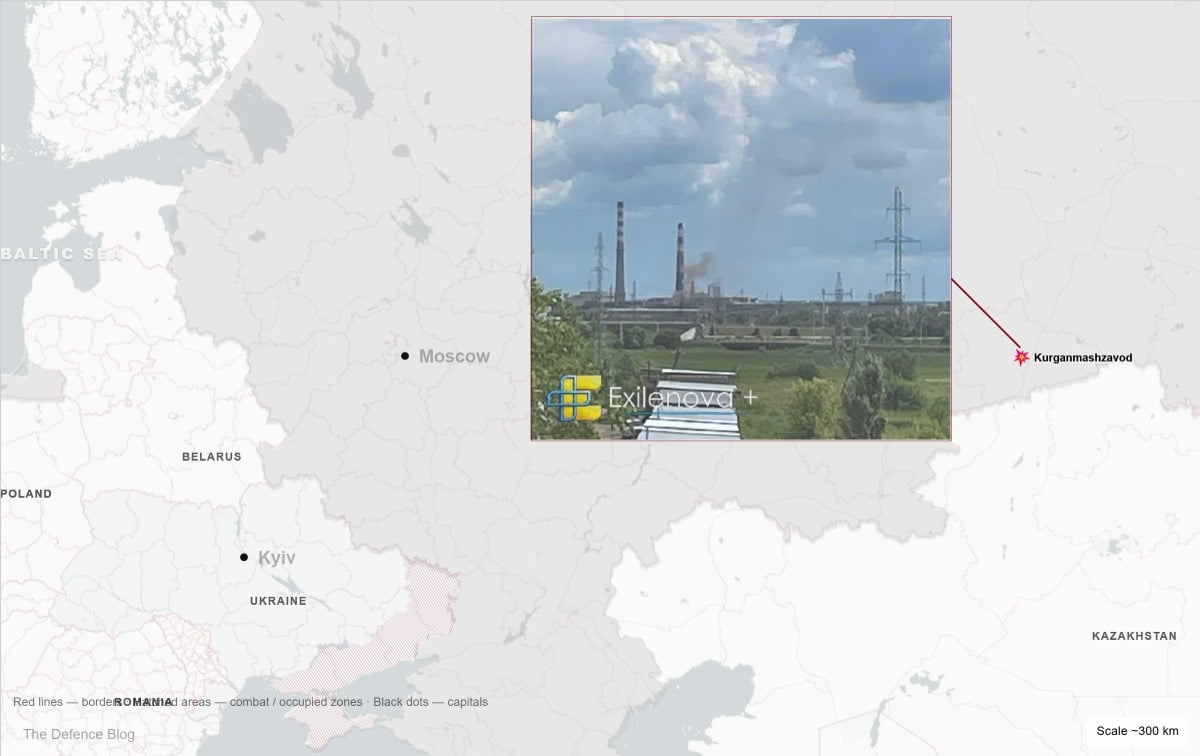
The air inside the Kurganmashzavod machine shop usually tastes like heavy cutting fluid, oxidized iron, and the sharp, hot tang of arc welding. For decades, this massive industrial footprint in the city of Kurgan has hummed with a predictable, rhythmic violence. It is the place where steel plates are pressed, welded, and molded into BMP-2 and BMP-3 infantry fighting vehicles. The metal hulls built here are heavy, designed to withstand anti-tank mines and heavy machine-gun fire on distant mud-slicked plains. They are monsters of weight and mass.
But weight means nothing when the threat weighs less than a suitcase.
At roughly noon, the rhythm broke. The sirens in the Kurgan region did not start with a roar, but with a mechanical whine that signaled an incoming drone threat. Minutes later, smoke began pooling against the gray Siberian sky, rising directly from the territory of Russia's premier armored vehicle plant. The distance from the internationally recognized Ukrainian border to this specific factory floor is just over 2,000 kilometers. To put that in perspective, that is roughly the distance from Madrid to Berlin. It is a distance that was supposed to guarantee absolute safety.
Living in the shadow of a wartime economy breeds a specific kind of cognitive dissonance. When a state relies heavily on its military industrial sector, a factory is not just a workplace; it is an anchor for the community. For the thousands of mechanics, engineers, and administrative staff who walk through the gates of the Kurgan plant every morning, the war was something that happened elsewhere—a meat-grinder thousands of miles away that consumed their products but left their homes untouched. The factory was a fortress of distance.
The smoke rising from the facility shatters that illusion.
Consider what happens next when the geographical shield dissolves. When a long-range strike campaign expands this deeply into the interior, it alters the psychological calculus of production. It is one thing to assemble an infantry fighting vehicle when the only pressure is a production quota handed down from Moscow. It is entirely another to do so while looking up at the skylights, wondering if a low-buzzing, fiberglass lawnmower engine is navigating toward your specific roof coordinate.
The technology driving this shift relies on an elegant, terrifying simplicity. For months, long-range aerial operations have systematically dismantled the blind spots of the continent. By targeting radar systems in border sectors like Bryansk, strike planners have effectively peeled back the layers of air defense monitoring. Once those primary tracking systems lose their coverage, the sky opens up. A low-altitude drone, built largely from composites that barely register on outdated radar systems, can slide through the gap. It moves slowly, quietly, charting its course through the vast Russian airspace until it reaches an industrial hub that thought it was untouchable.
The physical damage to a factory like Kurganmashzavod from a handful of drone strikes is often difficult to verify immediately. Moscow rarely confirms the details, and local Telegram channels offer only fractured glimpses—columns of gray smoke, a shaky smartphone video, a sudden, panicked exclamation from a bystander. But the structural damage to the infrastructure is almost secondary to the logistical friction these attacks introduce.
Imagine a supply chain as a delicate sequence of falling dominoes. Kurganmashzavod does not exist in a vacuum; it requires a constant influx of specialized steel, complex electrical harnesses, and precision optics. When a drone threat is declared, assembly lines halt. Power grids are selectively shut down to prevent secondary fires. Workers are evacuated into shelters. Even if a drone is shot down, or if it misses its primary target and explodes in an empty courtyard, the factory has still lost hours of production time. In a high-tempo war of attrition, those lost hours translate directly to empty spaces on a railway flatcar weeks later.
The deeper irony lies in the sheer asymmetry of the confrontation. The BMP-3 is an intricate piece of engineering, costing millions of dollars to manufacture, requiring specialized metallurgical facilities, massive assembly cranes, and hundreds of skilled labor hours. The instrument used to disrupt its birth is a flying wing constructed in a converted warehouse, powered by a commercial engine, and guided by a digital map. It costs a fraction of a percent of its target’s value. It does not need to obliterate the factory to achieve its purpose; it only needs to prove that the factory can be reached.
This is the reality facing the industrial centers of the Urals. The shield of distance has worn thin, leaving behind a sky that no longer feels secure, and a factory floor where the smell of burning metal is no longer just part of the job.