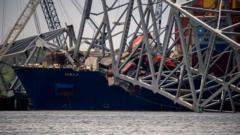
A single loose wire. On a vessel the size of a skyscraper, that sounds like a rounding error in a maintenance log. Yet, on May 12, 2026, the United States Department of Justice unsealed an indictment that strips away the veneer of "accidental mechanical failure" from the 2024 Francis Scott Key Bridge collapse. The federal government is no longer just asking for damages; they are alleging a criminal conspiracy.
Federal prosecutors have charged Singapore-based Synergy Marine Pte Ltd and India’s Synergy Maritime Pte Ltd, along with a shoreside technical superintendent, Radhakrishnan Karthik Nair, with a litany of crimes including conspiracy to defraud the United States and obstruction of an agency proceeding. The core of the case rests on a chilling premise: the disaster was not just preventable, but the direct result of a "pattern of deception" designed to keep a malfunctioning ship at sea to protect the bottom line.
The Illusion of Redundancy
Modern container ships like the Dali are engineered with the logic of a spacecraft. They possess redundant transformers, automated fail-safes, and secondary power systems designed to ensure that if one component fails, another instantly takes the load. According to the National Transportation Safety Board (NTSB) and the recent indictment, these systems were working exactly as intended. Until the operators deliberately handicapped them.
The initial blackout that morning was caused by a loose wire in a high-voltage switchboard. In a healthy operation, the ship’s automation would have detected the fault and rerouted power to a second transformer within seconds. Instead, investigators found the system had been switched to manual mode. This wasn't a technical glitch; it was a choice. By forcing the crew to manually troubleshoot a high-speed emergency in the dark, the operators stripped away the vessel's primary defense against a catastrophe.
The Flushing Pump Gambit
The most damning revelation in the unsealed indictment centers on a "flushing pump." Typically, these pumps are used for cleaning out heavy fuel oil during maintenance so it doesn't solidify and ruin the engines. They are not designed to supply fuel to generators during active navigation.
Prosecutors allege the defendants bypassed standard fuel supply pumps—which have automatic restart capabilities—and relied on this manual flushing pump to feed two of the ship's four generators. When the first blackout hit, the flushing pump died. Unlike the proper equipment, it stayed dead. This starved the generators of fuel, leading to a second, terminal blackout that left the 213-million-pound vessel drifting toward a bridge pier with no propulsion and no steering.
The DOJ’s math is simple. If the Dali had been using its proper, automated fuel pumps, power would have returned in time for the pilots to steer clear. By cutting corners to save on maintenance or time, the operators effectively turned the ship into a $5 billion unguided missile.
A Culture of Concealment
The criminal charges go beyond the mechanical. The indictment describes a concerted effort to hide the ship's true condition from the U.S. Coast Guard. International maritime law requires operators to report "hazardous conditions" before entering or leaving a port. The Dali had experienced two blackouts while still at the dock in Baltimore. Neither was reported.
Had the Coast Guard been notified, the ship would have been detained until the electrical issues were rectified. Instead, the vessel was pushed out into the Patapsco River under the cover of night. Radhakrishnan Karthik Nair is specifically accused of lying to the NTSB, claiming he was unaware that the ship was relying on the improper flushing pump.
This is the "flag-of-convenience" system at its most lethal. Under this global framework, ships are often registered in nations with lax oversight, managed by entities in a second country, and crewed by workers from a third. It creates a fragmented chain of accountability that makes investigative work a nightmare. This indictment represents a rare and aggressive attempt by U.S. federal authorities to pierce that veil.
The $2.5 Billion Price of Peace
While the criminal case moves forward, the civil landscape has shifted dramatically. On the same day the indictment was unsealed, Maryland Attorney General Anthony G. Brown announced a $2.5 billion settlement with Grace Ocean Private Limited (the ship’s owner) and Synergy Marine.
This settlement is massive, yet it remains a fraction of the total economic carnage. Replacement costs for the bridge alone are now estimated to top $5 billion. The state is still pursuing claims against the ship’s builder, Hyundai Heavy Industries, alleging that the original wiring installation was defective.
Liability and the 1851 Ghost
For much of the past two years, the legal battle hinged on a nearly 200-year-old statute: the Shipowners’ Limitation of Liability Act of 1851. This law, written when ships were made of wood and communication was limited to carrier pigeons, allows shipowners to limit their liability to the "post-accident value" of the vessel. For the Dali, that value was pegged at a mere $43.7 million.
The fact that Maryland secured a $2.5 billion payout indicates that the "limitation of liability" defense was crumbling. To successfully invoke that 1851 law, an owner must prove they had no "privity or knowledge" of the defects. The DOJ’s evidence of manual overrides, unreported blackouts, and improper pump usage made that argument nearly impossible to sustain in a modern courtroom.
The Human Toll of Policy Gaps
Six men—construction workers from Mexico, El Salvador, Honduras, and Guatemala—died because they didn't get a warning. The NTSB report highlights a critical communications lapse where the bridge crew was never alerted to the Dali’s emergency.
While the legal focus is on switchboards and fuel pumps, the systemic failure includes the bridge itself. Built in the 1970s, the Key Bridge had minimal pier protection. Grace Ocean’s legal team has spent months arguing that Maryland officials shared the blame for failing to conduct a modern vulnerability assessment. They aren't entirely wrong. The NTSB has criticized the state for decades of records showing a lack of adequate protection for a bridge that spanned one of the busiest shipping channels in the world.
This is the reality of global trade in 2026. We are navigating 21st-century megaships through 20th-century infrastructure, managed by companies using 19th-century liability laws. The indictment of Synergy Marine and its supervisor is a signal that the era of treating massive maritime "accidents" as inevitable acts of God is over.
Accountability is no longer just a civil line item; it is a criminal mandate. The DOJ's message to the shipping industry is loud. If you disable the safety systems to keep the cargo moving, you aren't just a negligent manager. You are a conspirator in the wreckage that follows.
Ship operators globally are now forced to re-evaluate their maintenance protocols. The "manual mode" that was once a shortcut for convenience has become the primary evidence in a federal criminal trial.