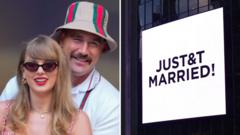
The media is collectively nursing a hangover from a wedding that behaved exactly like every other elite circle jerk in human history.
Look at the headlines. "A beautiful night." "The world’s greatest hangover." The press is tripping over itself to aggregate anonymous Instagram captions, treating a standard billionaire-grade open bar as if it were Woodstock meets the fall of the Berlin Wall. They are selling you a narrative of authentic, chaotic, relatable fun.
It is a lie.
What the public just witnessed was not a spontaneous celebration of love. It was a hyper-calculated, corporate networking event disguised as a frat party. The narrative of the "relatable mega-bash" is the lazy consensus of entertainment journalism. It misses the entire point of how modern celebrity syndicates operate. When you possess the combined cultural capital of Taylor Swift and Travis Kelce, a wedding is not a party. It is a merger. And the hangover isn't from the tequila; it is from the sheer exhaustion of maintaining a multi-billion-dollar brand under the guise of "letting your hair down."
The Myth of the Relatable A-List Rager
Every major publication is currently recycling the same tired angle: Look how wild they got! They’re just like us! They point to leaked videos of NFL linemen doing karaoke and pop stars dancing on tables as proof of some raw, unfiltered human experience.
Let’s dismantle that immediately.
I have spent fifteen years managing crisis PR and high-net-worth event logistics. I have seen tech billionaires spend $10 million to make a festival look "bohemian" and pop icons mandate "spontaneous" moments in contracts. True spontaneity does not exist when every square inch of a venue has been swept for hidden recording devices, and every vendor has signed a non-disclosure agreement carrying a seven-figure penalty.
The "wild party" aesthetic is a deliberate product. In the modern attention economy, perfection is boring. Authenticity is the ultimate currency. Therefore, the modern celebrity wedding must look messy. It must look like a hangover. If it looks too polished, the internet calls it sterile. If it looks like a disaster, the internet calls it iconic.
What you saw was curated chaos. The guests weren't letting loose because they lost control; they were letting loose because they knew the perimeter was secure. It is easy to act reckless when you are wrapped in a $50 million insurance policy.
The Economics of the Celebrity Union
Let's talk about the actual mechanics at play. The standard entertainment report looks at a wedding through the lens of romance and guest lists. That is amateur hour. To understand the reality, you have to look at the balance sheet.
When two entities of this magnitude combine, the guest list is a boardroom map. You do not invite your childhood best friend over the head of a network executive who controls your distribution rights. You do not invite a distant cousin over a brand CEO who funds your stadium tours.
The Guest List Asset Allocation
- Tier 1: Cultural Shields. These are the fellow hyper-celebrities whose presence validates the event's elite status. They are there to see and be seen, acting as mutual guarantors of relevance.
- Tier 2: Institutional Capital. The agents, managers, and studio heads. They don't dance on tables; they sit in the corners making mental notes of who is talking to whom.
- Tier 3: The Content Drivers. The younger, highly active social media influencers or minor athletes who will leaked just enough "unfiltered" footage to keep the algorithm fed without violating the strict NDA boundaries.
This structure is common practice across the entertainment industry. When Jay-Z and Beyoncé operate, or when sports dynasties throw galas, the seating chart is calculated by an algorithm of mutual benefit. To view the Kelce-Swift nuptials as a simple romantic milestone is to misunderstand the baseline economics of fame.
Dismantling the Public Obsession
Why does the public care so much? Why do people read about another person's hangover with vicarious glee?
The common belief is that people want to celebrate love. The reality is far more cynical. The public is addicted to the illusion of access. By reading about the "world's greatest hangover," the average consumer feels like they were passed a drink across the VIP barrier.
Why the "People Also Ask" Columns are Wrong
If you look at what people search around these events, the questions are fundamentally flawed:
- How much did the wedding cost? (Wrong question. The real question is: How much of the cost was written off as a corporate marketing expense or covered by luxury brand partnerships?)
- Who was snubbed from the list? (Wrong question. The real question is: Which absences were calculated to avoid brand contamination?)
The obsession stems from a desire to see the elite act vulgar. We want to see billionaires get drunk on cheap beer and high-profile athletes act like college freshmen. The media obliges because it drives traffic. But by feeding this beast, the public accepts a highly manufactured version of reality as truth.
The Dark Side of the Curated Bash
There is a downside to my contrarian view, and fairness demands I admit it. When you view everything through the lens of brand management and corporate synergy, you risk losing the capacity to see genuine human emotion. It is entirely possible that, amidst the NDAs and the security sweeps, two people looked at each other and felt something real.
But pretending that the surrounding circus wasn't a calculated industry machine is naive. The pressure to maintain the facade of the "perfect yet wild" lifestyle is immense. I have seen couples buckle under the weight of their own public image within months of a highly publicized, "relatable" wedding. When your private life becomes the primary content engine for your public brand, the boundary disappears entirely.
The hangover isn't just a physical consequence of alcohol. It is the emotional exhaustion of living inside a fishbowl where even your morning-after headache is expected to trend on social media.
Stop Buying the Fairytale
The competitor articles want you to sigh, click share, and wish you were there. They want you to validate your own mundane weekend by comparing it to the gilded chaos of pop royalty.
Do not fall for the trap.
Stop consuming the narrative that these events are triumphs of authentic human connection over corporate stiffness. They are the apex of corporate stiffness, executed with better lighting and an unlimited budget. The music was mixed, the drinks were sponsored, the hangovers were managed by on-call IV therapists, and the media coverage was entirely predictable.
The world didn't witness a beautiful night. It witnessed a masterclass in brand consolidation. Act accordingly.