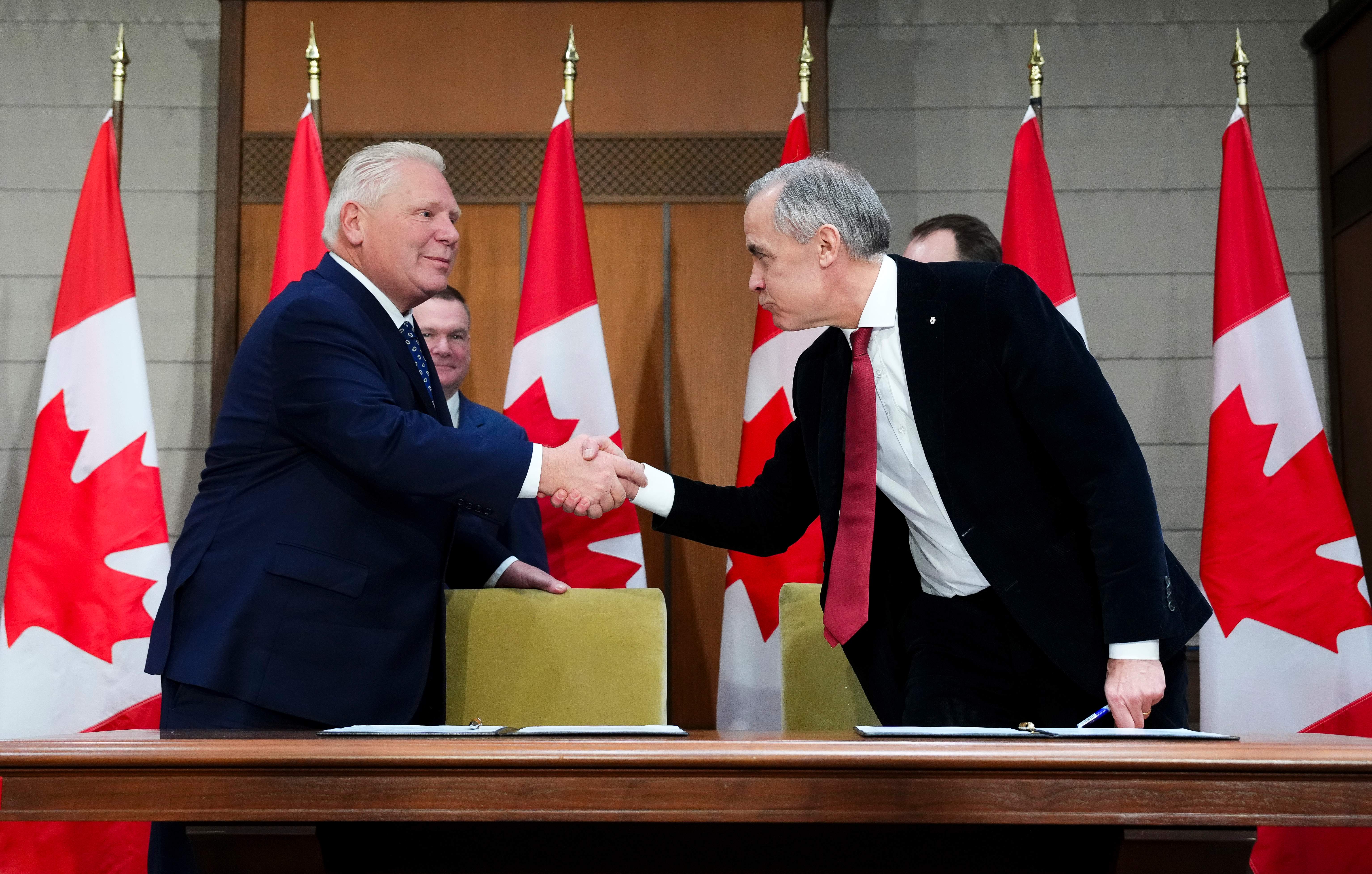
The press release smelled like victory. Politicians standing behind podiums, grinning over an $8.8 billion "historic" deal between the Federal government and Ontario. The pitch is simple: we will slash development charges to "unlock" housing supply and make homes affordable again.
It is a fairy tale.
In reality, this deal is a massive wealth transfer from future taxpayers to current developers, wrapped in the flag of "affordability." By dismantling the "growth pays for growth" model, the government isn't lowering the cost of living; they are merely shifting the invoice from the closing statement of a condo to your annual property tax bill.
If you believe that cutting a $50,000 development charge results in a $50,000 price drop for the buyer, you don't understand how markets work. You are falling for the greatest accounting trick in Canadian municipal history.
The Myth of the "Cost-Plus" Real Estate Market
The central fallacy of the Ontario-Ottawa deal is the assumption that real estate is priced based on the cost of production. It isn't. Real estate is priced based on absorption capacity—what the highest bidder is willing and able to pay at a specific moment in time.
When a developer looks at a plot of land, they calculate the "Residual Land Value." They look at what the finished units will sell for (market price), subtract their desired profit margin and construction costs, and what’s left over is what they can afford to pay for the land.
When the government swoops in and removes $80,000 in development charges per unit, the market price of the condo doesn't magically drop by $80,000. Why would it? If the guy next door just sold his unit for $700,000, no developer is going to list a twin unit for $620,000 out of the goodness of their heart.
Instead, that $80,000 "saving" gets baked into the land value. Landowners, sensing the increased margin, raise their asking prices. The developer keeps their margin, the landowner gets a windfall, and the "affordability" for the end-user remains a ghost.
Why "Growth Pays for Growth" Was Actually Fair
For decades, the principle in Ontario was simple: the people moving into a new subdivision should pay for the pipes, sewers, roads, and community centers required to service that subdivision. Development charges (DCs) were the mechanism for this.
By cutting these charges, we create a massive infrastructure deficit.
Imagine a scenario where a city adds 10,000 residents but lacks the funds to expand the water treatment plant because the development charges were waived. The pipes still need to be built. The police stations still need to be staffed. The library still needs books.
Where does that money come from now? It comes from Property Tax Hikes.
We are effectively asking a senior citizen on a fixed income in an existing home to subsidize the infrastructure for a luxury high-rise downtown. This isn't a housing strategy; it’s a predatory tax shift. We are cannibalizing the maintenance of our existing cities to fund the expansion of new ones, all while pretending we’re helping first-time buyers.
The Infrastructure Gap is a Time Bomb
The $8.8 billion being touted by the feds and the province is a drop in the bucket compared to the long-term lifecycle costs of the infrastructure they are incentivizing.
A study by the Association of Municipalities of Ontario (AMO) previously estimated that changes to the Development Charges Act could leave a $5 billion annual hole in municipal budgets. The "deal" announced doesn't even cover two years of that deficit.
Municipalities are now faced with a "Sophie’s Choice" of urban planning:
- Dramatically hike property taxes (often by 10% or more annually).
- Stop maintaining existing infrastructure, leading to the "Detroit-ification" of Ontario’s core.
- Take on massive debt, passing the bill to the next generation.
None of these outcomes result in a more affordable province. They result in a province where the cost of owning a home—through taxes and utilities—skyrockets even if the sticker price of buying stays flat.
The Supply Delusion: It’s Not Just About Permits
The "lazy consensus" among the pro-developer crowd is that supply is the only lever. "Build more, and prices must fall," they shout.
This ignores the labor and materials bottleneck.
Even if we waived every single fee and approved every permit tomorrow, we do not have the physical capacity to build 1.5 million homes in a decade. Our construction workforce is aging out. The cost of raw materials—lumber, concrete, steel—is dictated by global markets, not Ontario legislation.
By dumping $8.8 billion into "reducing charges," the government is stimulating demand for construction services in an already maxed-out market. Basic economics suggests this will simply lead to construction inflation. We aren't getting more houses; we’re just paying more for the ones we were already going to get.
The Better Way: Taxing Land, Not Growth
If the government actually wanted to fix housing, they wouldn't be fussing with development charges. They would move toward a Land Value Tax (LVT).
Currently, we reward speculators who sit on empty lots in downtown Toronto. Their property taxes are low because there is no "improvement" on the land. Meanwhile, we punish the developer who wants to build a mid-rise by hitting them with massive upfront fees.
A Land Value Tax flips the script. It taxes the value of the location regardless of what is built on it. This forces the "parking lot kings" to either build or sell to someone who will. It incentivizes density naturally without creating a billion-dollar hole in the municipal budget.
But politicians won't do that. It’s too hard to explain on a campaign bus. It’s much easier to hand out $8.8 billion of your money to cover the fees of their biggest donors.
The Brutal Reality of Municipal Insolvency
I’ve seen cities struggle with "growth" for twenty years. The math never adds up when you subsidize sprawl. Every new kilometer of road requires a lifetime of plowing, paving, and policing. When you strip away the upfront funding for that road (the development charge), you are essentially signing a death warrant for the city's long-term credit rating.
We are watching the "Financialization of the Commons." The provincial and federal governments get the headlines for "solving" housing, while the local mayors get the blame when the sewers back up and the property tax bill arrives with a double-digit increase.
What You Should Actually Do
If you are a homebuyer waiting for this $8.8 billion deal to make your dream home affordable: Stop waiting. The savings are already being eaten by land speculators and interest rate hedging. Instead of looking for "new builds" where the fees were supposedly cut, look for existing inventory in "inner-ring" suburbs where the infrastructure is already paid for.
If you are a taxpayer: Start screaming. Demand to know exactly how your municipality plans to bridge the "infrastructure gap" created by these fee cuts. Ask your councilors why you should pay 12% more in property tax so a developer can have a higher ROI on a "luxury" glass tower.
The "Housing Accelerator Fund" and these bilateral deals are not a "game-changer." They are a shell game. They move the money from your left pocket to your right pocket, while the government takes a "handling fee" and the developer takes the change.
Stop asking how we can make development cheaper. Start asking why we are subsidizing the destruction of our municipal balance sheets.
The $8.8 billion isn't a gift. It's a loan you didn't agree to take out, and the interest is going to hurt for the next thirty years.