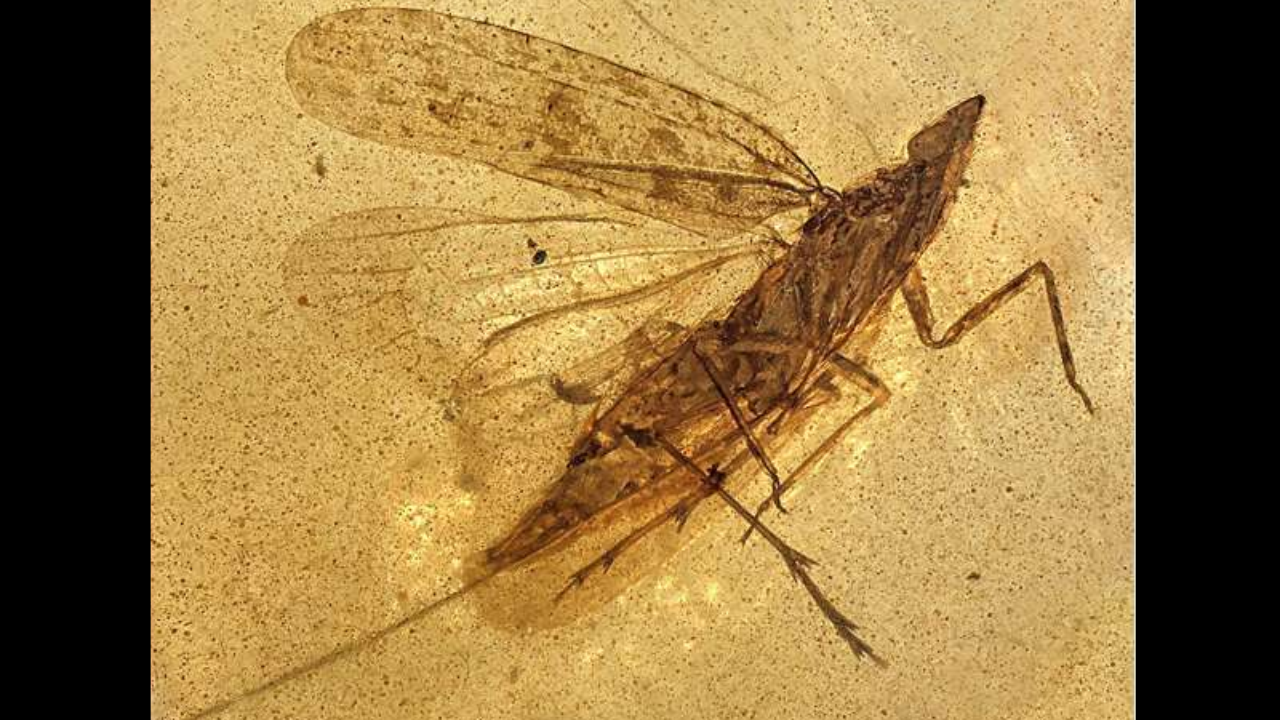
Tree resin is nature's ultimate time capsule. When it hardens into amber, it traps ancient creatures down to the microscopic hair. Recently, researchers examining 13 remarkable specimens trapped in 99-million-year-old Kachin amber from Myanmar uncovered a completely unknown chapter of Cretaceous evolution. They found an extinct planthopper species with a mouthpart nearly twice the length of its entire body.
If you think modern insects are bizarre, history holds stranger designs. This discovery forces us to rethink how ancient bugs survived alongside dinosaurs.
Meet Cretodorus Noonoo
Named affectionately after the vacuum cleaner character from the children's show Teletubbies, Cretodorus noonoo possessed an anatomical oddity that modern biology simply doesn't feature. Today's planthoppers rely on short, rigid, needle-like mouthparts to pierce plant tissue. They stab and sip.
Noo-Noo played by different rules. Its feeding organ was flexible, corrugated with transverse folds, and stretched out to nearly twice its body length.
Researchers using high-resolution micro-computed tomography discovered those surface folds weren't just for show. They functioned structurally like a corrugated hose or a bendy straw. They allowed the mouthpart to bend sharply without kinking, collapsing, or cutting off the internal fluid flow.
Several of the 13 fossilized specimens preserved this exact bent posture. Because tree resin freezes insects mid-action, scientists know this flexibility was a real, living trait rather than a post-mortem artifact.
Solving the Cretaceous Tree Bark Mystery
Why evolve a mouthpart twice your body length? It wasn't for sipping flower nectar.
Butterflies use long proboscises for flowers, but Noo-Noo's mouthparts pointed backward like standard piercing-and-sucking planthopper gear. Furthermore, amber scans revealed no accumulation of pollen on the bodies. This insect wasn't a pollinator.
Instead, scientists believe Noo-Noo specialized in tapping tree sap hidden deep inside tight fissures. Thick Cretaceous bark featured deep cracks. A rigid mouthpart would hit a dead end or snap. A long, bendy tube could snake through narrow gaps to reach vascular tissues deep inside the plant.
At the very tip of this remarkable organ, researchers identified two grooved lobes. These lobes likely functioned like an expanding wall anchor or plug inside a drilled hole. Once the insect wedged its mouth into a crack, the lobes opened up to anchor the feeding tube securely in place while it fed.
Rewriting the Ancient Insect Family Tree
This discovery does more than introduce a weird prehistoric bug. It exposes major gaps in our understanding of ancient ecosystems.
Because similar folded mouthpart structures appear in another extinct planthopper family known as Mimarachnidae, researchers proposed merging that family into Neazoniidae. Across the specimens studied, mouthpart lengths varied wildly from the size of hind legs to double the body length. This variation suggests different species adapted to feed on specific types of trees or bark thicknesses.
Evolution tries every possible configuration. Sometimes, brilliant adaptations disappear entirely when ecosystems shift. Noo-Noo proves that life 99 million years ago solved ecological challenges in ways modern nature abandoned.
Amber fossils keep reminding us how little we actually know about the history of this planet. Every chunk of tree resin holds secrets waiting for a CT scan.