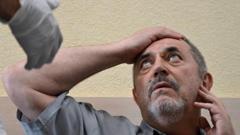
The paper bill looks fragile on the wooden table, a slip of cheap thermal print from a district court in Dolgoprudny, a quiet town on Moscow’s northern outskirts. It demands one thousand rubles. At the current exchange rate, that is roughly thirteen American dollars. You could spend more on a modest breakfast in any major city on earth.
But this bill was not issued for a meal. It was issued to a 63-year-old veteran politician named Boris Nadezhdin for a fraction of a second of digital video.
In a 2023 online clip, Nadezhdin briefly displayed an image of Alexei Navalny, the opposition leader who later perished in an Arctic penal colony. To the state, that split second was an act of "displaying extremist symbols".
The court staff who stamped the paperwork likely did not look Nadezhdin in the eye. They did not need to. The real transaction here has nothing to do with currency. The thirteen dollars is a token, a bureaucratic punctuation mark designed to trigger a legal trapdoor. Under current Russian law, this minor administrative conviction achieves exactly what a multi-year prison sentence would: it legally bars Nadezhdin from running in September’s parliamentary race.
Consider what happens next when the state decides that thirteen dollars is the price of an absolute political monopoly.
The Shrinking Room
To understand the weight of that tiny fine, one must look at what it feels like to live inside a country where the walls are moving inward by an inch every day.
Nadezhdin is not a radical bomb-thrower. In the 1990s, he wore the sharp suits of a government adviser, working closely with figures who now sit at the very right hand of President Vladimir Putin. He is a man who knows the system, who understands its rhythms and speaks its language. Yet, last month, when he announced his bid for the State Duma, the bureaucratic machinery instantly branded him a "foreign agent".
It is a phrase designed to taste like ash in the mouth, carrying deep pejorative weight intended to turn neighbors into strangers and voters into suspects.
When police detained him for several hours earlier in the week, the message became even clearer. Nadezhdin, whose health is failing, openly told the court that a prison sentence would simply be a death sentence behind bars. He is trapped. He cannot leave the country, and he cannot participate in its future.
But why now? Why target a municipal councilman with a thirteen-dollar fine over a year-old video?
The answer lies in the gas pumps and the distant, low thud of reality crossing the border.
The Price of Friction
No regime panics when everything is going perfectly. The desperation of the current clampdown is fueled by a quiet, mounting fatigue spreading through the Russian populace.
For a long time, the conflict in Ukraine could be treated by everyday citizens as a television show—something happening elsewhere, managed by professionals, requiring little more than passive compliance.
That illusion is burning away. Ukrainian drone strikes have repeatedly battered oil facilities across the country, turning massive fuel reservoirs into columns of black smoke. Across Russia, fuel shortages are no longer a theoretical warning; they are long lines at filling stations. Economic pain is creeping into the daily calculus of the average household.
When people are cold, tired, and wondering why their local fuel depot is on fire, their tolerance for systemic failure drops.
In this environment, even token opposition becomes an existential threat to the status quo. The Kremlin’s dominant United Russia party cannot afford an unscripted moment in the upcoming lower house elections. They require a clean, completely controlled choreography against a "systemic" opposition—parties that wear different names but vote in absolute lockstep with the executive branch on every critical issue.
Nadezhdin was a loose thread. The thirteen-dollar fine was the pair of scissors that snipped him out of the fabric.
The Cold Room in St. Petersburg
While Nadezhdin was handed a piece of paper and a closed door, another critic faced a much darker room on the very same day.
In St. Petersburg, a blogger named Ilya Remeslo was taken into custody. His trajectory reveals just how volatile the landscape has become. Remeslo was once a pro-Kremlin activist, someone who actively supported the state apparatus until the realities of the military action in Ukraine drove him to dissent. In March, he publicly called for Putin's resignation.
The response was swift, psychological, and archaic. Remeslo was placed into a psychiatric clinic for a month—a chilling echo of Soviet-era punitive psychiatry used to treat political disagreement as a mental illness.
On Friday, he was escorted under guard to Moscow. A judge ordered him to remain in a prison cell for at least two months pending a formal investigation into charges of spreading "false information" about the military.
If Nadezhdin’s fine represents the subtle, legalistic strangulation of dissent, Remeslo’s two-month detention represents the blunt force of a state that has stopped pretending to care about the optics of its actions.
The Gravity of Silence
It is easy to look at these stories from thousands of miles away and see them as a collection of foreign names and distant courtrooms. But the human element of this suppression is found in the everyday choices forced upon ordinary people.
When a joke, a social media repost, or a picture of a deceased dissident can cost you your livelihood, your freedom, or your health, silence ceases to be passive. It becomes an active, exhausting weight you carry through the streets every single day.
You learn to watch your tongue at the grocery store. You clear your browser history before you sleep. You look at an old friend and wonder, just for a second, if they would repeat what you said over dinner to the wrong person.
The true success of an authoritarian clampdown is not measured by how many people are currently sitting in prison cells. It is measured by the millions of people who decide, purely out of survival instinct, to lock their own thoughts away inside their heads.
Boris Nadezhdin will pay his one thousand rubles because he has no other choice. He will walk out of that Dolgoprudny courthouse into the summer air, barred from the ballot, effectively erased from the political life of the nation he spent thirty years trying to shape.
The state will get its thirteen dollars, and a quiet nation will keep waiting for the smoke over the oil facilities to clear.