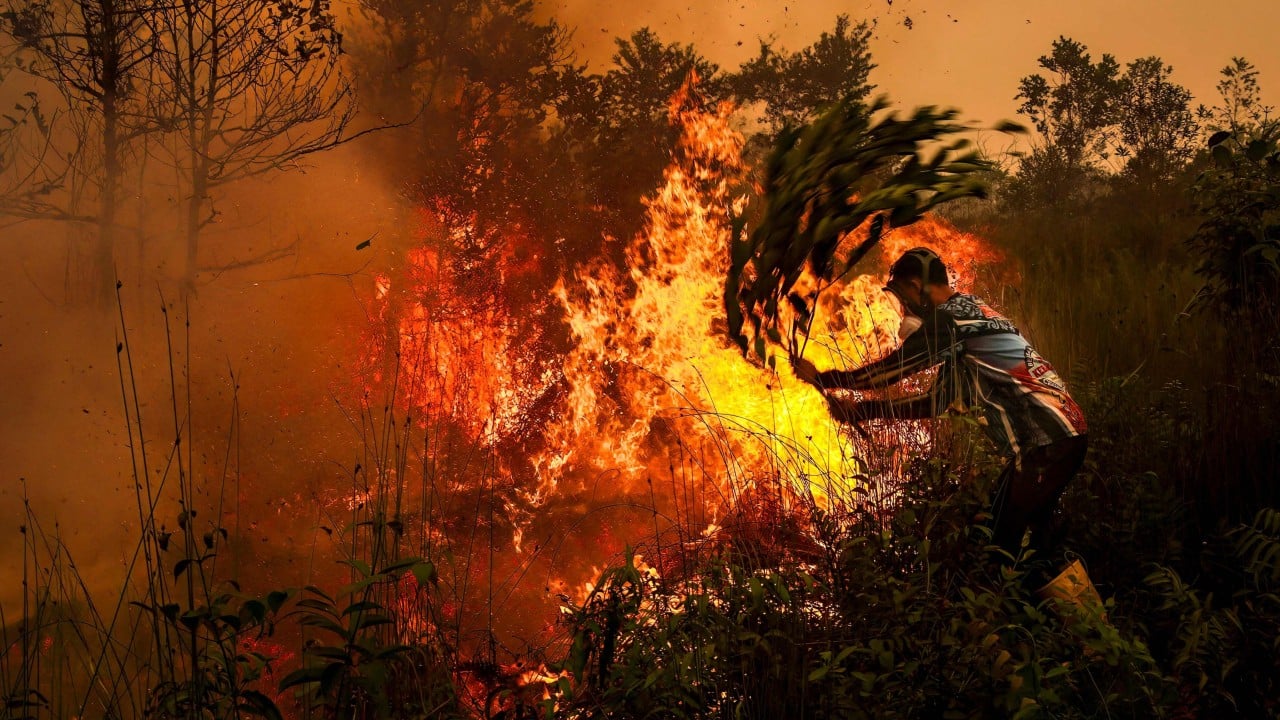
Indonesia is aggressively tightening its official emissions targets on paper even as choking smoke from burning peatlands pushes its real-world carbon output higher. Government ministries in Jakarta continue to announce ambitious forestry sinks and accelerated net-zero timelines for international audiences, relying on selective baseline accounting, delayed land-use data, and unverified carbon-credit frameworks to keep their climate pledges intact on spreadsheets while fire hotspots flare across Sumatra and Kalimantan.
To understand how a nation can simultaneously claim climate leadership and pump millions of tons of greenhouse gases into the atmosphere from preventable fires, you have to look past the press releases from annual climate summits. You have to look at the soil beneath the trees.
The Underground Carbon Bomb
Most people picture a forest fire as burning timber. Flames licking up trunks, canopies turning to ash, wildlife fleeing the smoke. In Indonesia, the trees are just the kindling.
The real crisis lies in tropical peatlands—waterlogged ecosystems composed of partially decayed plant matter that has accumulated over thousands of years. Across Sumatra, Kalimantan, and Papua, these spongy, acidic wetlands store an estimated 57 billion metric tons of carbon. That is more carbon locked beneath the surface than all the world's forests combined can absorb in several years of uninterrupted growth.
When intact and saturated with water, peat is nearly fireproof. Drain it, and it turns into fossil fuel sitting at ground level.
For decades, industrial expansion for palm oil plantations, pulpwood estates, and smallholder agriculture has relied on digging vast networks of drainage canals to dry out peat swamps so heavy machinery and commercial crops can survive. Once the water table drops, the exposed organic matter oxidizes, releasing carbon dioxide even without a spark. When someone inevitably uses fire to clear brush during a dry spell, the flames do not stay on the surface. They burrow underground.
A smoldering peat fire can burn meters beneath the forest floor for months, invisible to basic thermal satellites and immune to water bombers dropping loads from above. You cannot put out a peat fire with a hose. The only way to extinguish it is to flood the entire landscape back up to its natural water table—a hydrological feat that runs directly against the economic model of every plantation operating on drained soil.
How Jakarta Balances the Books
If the physical reality on the ground is thick haze and subterranean fires, how does the Indonesian government keep telling the United Nations that its climate goals are on track?
The answer lies in the mechanics of international carbon accounting, specifically within the Forestry and Other Land Use (FOLU) sector. Under the Paris Agreement, countries submit Nationally Determined Contributions (NDCs) that outline how much they plan to cut emissions compared to a "business-as-usual" baseline.
That baseline is where the magic happens.
By projecting an aggressive hypothetical scenario of unchecked deforestation and runaway fires into the future, policymakers create a massive ceiling of "expected" emissions. Any reduction below that inflated ceiling counts as a climate victory, even if actual emissions remain catastrophically high compared to historical norms.
Consider a hypothetical example to see how this accounting works in practice. Imagine a province historically emitted 50 million tons of carbon annually from land use. Planners project that without intervention, emissions would spike to 120 million tons by 2030. If fires and clearing push actual emissions to 85 million tons, the province still reports a 35-million-ton "reduction" against its business-as-usual baseline. On the international ledger, that registers as progress. In the atmosphere, it is a 70 percent increase over the historical average.
Indonesia's flagship FOLU Net Sink 2030 policy builds directly on this statistical architecture. The plan promises that by the end of the decade, Indonesia's forests and land will absorb more carbon than they emit. Achieving this requires massive reforestation, strict moratoriums on primary forest clearing, and the hydrological restoration of millions of hectares of degraded peat.
Yet the math depends heavily on excluding or smoothing over "natural disturbances" during severe dry seasons driven by El Niño weather patterns. When prolonged droughts hit the archipelago, dry peat ignites at exponential rates. Official inventories often treat these spikes as anomalous weather events rather than structural failures of land management, allowing long-term policy trajectories to remain undisturbed on paper.
The Economics of Burning
Nobody sets fire to a multi-million-dollar plantation by accident, and nobody clears land with matches because they enjoy the smoke. Fire is an economic tool.
Clearing a hectare of degraded scrubland or secondary forest using heavy excavators and mechanical mulchers costs hundreds of dollars per hectare, requires fuel, and takes weeks. Setting a match to dried brush at the end of the dry season costs practically nothing and leaves behind a layer of nutrient-rich ash that temporarily neutralizes the high acidity of tropical soils.
For smallholders operating on razor-thin margins, mechanical clearing is financially impossible. For larger corporate concessions, subcontracting land preparation to third-party operators creates a convenient layer of plausible deniability. When satellites detect thermal anomalies inside a corporate boundary, executives routinely blame neighboring farmers, rogue arsonists, or migrating wildfires jumping across property lines.
Enforcement has historically struggled to pierce this corporate veil. While Jakarta has imposed high-profile fines and revoked permits in egregious cases, the legal machinery moves slowly. Collecting court-ordered environmental damages from plantation companies often drags on for years through appeals, corporate restructuring, and shell-company transfers.
Meanwhile, the global market sends mixed signals. Demand for palm oil—the most land-efficient vegetable oil on earth, used in everything from packaged snacks to biodiesel—continues to climb. Even as the European Union rolls out strict deforestation-free supply chain regulations, domestic mandates in Indonesia have pushed biodiesel blending higher, creating a massive, state-backed internal market for crude palm oil that insulates producers from Western environmental scrutiny.
The Carbon Market Mirage
Facing immense pressure to fund its energy transition without derailing economic growth, Jakarta has increasingly pitched its vast tropical forests as an investable asset class. The launch of the IDXCarbon exchange and aggressive bilateral deals under frameworks like the Just Energy Transition Partnership (JETP) are designed to turn avoided deforestation into cold, hard foreign currency.
Here is the catch. Carbon markets only work if buyers trust that the carbon stays in the ground.
When a corporation in Tokyo or London buys a nature-based carbon credit from an Indonesian conservation project, it is paying for permanence. If a dry spell triggers widespread peat fires across the same region two years later, that permanence evaporates into smoke.
International buyers have grown deeply skeptical of tropical forestry offsets following a string of global investigations showing that many credits generated worldwide were based on phantom deforestation threats. Indonesia's push to centralize and regulate its domestic carbon market was meant to restore credibility, requiring projects to align with national accounting rules before credits can be sold abroad.
In practice, this has created a bottleneck. Foreign investors hesitate to pour capital into restoration projects when regulatory rules shift mid-stream, while recurring wildfire headlines undercut the narrative that Indonesia's forests are secure long-term vaults. You cannot sell carbon stability to Wall Street while transboundary haze is closing airports in Singapore and Kuala Lumpur.
What Actually Stops the Smoke
Watching decades of Indonesian climate policy reveals a sharp divide between what gets announced in conference halls and what actually works in the swamp.
Laws on paper do not stop fires. Satellite monitoring portals do not stop fires. Even the permanent moratorium on new permits in primary forests and peatlands—a genuinely landmark policy introduced over a decade ago and later made permanent—has a glaring loophole. It does not force companies to surrender existing concessions that were granted before the freeze took effect. Millions of hectares of carbon-rich peat remain legally zoned for agriculture and forestry.
Where fire rates have genuinely dropped, the drivers have been physical and financial rather than bureaucratic.
Rewetting the Sponge
The Peatland and Mangrove Restoration Agency (BRGM) has spent years building tens of thousands of canal blocks—simple dams made of local timber, compacted peat, and sandbags designed to trap rainwater and raise the water table back to the surface. When executed properly and maintained year-round, canal blocking turns a tinderbox back into a wetland.
The problem is maintenance. A wooden dam in a tropical swamp rots within a few years. Without continuous funding and local buy-in, canals wash out, water drains away again, and the fire risk returns before the next dry cycle arrives.
Supply Chain Traceability
The single most effective deterrent against corporate burning over the past decade has not come from a government ministry, but from consumer-goods giants terrified of brand boycotts. When major refiners and traders adopted "No Deforestation, No Peat, No Exploitation" (NDPE) policies and began mapping their supply chains down to individual mills and plantations, fire hotspots inside major corporate concessions dropped precipitously.
When a plantation group knows that a single fire on its land will result in immediate suspension from global buyers—cutting off access to international financing and export markets—fire prevention suddenly becomes a boardroom priority. Watchtowers get staffed. Fire brigades get funded. Water levels get monitored daily.
Paying Farmers Not to Burn
You cannot police millions of rural smallholders with drones and jail threats. Villages surrounded by degraded peatlands need viable economic alternatives that do not require draining the soil.
Paludiculture—farming native wetland species like sago, jelutung, and certain types of rattan that thrive in wet, undrained peat—offers a way out. Yet market infrastructure for these crops remains tiny compared to the massive logistical machine built around palm oil and rubber. Until a farmer can make a reliable living keeping the peat wet, the matchbook will remain the cheapest tool in the shed.
The Collision Ahead
Indonesia stands at an unavoidable collision between its development ambitions and physical reality. The government wants to achieve high-income status by 2045, expand downstream mineral processing—particularly nickel smelting powered largely by captive coal plants—and maintain its position as the world's dominant palm oil exporter. At the same time, it wants to be recognized as a premier global climate powerhouse.
Accounting tricks can bridge that gap for a few budget cycles. Creative baselines and optimistic reforestation projections can buy diplomatic goodwill and keep climate finance negotiations alive.
The atmosphere, however, does not read policy papers. Every El Niño cycle acts as an audit on Indonesia's land management, stripping away accounting assumptions and exposing the true moisture level of the soil. Until the financial incentives on the ground favor wet peat over dry plantations, doubling down on climate pledges in Jakarta will remain an exercise in creative bookkeeping while the real carbon ledger goes up in smoke.