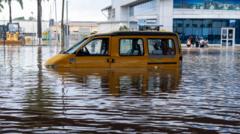
Accra woke up to a nightmare on Monday morning. Torrential downpours slammed the city with 140 millimeters of rain in a single day, nearly triple last year's high. Within hours, homes were underwater, roads became rushing rivers, and families huddled on rooftops waiting for rescue teams. The Ghana National Fire Service has confirmed that at least nine people lost their lives in the devastation across Accra and Tema, with emergency crews fearing the death toll could climb higher as search operations drag on.
This isn't just bad luck. It's an annual catastrophe that gets worse every single time. While the immediate focus remains on active search-and-rescue efforts, the bitter truth is that we've seen this exact movie before. For an alternative look, consider: this related article.
The Human Toll of Monday’s Deluge
The storm started lashing the city around 3:00 am, catching millions of residents asleep. By dawn, low-lying areas like Alajo, Tse Addo, and Tema Manhean were completely cut off.
Emergency responders from the National Disaster Management Organization, the military, and the Marine Police deployed boats to extract trapped citizens. In Tse Addo alone, crews rescued 105 people, including 15 children and an infant. Similar analysis on this trend has been provided by Al Jazeera.
The losses are heartbreaking and deeply personal.
- In Alajo, officials recovered the body of a man in his 60s who drowned in the fast-rising waters. A mother and her young child also perished in the same suburb.
- Two people died from electrocution when floodwaters surged into their homes and made contact with live electrical wiring.
- In the middle of the chaos, a massive fire broke out at a rubber factory near the Kwame Nkrumah Circle, tearing through market and residential structures while flooded streets slowed down fire trucks.
Longtime residents lost everything. Philip Mensah, a 67-year-old retired journalist, told reporters his home was entirely swamped, destroying a vinyl record collection he had built since the 1970s. Schoolteacher Patience Naa Adjeley Adjei described a exhausting battle against the water, mopping her room eight times before realizing the outside world was completely submerged.
Blaming Climate Change Covers for Bad Policy
President John Mahama addressed the disaster on X, pointing to a mix of shifting weather patterns and human behavior. He noted that the intensity of the storm was fueled by changing climatic conditions beyond local control.
He's partly right. The intensity of modern rainstorms defies historical patterns. However, hiding behind climate change ignores the manufactured vulnerability of Ghana's capital.
The real crisis is unchecked urbanization. Over five million people now crowd the Greater Accra Metropolitan Area. As the city grows, developers pave over natural floodplains with concrete. Water has nowhere to go.
Worse, people keep building structures directly inside designated waterways. When the government attempts to demolish these illegal buildings, public pushback often stalls the machinery. The result is a clogged, concrete basin that fills up like a bathtub every time a storm rolls in.
A Systemic Failure of Infrastructure
You can't blame everything on illegal housing. The state's drainage infrastructure is woefully inadequate and poorly maintained. Most gutters in Accra are open, shallow, and perpetually choked with plastic waste and silt.
When 140 millimeters of water falls on a city with blocked arteries, disaster is a mathematical certainty. Decades of underinvestment in deep, subterranean storm drains mean the city relies on drainage systems designed for a fraction of its current population.
Compounding the issue is the deadly interaction between water and our electrical grid. The Electricity Company of Ghana had to shut off power to several submerged neighborhoods on Monday to prevent further electrocutions, leaving stranded residents in total darkness as they waited for rescue.
The Immediate Threat Looming Over the City
The danger hasn't passed yet. The Ghana Meteorological Agency issued an urgent warning that rain-bearing clouds are persisting over southeastern Ghana and moving westward. Another major storm is forecast to hit the region, threatening to swamp communities that are already saturated.
If you live in a low-lying area or a known flood zone, you need to act immediately before the next clouds burst.
- Unplug everything right now. Turn off your main circuit breaker if water starts approaching your doorstep. Don't risk electrocution.
- Move to higher ground. Do not wait for the water to reach your knees before deciding to leave. Identify a multi-story building or a hill nearby.
- Pack an emergency bag. Keep your passport, Ghana Card, land documents, and essential medications in a waterproof bag ready to grab.
- Avoid unnecessary travel. The Ministry of the Interior has explicitly asked people to stay off the roads. Rushing water can sweep a car away in seconds, and hidden potholes or open drains become invisible death traps.
We need real structural enforcement, massive investment in underground drainage systems, and a zero-tolerance policy for building on waterways. Until then, stay safe, watch the weather alerts, and look out for your neighbors.
A dramatic view of the flooding can be seen in this Africanews report on Accra floods, which captures the scale of the destruction and the rescue operations carried out by emergency teams using boats to navigate submerged streets.