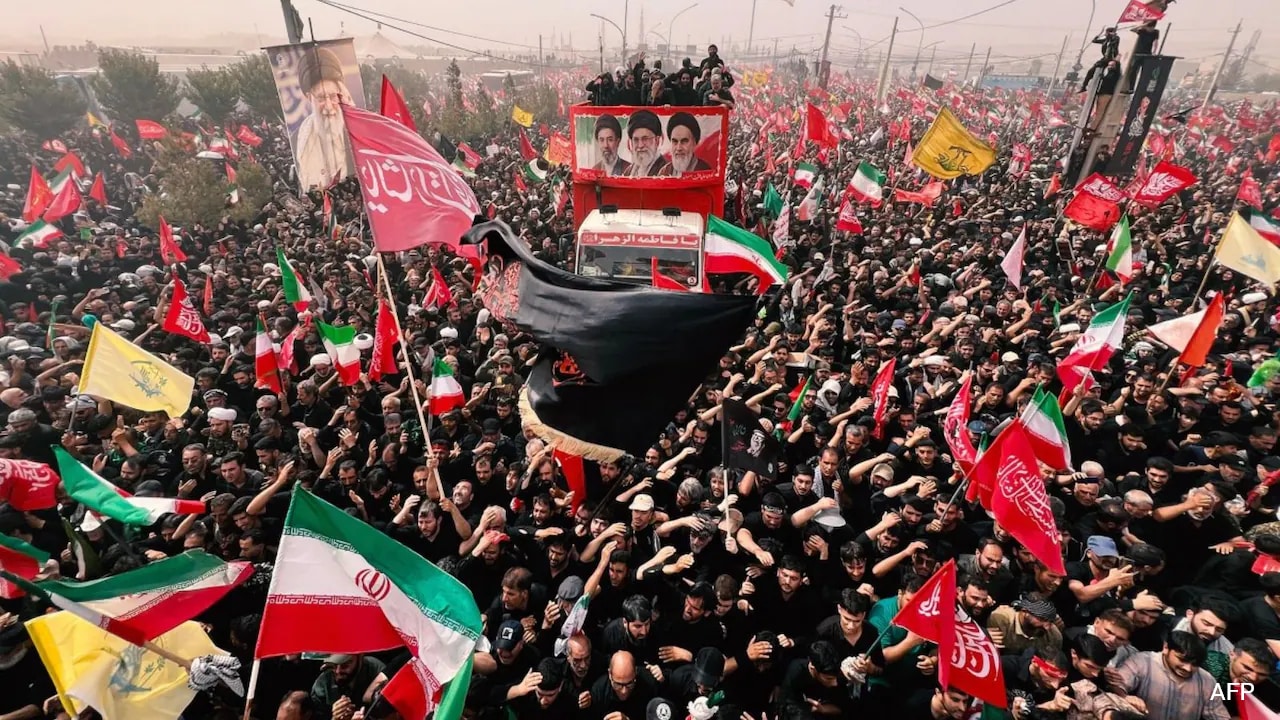
The air inside Tehran’s Grand Mosalla is heavy with the scent of rosewater and sweat. Outside, the city is a labyrinth of armored vehicles and anxious murmurs. It is the summer of 2026. A 60-day interim ceasefire holds a fragile, bleeding peace over Iran, but inside the cavernous prayer hall, time has compressed.
On the raised platform lies the body of Ali Khamenei.
An airstrike on February 28 brought an abrupt end to his 37-year reign. For months, the war raged too fiercely for a proper burial, but now, the state is stage-managing an exit meant to ripple across the next century.
A middle-aged man named Reza stands near the barriers, his eyes fixed on the white-wrapped shroud. Reza is not a government official. He is a high school history teacher from Mashhad, a man whose entire life has been bracketed by the decrees of the man in the coffin. Reza remembers the hunger of the sanctions, the terrifying rumble of the recent joint Western-Israeli offensive, and the quiet disappearance of neighbors who dared speak too loudly in the cafes. Yet, as he listens to the rhythm of the chanting around him, he hears something that troubles him more than the drone strikes.
The state media broadcasts are no longer just mourning a political leader. They are rewriting a biography into theology.
The political apparatus is executing its final, most ambitious directive: the canonization of Ali Khamenei. Government-sanctioned speakers are already declaring that within a century, Khamenei will not be remembered merely as a wartime president or a master of regional proxies. They are claiming he will be revered as the Second Imam Hussain.
To understand the weight of that claim is to understand the very DNA of Shia Islam. Imam Hussain, the grandson of the Prophet Muhammad, is the ultimate moral North Star of the faith. His slaughter at the Battle of Karbala in 680 AD created a permanent template for sacred resistance against tyranny. To compare a modern, bureaucratic ruler—one who commanded vast intelligence networks, drones, and police forces—to the ultimate martyr of Karbala is a staggering theological leap.
It is a maneuver born of absolute necessity.
The regime Khamenei left behind is fracturing. His second son, Mojtaba Khamenei, has assumed the mantle of Supreme Leader, but hereditary succession is a bitter pill for a republic founded on the rejection of monarchy. The economy is hollowed out. The state’s Revolutionary Guard Corps is powerful but stretched thin by years of shadow warfare and domestic crackdowns.
When a government can no longer promise prosperity, or even physical safety, it must trade in the currency of eternity.
Consider what happens next on the funeral route. The body will not simply be lowered into the earth. It is being taken on a calculated, multi-city pilgrimage designed to mirror the historic geography of Shia suffering. From Tehran, it travels south to the seminary city of Qom. Then, it crosses the border into Iraq, heading straight to Karbala itself—to the actual shrine of Imam Hussain.
This is not a logistical choice; it is a visual argument. By physically placing Khamenei’s coffin next to the ultimate symbol of Islamic martyrdom, the state is attempting an algorithmic transfer of holiness. They want the public to forget the administrative reality of the Office of the Supreme Leader and remember only a myth of perpetual defiance against global arrogance.
But the real problem lies in the collective memory of the people standing in the dust.
Reza looks around at the younger faces in the crowd. Many of them are not weeping. They are watching. They remember Wednesday—the day the funeral procession is scheduled to peak—not just as a day of religious mourning, but as the anniversary of bloody crackdowns against domestic protests. They remember a state that used the language of God to justify the price of bread and the silencing of dissent.
The state’s gamble is that time erases complexity. They are betting that in 100 years, the economic reports, the political imprisonments, and the strategic miscalculations of the 2026 war will dissolve into the background. They hope that only the icon will remain: the soft-spoken cleric with the paralyzed right arm—shattered in a 1981 assassination attempt—who stood against the world’s superpowers for nearly four decades.
An analogy helps parse this ambition. It is the difference between a monument made of sandstone and one made of reinforced concrete. The Iranian state is trying to pour a concrete myth over a fractured history, hoping it hardens before the internal fissures tear the structure apart.
The funeral procession will eventually end in Mashhad, at the sprawling Imam Reza shrine, where millions of pilgrims go each year to seek relief from sorrow. There, Khamenei will be laid to rest alongside the eighth Shia Imam and his late political ally, Ebrahim Raisi.
As the chanting rises to a crescendo inside the Mosalla, Reza turns away from the barrier and walks toward the exit. The heat outside is oppressive, the future of his country utterly opaque under a new, untested leadership. The state may command the speakers, the television stations, and the direction of the procession. They can declare a new saint by decree. But as Reza steps out into the blinding Tehran sun, the silence of the ordinary citizens on the sidewalk suggests that the final verdict on Ali Khamenei belongs to history, not the state.