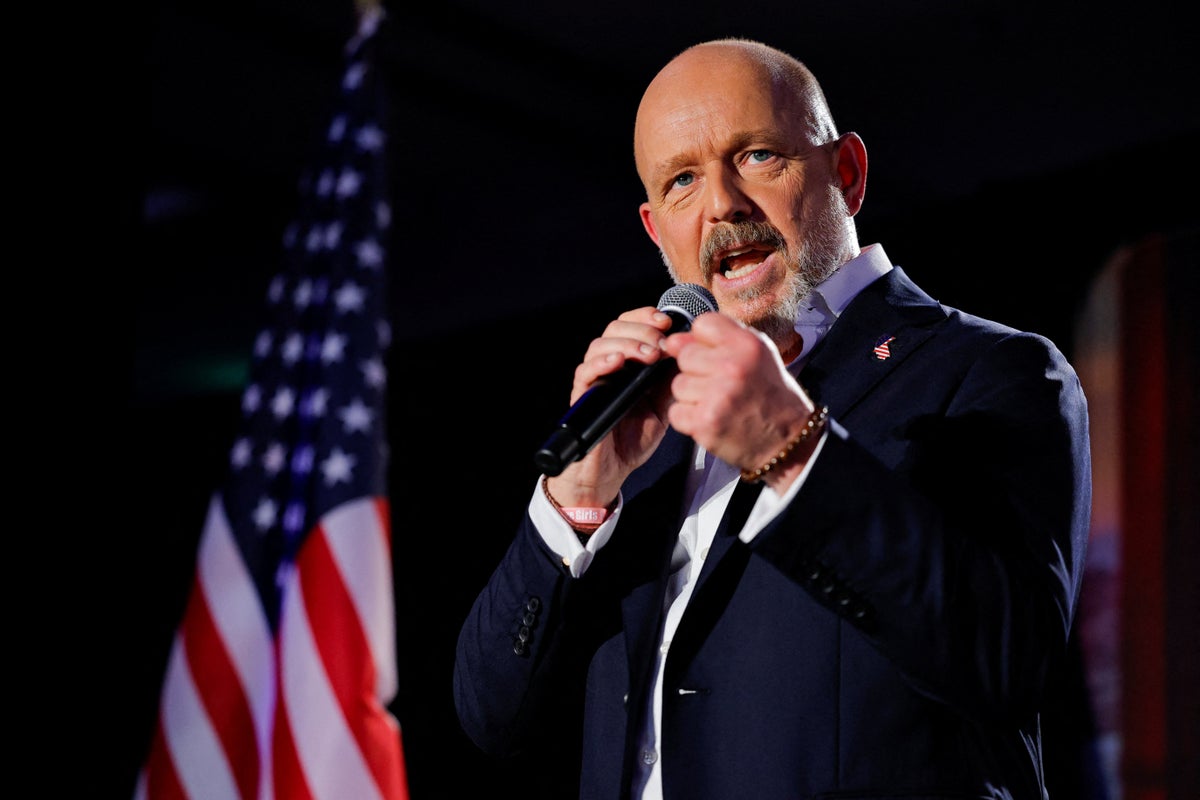
The results of the June 2, 2026, California gubernatorial primary establish a structural face-off that defies conventional partisan polling models. With more than half of the ballots tallied, Republican Steve Hilton, a former political strategist and television commentator, leads the field with 27.8 percent of the vote. Xavier Becerra, the former U.S. Secretary of Health and Human Services and California Attorney General, follows at 25.4 percent.
This outcome triggers the state’s nonpartisan top-two open primary mechanism, colloquially known as the jungle primary. By advancing the top two vote-getters regardless of party affiliation to the November general election, the system alters traditional general election dynamics. To analyze this trajectory, one must evaluate the structural math of the electorate, the financial efficiency of the campaigns, and the operational bottlenecks facing both candidates.
The Structural Mechanics of the Jungle Primary
The primary function of California's top-two system is to force a consolidation of divergent political factions early in the electoral cycle. In a standard closed primary, candidates optimize for the ideological extremes of their respective bases. In the open format, the optimal strategy shifts toward capturing plurality coalitions within a fractured field.
The 2026 field was highly fragmented. The Democratic vote split across multiple high-profile figures:
- Xavier Becerra: Maintained an institutional legacy, drawing on high name recognition from his tenure as state Attorney General and a federal cabinet official.
- Tom Steyer: Leveraged a self-funded, climate-focused capital injection, capturing 19.6 percent of the vote.
- Alternative Left Factions: Fractured further around secondary candidates such as San Jose Mayor Matt Mahan and former Representative Katie Porter, who failed to achieve the necessary threshold before acknowledging exit vectors on Tuesday night.
The Republican field experienced a cleaner consolidation. While Riverside County Sheriff Chad Bianco held localized support among law enforcement and inland conservative blocs, Hilton successfully nationalized his platform. Backed by an endorsement from Donald Trump and elevated by a media platform built during his tenure as a Fox News host, Hilton consolidated the state's baseline Republican electorate.
The baseline reality of California's voter registration acts as a rigid ceiling for this strategy. Democrats hold an approximate 20-point registration advantage statewide. For a Republican to advance to the top two, the math requires absolute consolidation of a disciplined minority turnout. For a Democrat to advance, the math requires survival through a war of attrition against well-funded intra-party rivals.
The Electoral Cost Function and Capital Efficiency
The efficiency of a campaign can be evaluated through a simple cost-per-vote metric. In this race, the efficiency curves of the top three candidates diverged sharply based on capital sourcing.
Candidate Capital Efficiency Matrix (Primary Phase)
-----------------------------------------------------------------------
Candidate       Capital Source       Audience Acquisition Strategy
-----------------------------------------------------------------------
Steve Hilton    Earned Media / PAC   Media amplification, national donor pool
Xavier Becerra  Institutional PACs   Union endorsements, historical state network
Tom Steyer      Self-Funded Retail   High-saturation digital/linear ad spend
Steyer’s campaign relied on massive capital deployment to buy market share. This strategy faces diminishing marginal returns in high-cost California media markets like Los Angeles and the San Francisco Bay Area. Because retail ad buyer saturation reaches a ceiling quickly, self-funded campaigns often exhibit poor capital efficiency per percentage point gained.
Conversely, Hilton operated on a high-efficiency earned media model. His background as a political commentator provided a pre-existing distribution channel. This structural advantage lowered his client acquisition cost for voters, allowing his campaign to preserve capital for the general election phase where broad-spectrum appeal is required.
Becerra relied on institutional capital. Major labor unions and established Democratic fundraising committees provided a baseline floor. The limitation of institutional capital is its rigidity; it is tied to specific turnout operations and traditional voter files, which struggle to capture independent or disaffected unaligned voters.
Structural Bottlenecks in the General Election
The general election shifts the game theoretical optimal position from factional consolidation to median voter capture. Both advancing candidates face distinct structural bottlenecks that limit their path to a 50 percent plus one majority.
The Hilton Ceiling: The Partisan Sorting Function
The primary challenge for Hilton is the absolute registration deficit. A Republican candidate has not won a statewide election in California since 2006. The sorting function of nationalized politics means that a significant portion of the electorate votes strictly on party lines in general elections, regardless of localized messaging.
To break through this ceiling, Hilton’s strategy relies on a economic disaffection framework. His platform targets the operational cost of living in the state, specifically highlighting housing supply constraints caused by project labor agreements and union-backed regulatory friction. By framing the election as a referendum on California's outward migration and affordability crisis, he attempts to decoupling local governance from national partisan identities.
However, the structural limitation of this strategy is his close alignment with national conservative figures. In a state that voted against the national Republican platform by roughly 20 points in consecutive cycles, that alignment acts as a powerful counter-mobilization trigger for the Democratic base.
The Becerra Floor: Institutional Inertia vs. Disaffection
Becerra’s challenge is not voter registration math, but enthusiasm and operational execution. As the institutional candidate, he inherits the legacy of the incumbent administration under Gavin Newsom. Any systemic friction within the state—such as persistent infrastructure delays, electrical grid instability, or localized inflationary pressures—is attributed directly to the governing party.
Becerra’s operational messaging centers on executive competence, frequently citing his 35 years in state and federal offices to argue that the state's massive bureaucracy requires a seasoned practitioner rather than an outsider. The vulnerability here is that "competence" is a defensive narrative. If independent voters prioritize systemic change over continuity, a message based entirely on institutional longevity loses its efficacy.
Strategic Playbook for the General Election Campaign
The general election phase will be won or lost in the suburban rings of the Central Valley, Orange County, and the Inland Empire. The deep-blue urban cores of Los Angeles and San Francisco will reliably deliver margins for the Democratic column, while rural northern and eastern counties will isolate for the Republican column.
The decisive variable is the allocation of the 19.6 percent of the electorate that voted for Tom Steyer, alongside the smaller tranches cleared from the field on Tuesday night.
The Recommendation for the Democratic Campaign
The campaign mustPivot immediately from institutional defense to a forward-looking economic stabilization narrative. Relying purely on anti-Trump counter-mobilization will yield lower turnout in an off-year cycle. The campaign must explicitly decouple its platform from corporate donor influences—addressing attacks leveled by Steyer during the primary regarding energy sector contributions—and focus heavily on a tangible cost-reduction framework for middle-class families.
The Recommendation for the Republican Campaign
The campaign must suppress the nationalized partisan rhetoric that served as a consolidation mechanism during the primary. The strategy must shift to a hyper-local, technocratic critique of state regulatory structures. Hilton must frame his platform not as a conservative ideological shift, but as a structural deregulation play designed to lower housing costs, optimize infrastructure spend, and return fiscal accountability to Sacramento.