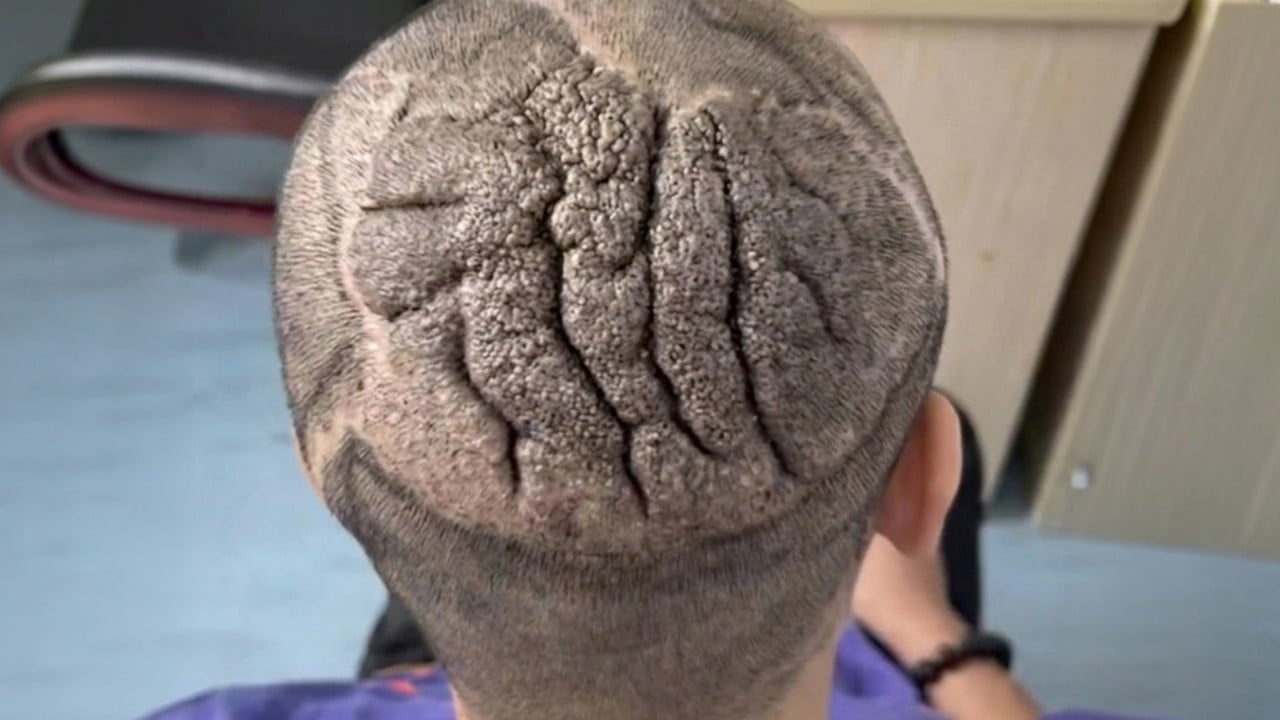
A rare medical anomaly recently captured public attention when a patient presented with severe scalp thickening that created deep folds resembling the gyri and sulci of the human brain. This condition, known medically as cutis verticis gyrata, turns standard dermatology on its head. It forces clinicians to look past routine presentation and confront a tangled web of structural tissue growth, genetic predisposition, and underlying systemic pathology.
Most people take the uniform texture of their scalp for granted. We wash it, brush it, and rarely consider the complex biomechanics holding it together. Cutis verticis gyrata shatters that assumption. The condition manifests as ridges and furrows on the scalp that cannot be flattened by pressure. To the untrained eye, it looks like a neurological map transposed onto the exterior of the skull.
Understanding why this happens requires moving past the shock value of the initial imagery. We have to examine the physiological architecture of the skin, the classification boundaries set by medical science, and the diagnostic failures that often delay proper treatment for years.
The Structural Breakdown of Gyrate Scalps
Cutis verticis gyrata is not a disease in its own right. It is a morphological description of a physical sign. The scalp thickens, the subcutaneous tissue expands, and excess skin has nowhere to go. Consequently, it bunches up into parallel folds that mimic the cerebral cortex.
Dermatologists divide the condition into two distinct categories. Primary essential cutis verticis gyrata occurs without any associated neurological or psychiatric abnormalities. Its exact cause remains shrouded in mystery, though researchers suspect a congenital developmental defect in the connective tissue of the scalp. Secondary cutis verticis gyrata tells a completely different story. It arises as a direct consequence of another disease process.
Secondary cases demand immediate investigative scrutiny. They are frequently linked to conditions like pachyderioperiostosis, an inherited disorder characterized by clubbed fingers, thickening of the skin, and excessive bone growth. Other times, the culprit is an underlying malignancy, acromegaly, amyloidosis, or inflammatory conditions like eczema and psoriasis that cause chronic tissue remodeling.
When a patient walks into a clinic with a deeply furrowed scalp, the primary task for the physician is not cosmetic management. It is a forensic hunt for systemic disease. Treating the superficial folds without investigating the endocrine system, the skeletal structure, or potential neoplastic growth is professional malpractice.
Diagnostic Traps and Clinical Oversight
The medical establishment often struggles with rare presentations. Because cutis verticis gyrata affects only a fraction of the population—disproportionately impacting males—general practitioners rarely encounter it during training.
Patients often spend decades visiting dermatologist after dermatologist, receiving misdiagnoses of severe dandruff, chronic dermatitis, or standard localized swelling. The physical manifestation is obvious, but the clinical interpretation lags behind. Biopsies are mandatory to rule out cerebriform intradermal nevi or other benign and malignant tumors that can mimic the condition.
Furthermore, the psychological toll on the patient is immense. The visual similarity between the scalp and the human brain invites stares, misunderstandings, and social isolation. Medical literature frequently focuses on the histology while ignoring the social reality of living with a head that looks like an anatomical specimen.
Clinicians must adopt a broader diagnostic checklist when evaluating scalp abnormalities. A thorough workup requires:
- Histopathological examination via deep tissue biopsy to analyze collagen bundles and cellular proliferation.
- Endocrine profiling to check growth hormone levels and thyroid function.
- Radiological imaging of the skull and long bones to rule out periostosis or underlying bone dysplasia.
- Neurological evaluation to ensure primary essential cases are truly isolated from central nervous system anomalies.
Surgical Reality Checks
When patients seek relief from primary cutis verticis gyrata, they usually want the folds gone. The medical response is rarely simple.
Topical treatments and non-invasive therapies fail entirely. The excess tissue is structural. It requires mechanical reduction. Surgical excision remains the gold standard for severe cases, but it is a delicate endeavor. The scalp is remarkably vascular. Operating on a heavily folded scalp risks massive blood loss, nerve damage, and severe scarring that can leave the patient with permanent alopecia.
Surgeons often use tissue expanders or staged excisions to remove the redundant skin over time. In some instances, hair transplantation is required afterward to restore a natural hairline. It is a grueling, multi-step surgical journey with no guarantees of a pristine cosmetic outcome.
Physicians must manage patient expectations ruthlessly. The goal of surgery is functional improvement and reduction of hygiene risks—deep folds can trap sweat, sebum, and bacteria, leading to chronic infections and foul odors—rather than absolute aesthetic perfection.
The Broader Lesson of Rare Anomalies
Cases involving extreme anatomical variants like brain-like scalps do more than satisfy morbid curiosity. They expose the limits of current medical classification and the gaps in rare disease research.
When a body part grows into the shape of an entirely different organ system, it reminds us how much we still do not understand about human morphogenesis. The signaling pathways that tell skin to fold, bone to thicken, and tissue to expand out of proportion are complex and fragile.
Cutis verticis gyrata forces a confrontation with the unexpected. It demands meticulous investigation, skeptical clinical observation, and a refusal to settle for comfortable, surface-level diagnoses.
The scalp is just skin and bone. Until it decides to build its own landscape.