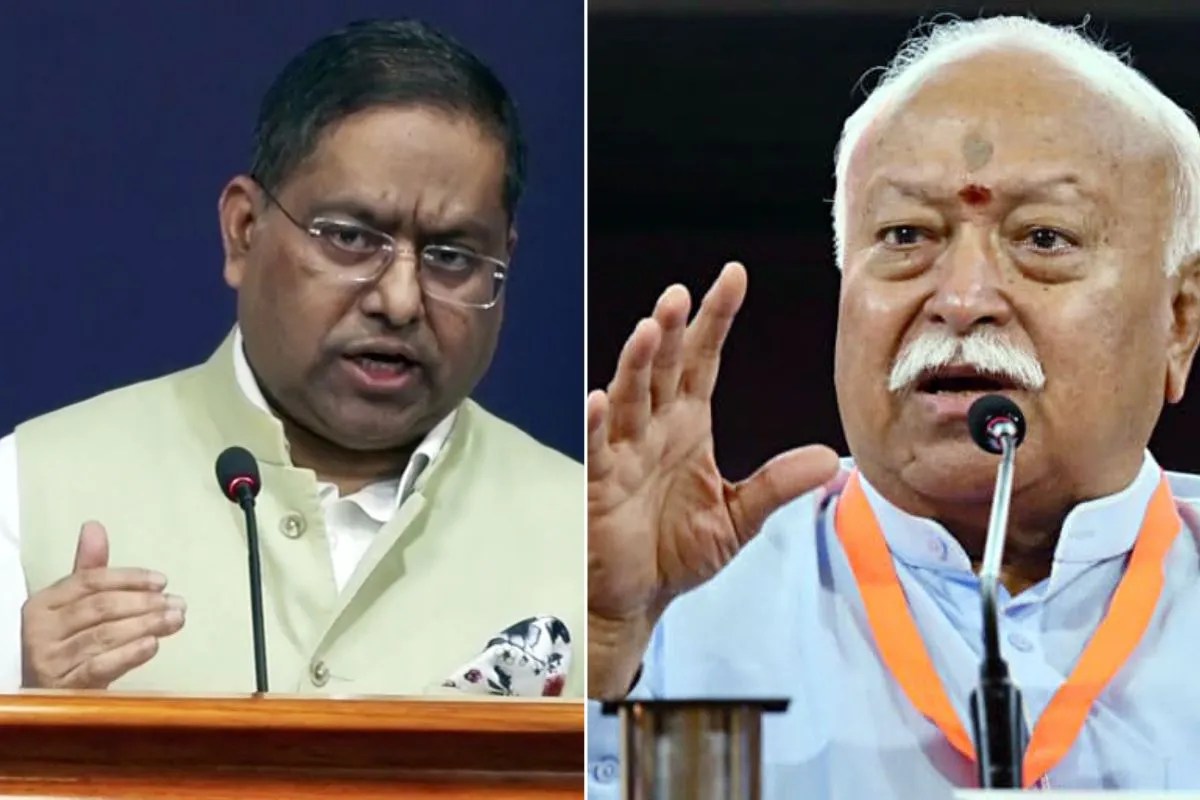
India has forcefully rejected recommendations from the United States Commission on International Religious Freedom (USCIRF) urging targeted sanctions and travel restrictions against the Rashtriya Swayamsevak Sangh (RSS), dismissing the federal watchdog as a biased entity operating with a distinct political agenda. Ministry of External Affairs spokesperson Randhir Jaiswal addressed the recurring friction during a media briefing, stating that the American panel lacks basic credibility due to its history of issuing inflammatory and disparaging assessments regarding domestic Indian affairs. This escalation underscores a widening chasm between Washington's statutory human rights monitoring mechanisms and New Delhi's rigid defense of national sovereignty.
To understand why this diplomatic row carries weight, one must examine the structural friction points between foreign advisory boards and sovereign states. The USCIRF functions as an independent, bipartisan federal commission established by the 1998 International Religious Freedom Act. Its mandate requires monitoring global adherence to religious freedoms and offering policy prescriptions to the White House and Congress. Yet, its reports are advisory rather than binding, occupying an awkward space between official executive branch foreign policy and domestic American political advocacy. When the commission targets ideological pillars like the RSS—an expansive socio-cultural movement with deep organizational ties to India's ruling political establishment—the friction transcends ordinary bureaucratic disagreement. It touches the core of how external actors evaluate internal governance in the world's largest democracy.
The timing of the latest confrontation is hardly coincidental. Tensions spiked following public statements from commission leadership criticizing an upcoming visit to New York by RSS chief Mohan Bhagwat, coupled with sweeping demands for asset freezes and visa bans against specific Indian entities. New Delhi views these maneuvers as an unwarranted intrusion into domestic politics, pointing out that foreign bodies routinely apply Western standards out of context to societies undergoing complex socio-political transformations.
Consider a hypothetical scenario to illustrate this structural disconnect: Imagine a foreign legislative panel issuing continuous compliance mandates on domestic labor policies within another sovereign nation without accounting for local legal frameworks or grassroots realities. The affected government naturally perceives the exercise not as a good-faith audit, but as a pressure tactic designed to influence internal politics.
This dynamic highlights the limits of moral diplomacy in a multipolar world. While human rights advocacy groups argue that transnational scrutiny ensures accountability, major powers like India possess the economic and geopolitical leverage to simply disregard recommendations they find politically motivated.
The standoff exposes a fundamental dilemma for bilateral relations. Washington values New Delhi as a vital strategic counterweight in the Indo-Pacific, yet its legislative architecture houses autonomous watchdogs whose outputs frequently complicate executive-level diplomacy. As long as these institutional mandates continue to overlap with domestic political sensitivities, friction will remain a permanent fixture of the diplomatic landscape.
India Rejects USCIRF Call For Sanctions On RSS | MEA Hits Back At 'Biased' Report
This video provides a direct look at the official Ministry of External Affairs response regarding the contentious recommendations.