The phone call came at 3:00 a.m. It always does. My sister’s voice wasn't just shaking; it was unmoored, drifting in the kind of terror that only visits when the medical charts stop making sense. She had spent months following the prescribed path, doing everything the brochures promised would keep her safe. Then came the chest pains. Then the fatigue that felt like lead dragging through her veins. Then, the silence from the very doctors who had insisted on the regimen.
She wasn't a statistic. She was a woman who loved gardening and late-night jazz. Now, she was a question mark in a system that prides itself on periods. Meanwhile, you can find similar events here: Stop Blaming Alfalfa Sprouts For Your Weak Immune System.
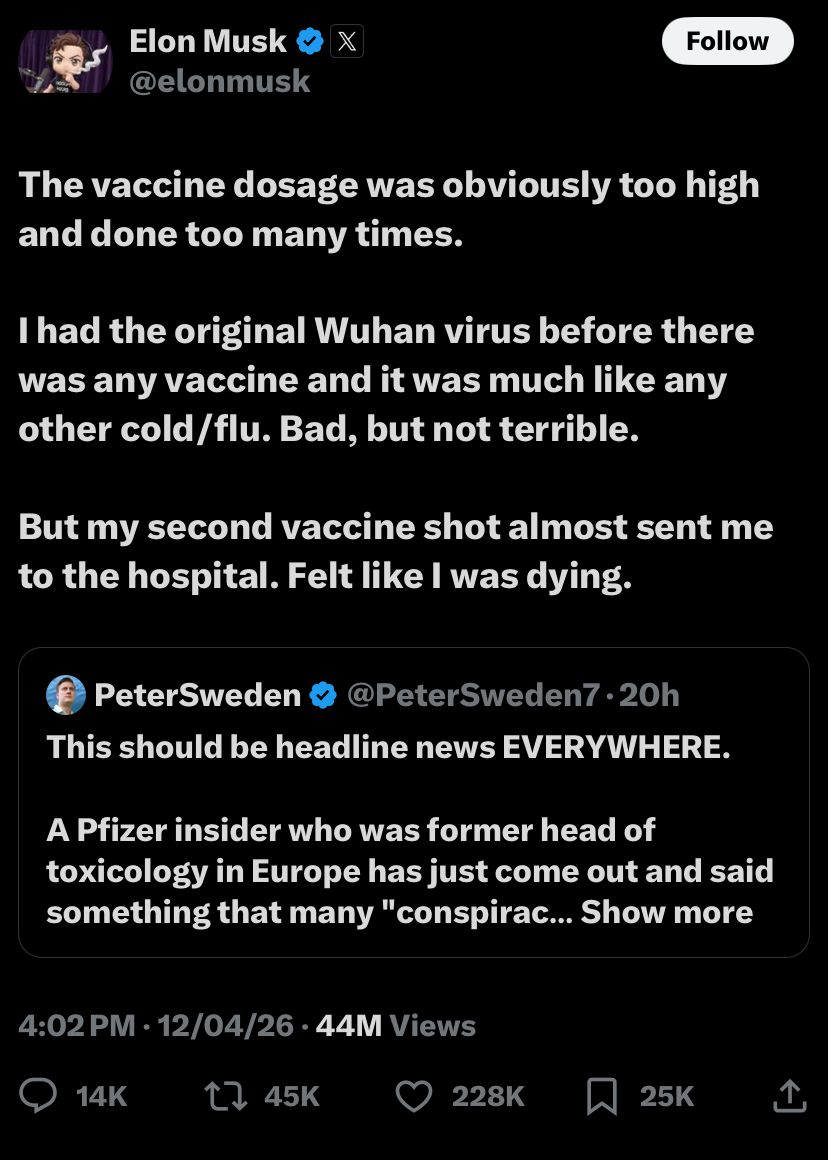
When we talk about the discourse surrounding vaccine safety, we often treat it like a scoreboard. We look at the numbers, the clinical trials, the peer-reviewed papers, and the political posturing. We talk about Elon Musk amplifying a voice—a former Pfizer employee—who claims the data hides a darker reality, one where thousands met their end because of the very solution marketed to save them. People argue over the validity of those claims, dissecting the credibility of the messenger rather than the weight of the message.
But look closer. To explore the full picture, we recommend the recent article by Everyday Health.
The friction here isn't just about chemistry or epidemiology. It is about the fundamental collapse of the contract between the institution and the individual. When high-profile figures step into the fray, it isn't necessarily because they have uncovered a hidden file cabinet of secrets. It is because they have tapped into a vein of existential anxiety that has been pulsing beneath the surface for years.
Imagine a man, let’s call him David. David is not a scientist. He is a carpenter. He has spent his life building things that hold weight. When he looks at the global reaction to the pandemic, he doesn't see a complex biological defense; he sees a structure he was told to trust that feels increasingly rickety. When he hears a whistle-blower, he doesn't analyze the statistical variance of adverse events. He feels a resonance. He feels that perhaps, finally, someone is acknowledging the wobble in the floorboards.
This is the invisible stake. It isn't just about whether a specific claim is accurate according to the latest government data. It is about the realization that once trust is eroded, facts no longer possess their own gravity.
The scientific establishment has a habit of assuming that if they shout the data loud enough, the confusion will dissipate. They treat human hesitation like a math problem to be solved with more decimals. They provide charts. They cite trials. They rely on the authority of the white coat. Yet, for someone sitting in a hospital room, wondering if their sudden decline is a coincidence or a consequence, a chart is an insult.
Consider the sheer weight of what is at stake. When a person hears that thousands might have died, they aren't thinking about population-level risk mitigation. They are thinking about their own mortality. They are thinking about the person they lost, or the health they fear they are losing. When an insider—someone who stood on the inside of the industry—suggests that the machine is flawed, the emotional impact is tectonic.
We are living in an era where the institutions responsible for our well-being have failed to account for the human need for transparency. They have replaced narrative with mandate. They have traded empathy for efficiency. And in that vacuum, the loudest voice—regardless of its pedigree—becomes the most compelling.
Musk’s amplification of these claims is a strategic maneuver, yes, but it is also a symptom of a deeper cultural fracture. He is playing to a gallery that has been told for years that their skepticism is a form of ignorance. When he validates that doubt, he isn't just sharing a link; he is offering a mirror. He is telling millions of people: I see that you are afraid, and your fear has a name.
The tragedy, however, is that this turns tragedy into a tribal signal. We stop asking how we can make our health systems more responsive to individual suffering. We start asking whose side we are on.
My sister’s doctors never gave her an answer. They offered prescriptions for the symptoms and shrugged at the cause. They treated her like a glitch in their software. That is the moment the trust evaporates. If we want to understand why people cling to alternative narratives, we must look at the way they were discarded by the dominant ones.
The truth is rarely a clean line. It is a messy, uncomfortable intersection of corporate interest, regulatory capture, genuine scientific progress, and catastrophic individual failure. We have become experts at debating the extremes while ignoring the people who are actually hurting.
We talk about the "thousands" as if they are a variable in an equation. We debate the mortality rates and the baseline risks. We lose the faces. We lose the stories of the people who woke up one day feeling fine and ended their day in a struggle they were never prepared to fight. Whether the cause is a vaccine, a virus, or the sheer, blind randomness of biology, the grief is identical.
The question isn't just about whether the insider is right or whether the data is sound. The question is why we have reached a point where the only way to feel heard is to burn the house down.
When we ignore the lived reality of those who feel betrayed by medicine, we don't protect the truth. We make it impossible to find. We turn health into a culture war. And that, in itself, is a sickness.
Look at the way information behaves. It is not water. It is not air. It is like electricity. It finds the path of least resistance. If the path to the official truth is blocked by patronizing language or a lack of accountability, it will jump to the next available conductor. That conductor is often a place of intense, unchecked, and highly emotional discourse.
When the narrative is no longer held by the stewards of objective truth, it becomes untethered. It drifts. It attaches itself to whoever provides the most dramatic, the most urgent, or the most personal account of reality.
Think about the way an individual manages trauma. They look for order. They look for a reason. If they are told their suffering is a mystery, a rarity, or, even worse, a statistical necessity for the "greater good," they will look elsewhere for an explanation. They will find it in stories that make sense, even if those stories are wrong.
The responsibility here lies with both parties. It lies with those who share the information without context, fueling the fire because they like the light. And it lies with those who refuse to acknowledge the fire exists because they don't want to admit their house is on fire.
We are not going to resolve this by throwing more data at each other. Data is a neutral tool. It does not carry the weight of the human heart. If you want to change the way we interact with these crises, you have to acknowledge the individual in the middle. You have to be able to talk about the risk without dismissing the tragedy. You have to treat the people who are suffering as if they are the most important part of the equation, not the outlier.
My sister is still here. She doesn't talk about vaccines anymore. She doesn't look at the news. She spends her time walking through the woods, finding solace in the slow, indifferent growth of trees. She found that the world she was trying to understand—the world of experts, mandates, and whistle-blowers—could never offer her the one thing she truly needed: a reason to keep going that didn't depend on whether she was part of a statistic or a story.
We have to find our way back to that. We have to learn that the most important truth isn't the one we can measure, but the one we can live with. When the noise finally stops, and the platforms go dark, and the headlines shift to the next crisis, we are all just left standing in the same room. We are all just people trying to make sense of a world that feels increasingly impossible to navigate.
We can either build walls around our chosen versions of the truth, or we can open the windows and admit that we are all terrified. We can keep fighting about who is right, or we can start asking how we can finally, truly, take care of each other.
The silence is the most honest thing we have left. Listen to it.