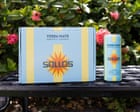
Launching a premium consumer packaged goods (CPG) brand requires solving a multi-variable optimization problem involving production unit economics, distribution access, and authentic brand equity. When political scions attempt to convert generic fame into retail market share, they often fail to align these variables. The recent market entries of Sollos Yerba Mate, co-founded by Barron Trump, and the Accelerator energy drink collaboration with Kai Trump provide a clear case study in how misaligned value propositions undermine high-premium pricing models.
A critical review of these products reveals a core structural flaw: both brands rely on an unsustainable arbitrage between political celebrity and functional beverage economics. Instead of building products that satisfy the core utility demands of the functional beverage market—taste optimization, ingredient clean-labeling, and competitive pricing—these ventures treat the product as secondary to the narrative.
The Unit Economics of the Premium CPG Bottleneck
Sollos Yerba Mate entered the market with a direct-to-consumer (DTC) price point of $39 for a 12-pack, which translates to $3.25 per 12-ounce can before shipping and handling. This pricing structure places the product firmly within the hyper-premium tier of the functional beverage sector, significantly higher than established competitors like Guayaki or Clean Cause, which typically trade between $2.20 and $2.65 per unit at retail.
The cost function of a startup beverage brand contains three fixed realities:
- Co-Packing Minimum Order Quantities (MOQs): Small-batch manufacturing incurs disproportionately high per-unit packaging and canning costs. Sollos raised an initial $1 million through a private placement, a capital injection that limits their initial production runs and prevents them from achieving the economies of scale necessary to compress gross margins.
- Logistical Drag: Shipping liquid via DTC models is notoriously inefficient. Water weight drives up fulfillment costs, meaning a $3.25 per-can price tag must absorb substantial shipping overhead unless offset by retail distribution partnerships.
- Ingredient Premiumization: Utilizing USDA Organic certified yerba mate increases raw material costs by an estimated 25% to 40% compared to conventional synthetic caffeine bases.
By optimizing for a singular flavor profile (Pineapple + Coconut) over a year of development, the brand attempted to reduce formulation risk. However, restricting a market launch to a single flavor profile creates a critical bottleneck in inventory turnover. If the initial flavor profile fails to achieve broad consumer acceptance, the brand lacks secondary SKUs to stabilize revenue.
The Narrative Deficit and Brand Disconnection
The secondary flaw in the market entry strategy is the dissonance between the brand narrative and the actual product utility. Sollos positions itself as a "lifestyle beverage brand built around clean and functional ingredients," specifically targeting the South Florida outdoor aesthetic.
The underlying logic of this positioning breaks down upon analyzing the core target demographic. Traditional yerba mate consumers prioritize functional wellness, sustained energy curves via natural theobromine and L-theanine, and minimal environmental impact. Merging this specific consumer profile with a highly polarized political brand creates an immediate ceiling on customer acquisition.
[Brand Equity Alignment Matrix]
High Polarization + Wellness Messaging = Target Audience Fragmentation
High Premium Pricing + Lack of Flavor Variety = Low Repeat Purchase Rate
The consumer feedback loop highlighted by initial product testers points to an operational failure in formulation. Descriptions of the beverage tasting or smelling like synthetic suncream suggest a failure to balance the naturally earthy, bitter notes of yerba mate with the volatile flavor compounds of coconut and pineapple. Masking the natural astringency of herbal tea without using artificial sweeteners requires complex acid-and-ester balancing. When a premium product fails the basic sensory test, customer lifetime value (LTV) collapses, leaving the brand entirely dependent on expensive, non-repeating first-time purchases.
Distribution Architecture and the Accelerator Analogy
The strategic alternative to launching an independent DTC brand is the licensing or co-branding model, exemplified by Kai Trump’s partnership with Accelerator. This approach bypasses the capital-intensive infrastructure of manufacturing and logistics, embedding the creator directly into an existing distribution matrix.
Accelerator avoids the small-scale manufacturing trap by operating on an established corporate footprint. This product delivers a high-stimulant utility function: 200mg of caffeine per can, targeted squarely at the performance energy segment.
Yet, this model introduces its own strategic friction points:
- Demographic Mismatch: The drink carries an explicit warning indicating it is not recommended for individuals under 18 years of age. Utilizing a 19-year-old creator whose primary cultural footprint sits with Gen Z and younger demographics creates a fundamental conflict between influencer reach and product compliance.
- Commoditization of Flavor: Launching a "Blue Raz Slush" flavor positions the product in direct competition with massive, entrenched players like Ghost, C4, and Celsius. These legacy brands possess deeply entrenched slotting fees in big-box retail and convenience networks.
- The Chemical Finish Dilemma: High-caffeine formulations (200mg+) that contain zero sugar rely heavily on artificial sweeteners like sucralose and acesulfame potassium to mask the bitter taste of pure anhydrous caffeine. This creates a distinct chemical aftertaste that alienates consumers looking for clean or premium taste profiles.
Strategic Realignment Plan
To prevent capital depletion within the next twelve to eighteen months, both entities must transition away from relying on novelty purchases driven by political fame and pivot toward objective market metrics.
Sollos must immediately diversify its flavor portfolio to include at least one traditional, low-acid SKU (such as Mint or Lemon-Mint) to lower the barrier to repeat consumption. Concurrently, the operation must transition from a pure DTC model to localized, high-density placement in South Florida boutique grocers and convenience stores to eliminate the margin-killing drag of direct-to-consumer liquid shipping.
For the Accelerator partnership, the brand must recalibrate its marketing assets away from the personality of the creator and toward the measurable functional benefits of the product itself, such as metabolic acceleration or zero-sugar endurance. If the product continues to be marketed primarily as an extension of a polarizing family name, it will remain trapped in a niche novelty ecosystem, unable to scale into a mainstream retail staple.