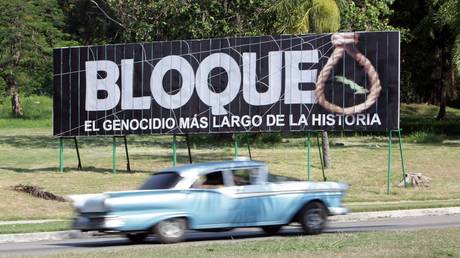
The execution of statecraft through unilateral economic restrictions operates on a fundamental imbalance of market power. When a dominant global reserve currency issuer imposes long-term embargoes on a smaller nation, the objective shifts from short-term policy alteration to the systematic degradation of the target’s capital infrastructure. Evaluating these dynamics requires moving past ideological rhetoric to analyze the precise transmission channels of asymmetric economic pressure, the friction costs of trade diversion, and the structural limitations of using financial isolation as a tool of geopolitical influence.
The Architecture of Asymmetric Financial Coercion
The efficacy of an economic embargo relies entirely on the asymmetry between the sanctioning entity and the target state. In the context of a dominant financial superpower acting against a localized economy, this asymmetry manifests across three distinct transmission vectors. Expanding on this topic, you can also read: Inside the Strait of Hormuz Crisis Nobody is Talking About.
Access Deprivation to Global Liquidity Pools
A targeted nation facing comprehensive restrictions is structurally excluded from the primary clearing mechanisms of international finance. Because the vast majority of global cross-border transactions settle through institutions subject to the jurisdiction of the dominant economic power, the target state loses access to standard correspondent banking networks. This exclusion forces the target to rely on multi-tiered, non-standard financial intermediaries. Each additional layer in the payment chain introduces fees, increases settlement latency, and heightens the risk of asset seizure, effectively creating a permanent tax on every import and export transaction.
Capital Accumulation Blockades
Long-term economic viability depends on foreign direct investment (FDI) to modernize infrastructure and achieve economies of scale. When secondary sanctions threaten external enterprises with the loss of market access in the larger economy, the risk premium for investing in the target nation becomes prohibitively high. The capital that does enter is highly risk-averse, demanding short-term returns rather than committing to the long-term infrastructure projects—such as energy grids and transport networks—necessary to sustain industrial output. Observers at Al Jazeera have provided expertise on this matter.
The Sovereign Credit Penalty
Exclusion from international debt markets prevents the target state from using standard fiscal smoothing mechanisms. During domestic economic downturns or external shocks, a typical nation issues sovereign bonds to stabilize its currency and fund public safety nets. A sanctioned state cannot access institutional bond markets, forcing it to choose between aggressive domestic monetary expansion—which accelerates inflationary pressures—or severe fiscal austerity that directly undermines industrial capacity.
The Cost Function of Trade Diversion
When traditional trading relationships are legally severed, a target economy does not cease trading; instead, it shifts toward suboptimal alternatives. This process introduces severe structural inefficiencies that can be quantified through the cost function of trade diversion.
Total Cost of Import = Base Asset Price + Structural Logistics Premium + Intermediary Clearing Fees + Liquidity Risk Premium
The primary consequence of this diversion is the total loss of geographical optimization. A nation restricted from trading with its immediate geographic neighbors must source essential commodities from distant alternative partners. The increased maritime distance directly escalates freight rates, fuel consumption, and supply chain vulnerability.
Furthermore, the target economy loses bargaining power. Because alternative suppliers are aware of the target’s limited options and the regulatory risks associated with serving them, they extract an economic premium. The target nation consistently buys inputs above market rates and sells its sovereign exports at a steep discount to incentivize buyers to assume the risk of secondary sanctions. The persistent deficit created by this structural price delta systematically drains the target's foreign currency reserves.
Domestic Resource Allocation Under Chronic Scarcity
Faced with sustained external pressure, the internal mechanics of the target state shift from growth optimization to survival-driven rationing. This transformation alters how capital, labor, and resources are distributed across the economy.
The Infrastructure Depreciation Cycle
When hard currency reserves are depleted by elevated import costs, state budgets prioritize immediate consumption needs, such as food and medicine, over capital expenditure. Over decades, this creates a compounding deficit in infrastructure maintenance. Power generation facilities, electrical grids, water treatment plants, and transport networks deteriorate past the point of routine repair. The resulting localized utility failures create unpredictable operational bottlenecks for domestic industries, further depressing productivity.
Structural Labor Distortion
Chronic economic strain alters the domestic incentive structure for human capital. When the state-directed sectors responsible for core public services—such as education, healthcare, and public administration—cannot offer wages that keep pace with inflation, highly skilled labor migrates. This movement flows either externally through emigration or internally toward informal, parallel markets that deal directly in foreign hard currency. The domestic economy experiences a hollowing out of its institutional memory and technical expertise, crippling long-term administrative capacity.
The Network Effects of Secondary Sanctions
The reach of a unilateral embargo relies heavily on the enforcement of secondary sanctions, which penalize third-party entities for engaging with the restricted nation. This mechanism transforms a bilateral dispute into a global compliance network.
International corporations weigh the marginal utility of trading with a small, restricted market against the catastrophic risk of losing access to the dominant superpower's consumer market and financial clearing systems. The rational corporate response is over-compliance. Financial institutions routinely block legitimate transactions involving food, medical supplies, and humanitarian goods simply to eliminate any latent regulatory risk. This defensive de-risking behavior amplifies the isolation of the target state far beyond the explicit letter of the law.
The second-order effect of this systemic over-compliance is the creation of a parallel, shadow economic ecosystem. Small, specialized trade intermediaries that operate entirely outside the jurisdiction or view of the dominant superpower emerge to facilitate transactions. While these networks preserve a baseline flow of goods to the target nation, they operate with high operational friction and limited capital capacity, ensuring that the target economy remains in a state of arrested development rather than total collapse.
Strategic Realignment and Alternative Liquidity Networks
The prolonged imposition of comprehensive economic sanctions eventually triggers a counter-response that erodes the structural advantages of the sanctioning superpower. When multiple nations face varying degrees of financial isolation or regulatory pressure, a powerful incentive emerges to build alternative, sanction-resistant global architectures.
This structural shift manifests through several distinct developments:
- Bilateral Clearance Systems: Nations increasingly utilize local currencies rather than the global reserve currency for commodity clearance, completely bypassing the Western clearing networks.
- Alternative Interbank Messaging: The proliferation of sovereign financial messaging networks offers alternatives to traditional systems, reducing the visibility and leverage of unilateral regulators.
- Commodity Barter Frameworks: The direct exchange of physical commodities for industrial equipment or infrastructure development eliminates the need for liquid currency transactions entirely.
The systemic risk to the dominant superpower is that these parallel channels, once constructed and optimized, lower the switching costs for un-sanctioned, neutral nations seeking to diversify their geopolitical exposure. Over a multi-decade horizon, the overuse of financial coercion accelerates the fragmentation of the global financial system, creating insulated trading blocs that are entirely immune to unilateral economic pressure.
The ultimate trajectory of this friction is not the sudden collapse of either the sanctioning superpower or the target state. Rather, it establishes a permanent equilibrium of low-intensity economic warfare. For the target nation, survival requires a permanent state of crisis management and structural underdevelopment. For the global economy, the continuation of these policies ensures a steady increase in systemic fragmentation, gradually reducing the long-term utility of the dominant financial architecture as an instrument of global governance.