Universal jurisdiction and specialized domestic tribunals are rapidly displacing gridlocked international bodies as the primary venues for legal accountability in modern asymmetric warfare. When the International Criminal Court (ICC) faces systemic enforcement bottlenecks and geopolitical vetoes, municipal legal systems with extraterritorial mandates become the default recourse. The filing of a criminal complaint with constitution de partie civile in the French judicial system by international civil society organizations and a Franco-Lebanese national illustrates this shift. This mechanism relies on strict statutory links—specifically, the dual nationality of a victim or complainant—to anchor French jurisdiction over actions occurring entirely outside its sovereign borders.
The Jurisdictional Architecture: Active and Passive Personality Links
Domestic prosecution of international crimes requires a precise statutory hook to overcome the presumption against extraterritoriality. French criminal procedure operates under specific jurisdictional matrices defined by the Code de procédure pénale. You might also find this similar story useful: The Anatomy of Xenophobic Mobilization: Economic Scarcity and Structural Failure in South Africa.
- The Passive Personality Principle: Under Article 113-7 of the French Criminal Code, French criminal law applies to any felony, and under certain conditions to misdemeanors, committed by a foreigner outside the territory of the Republic when the victim is of French nationality at the time of the offense.
- The Competence of the Pôle Crimes Contre l'Humanité: The specialized unit within the Paris Judicial Tribunal possesses centralized jurisdiction over war crimes, crimes against humanity, and genocide. This framework bypasses the diplomatic immunity constraints that frequently paralyze standard diplomatic channels.
The strategic choice of filing a complaint with a constitution de partie civile forces the appointment of an independent investigative judge (juge d'instruction). Unlike a standard complaint filed with a public prosecutor—which can be dismissed at the prosecutor's discretion based on diplomatic or political expedience—a partie civile filing legally compels the initiation of an independent judicial investigation, provided the complainant can demonstrate direct personal injury resulting from the alleged infraction.
Evidentiary Reconstitution and Digital Forensics: Shifting the Burden of Proof
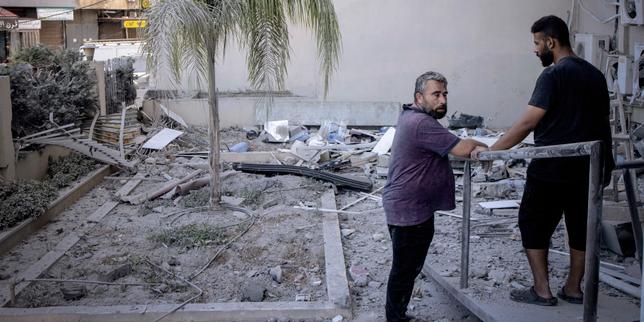
Prosecuting kinetic actions in active conflict zones requires a transition from traditional eyewitness testimony to verifiable, high-density digital data. The reliance on remote open-source intelligence (OSINT) and 3D architectural modeling replaces the necessity of immediate physical access to the blast site. As extensively documented in recent reports by USA Today, the results are notable.
The evidentiary framework utilizes a three-tiered verification methodology:
- Spatial Analysis: Satellite imagery analysis establishes pre-strike and post-strike geometry, determining the exact vector, angle of entry, and kinetic yield of the ordnance used.
- Chronological Mapping: Synchronizing localized mobile phone footage, broadcast feeds, and digital metadata fixes the timestamp of the strike down to the second, matching it against publicly declared military operations.
- Digital Structural Reconstitution: Organizations like Forensic Architecture utilize spatial computing to rebuild the targeted civilian structure digitally. This allows investigators to trace the path of destruction through concrete and steel, proving whether the strike target was a specific point within a building or the structural integrity of the entire civilian asset.
This digital matrix addresses the primary defense vector used by state actors: the claim of a legitimate military target within a civilian area. By mapping the precise trajectory and blast radius, the digital reconstruction can isolate the kinetic effect, demonstrating whether the attack conformed to the technical requirements of precision targeting or constituted an indiscriminate strike.
The Legal Mechanics of International Humanitarian Law: Distinction and Proportionality
The legal substance of the complaint rests on explicit violations of International Humanitarian Law (IHL), specifically codified within the French Criminal Code under Article 461-1 onwards. The prosecution must satisfy two distinct structural tests to establish a war crime in the context of an urban aerial bombardment.
The Principle of Distinction
The military commander must distinguish at all times between civilian objects and military objectives. Article 461-12 of the French Criminal Code criminalizes the act of intentionally directing attacks against civilian objects. To counter the inevitable defense that a civilian building housed operational adversary infrastructure, the evidentiary brief must demonstrate a systemic absence of military activity or personnel at the specific coordinates during the temporal window of the strike.
The Proportionality Matrix
If a state actor establishes the presence of a legitimate military objective, the analysis shifts to the proportionality equation. This calculation balances the anticipated concrete and direct military advantage against the incidental loss of civilian life, injury to civilians, or damage to civilian objects.
The legal bottleneck for state defenses lies in the asymmetric scale of destruction. When a precision-guided munition completely levels a multi-story residential building to eliminate a single low-level asset, the anticipated military advantage fails the proportionality test under customary international law. The structural prose of the complaint converts these battlefield realities into distinct counts of criminal negligence or deliberate intent under domestic statutes.
Operational Risks for Foreign Military Command Structures
The real-world utility of filing these actions in French courts extends beyond symbolic accountability. The issuance of an international arrest warrant (mandat d'arrêt international) by a French investigative judge carries immediate operational consequences for the targeted state's military and political apparatus.
- Schengen Area Travel Restrictions: An active Interpol Red Notice or a European Arrest Warrant triggered by a French judge effectively bars the targeted individuals from entering 29 European nations without facing immediate detention and extradition proceedings.
- Command Chain Exposure: The scope of a French judicial inquiry is not restricted to the low-level operators who executed the strike. Under the doctrine of command responsibility, codified in French law, superior officers and high-level decision-makers who knew or should have known that their subordinates were committing crimes, and failed to take necessary measures to prevent them, face direct exposure to prosecution.
This dynamic alters the risk calculus for military planning branches. The potential for lifetime travel restrictions and international isolation introduces a tangible cost-function into the execution of urban kinetic campaigns, forcing legal advisors within foreign militaries to exercise greater oversight over targeting methodologies.
Strategic Forecast: The Decentralization of Accountability
The institutional gridlock within the United Nations Security Council ensures that international ad hoc tribunals are structurally incapable of addressing contemporary state-sponsored violence uniformly. Consequently, the decentralization of international criminal law into specialized domestic courts represents the future trajectory of strategic litigation.
Future legal actions will likely mimic this blueprint, leveraging dual nationals across Western jurisdictions—including Germany, Sweden, and the Netherlands—where universal jurisdiction laws are robustly integrated into domestic criminal codes. As digital forensics achieve higher levels of fidelity and judicial recognition, the gap between spatial documentation and legal enforcement will continue to compress. The strategic play for civil society organizations is now the systematic documentation of kinetic strikes involving dual-national casualties, establishing a matrix of domestic legal vulnerabilities that state actors can no longer ignore through diplomatic maneuvering.