The fatal ground collision of two helicopters during simultaneous landing operations in Nepal demonstrates a structural failure in high-altitude airspace management, visual flight rule protocols, and ground-marshaling infrastructure. When two rotorcraft converge on a single landing zone—resulting in one fatality and catastrophic airframe loss—the event is rarely an isolated error of pilotage. It is the predictable output of an operational environment where commercial demand outpaces air traffic control modernization, and where physics compresses the margin for human error to zero.
Understanding how two aircraft occupy the same three-dimensional space during the terminal phase of flight requires stripping away sensationalism and examining the mechanics of rotorcraft aerodynamics, visual blind spots, and the regulatory vacuum governing remote helipads across the Himalayas.
The Physics and Geometry of Terminal Phase Convergence
Helicopter operations in mountainous terrain operate under severe aerodynamic and spatial constraints. Unlike fixed-wing aircraft, which follow rigid, predictable glideslopes onto long runways, helicopters execute steep, variable approaches into confined landing zones (LZs). In Nepal—particularly along high-traffic corridors serving Everest, Annapurna, and remote religious or commercial hubs—these LZs are frequently unimproved dirt pads, ridge-line clearings, or crowded aprons at regional airports like Lukla or Kathmandu.
The terminal phase of a helicopter landing involves a transition from translational lift to hover. During this deceleration, the pilot’s workload spikes while visibility degrades.
- The Rotor Disc Blind Spot: In almost all light utility helicopters operating in Nepal (such as the Airbus H125/AS350 or Bell 407 series), the main rotor system sits directly above the cabin. When banking or flaring to bleed off airspeed prior to touchdown, the fuselage tilts upward, obstructing the pilot’s forward-below field of view. Simultaneously, an aircraft descending from a higher altitude into the same approach corridor remains completely hidden above the lower aircraft's cabin roof.
- Downwash and Brownout Dynamics: As the first helicopter enters ground effect—typically within one rotor diameter of the surface—its main rotor accelerates air downward, generating intense localized turbulence. In unpaved Himalayan LZs, this immediately kicks up dust, gravel, or snow, creating brownout or whiteout conditions. A second aircraft trailing closely behind loses visual reference to both the ground and the preceding airframe precisely when spatial precision is required.
- Vortex Ring State (VRS) Avoidance: Pilots descending at high density altitudes must carefully manage their rate of descent to avoid settling with power. Because thin air reduces rotor efficiency, pilots often execute shallow, fast approaches to maintain translational lift until the last possible second. This leaves minimal kinetic or spatial buffer to execute a sudden wave-off if another aircraft encroaches on the pad.
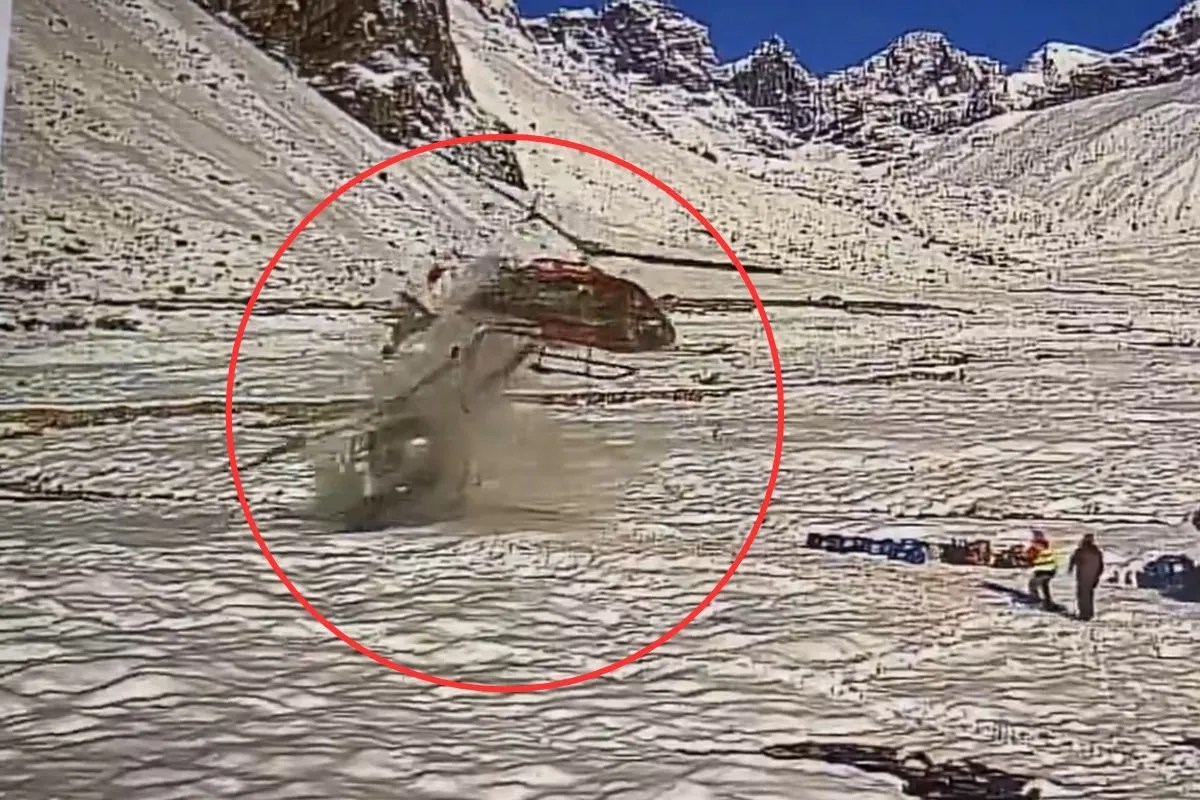
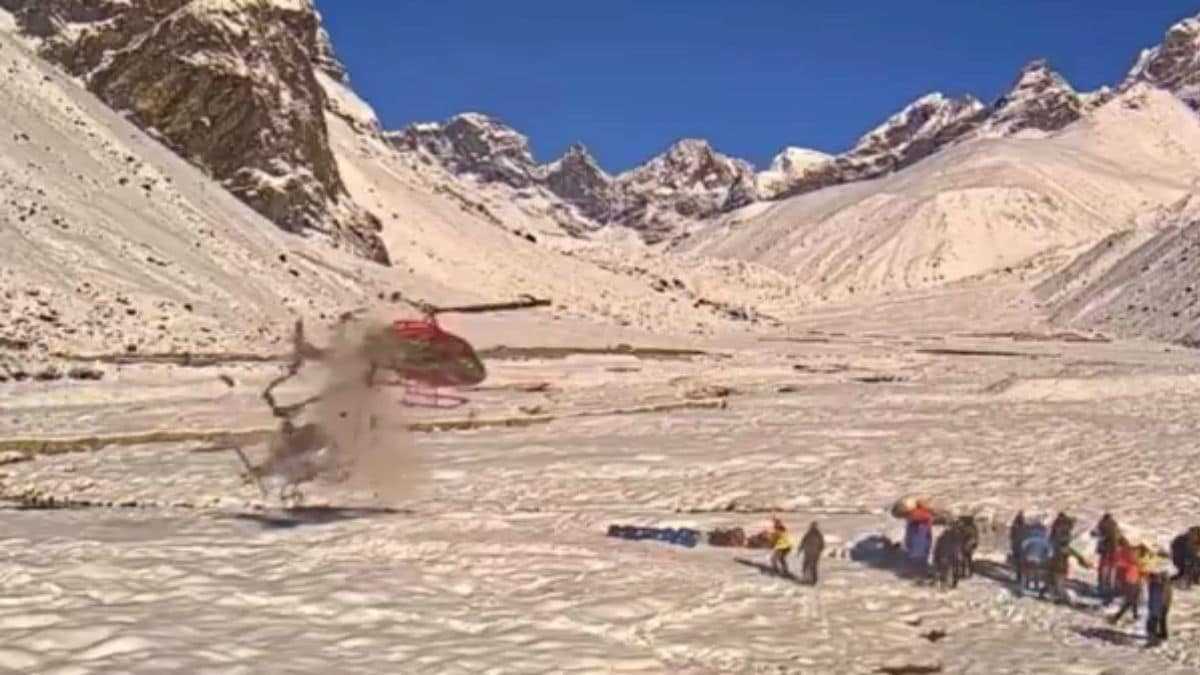
When two helicopters converge on camera during a landing sequence, the visual evidence typically reveals a failure of vertical and lateral separation during the final 100 feet of descent. One aircraft frequently occupies the low hover or ground position while the second descends into its blind spot, leading to main-rotor-to-tail-boom or rotor-to-fuselage contact.
Systemic Failures in Nepalese Rotorcraft Operations
Aviation safety in Nepal has historically suffered from a disconnect between rapid commercial expansion and static infrastructure. While international scrutiny often focuses on fixed-wing controlled flight into terrain (CFIT), rotary-wing operations face an entirely different set of structural hazards.
1. The Limits of "See and Avoid" Under Visual Flight Rules (VFR)
The vast majority of helicopter flights in Nepal operate under Visual Flight Rules. Under VFR, the primary mechanism for collision avoidance is the "see and avoid" principle, supplemented by radio position reporting on a Common Traffic Advisory Frequency (CTAF).
This system breaks down under three specific conditions common to Nepalese operations:
- Frequency Congestion and Language Friction: During narrow morning weather windows—before mountain winds pick up and clouds obscure the valleys—dozens of helicopters launch simultaneously. Pilots must monitor company frequencies, local tower controllers (where available), and CTAF simultaneously. Critical position calls are routinely stepped on, misunderstood, or omitted during high-workload phases.
- Terrain Masking: VHF radio waves travel strictly line-of-sight. Two helicopters approaching a ridge-line helipad from opposite sides of a spur cannot hear each other's radio transmissions, nor can they see each other until both clear the terrain barrier seconds before touchdown.
- Visual Camouflage: Light helicopters painted in corporate liveries blend seamlessly into complex, high-contrast mountain backdrops of rock, scree, and shadow. Without high-intensity pulsed landing lights or active electronic conspicuity, a moving helicopter against a static mountain wall is virtually invisible to the human eye until closure rates become unrecoverable.
2. Ground Marshaling and Helipad Infrastructure Deficits
At major international heliports, movement on the apron is strictly controlled by ground marshallers equipped with high-visibility wands, dedicated radio links, and clear hold-short lines. In Nepal's remote sectors, and even at congested regional staging areas, ground infrastructure is frequently rudimentary.
When multiple helicopters service a single tourist group, rescue mission, or cargo drop, commercial pressure dictates rapid turnaround times. Engines remain running ("hot" turnarounds) to save battery cycles and avoid hot-start risks at high altitude. In this environment, ground staff are often overwhelmed, undertrained, or focused entirely on passenger boarding rather than airspace deconfliction. Without an authoritative ground controller holding the second aircraft at a designated standoff point, pilots are left to self-sequence in a dynamic, high-stress environment.
3. Commercial Compression and Weather Windows
The economics of Nepalese aviation are dictated by meteorology. Weather in the Himalayas deteriorates predictably by late morning as solar heating drives convective clouds up the valleys. Consequently, operators compress an entire day's revenue-generating flights into a three-to-four-hour morning window.
This compression creates a queuing problem at bottleneck destinations. Every minute a helicopter spends orbiting a landing zone burns expensive aviation turbine fuel (Jet A-1) and erodes payload capacity—a critical variable when operating near maximum gross weight at high density altitudes. Pilots face immense implicit pressure to get on the ground immediately, encouraging tight, simultaneous approaches rather than conservative, single-file holding patterns.
The Mechanics of Rotorcraft Ground Collisions
To understand why a seemingly low-speed landing collision proves fatal, one must examine the kinetic energy stored in a helicopter's rotor system.
Even at flight idle, the main rotor blades of a medium-light helicopter spin at roughly 380 to 400 revolutions per minute. The blade tips travel at velocities approaching 650 to 700 feet per second (nearly Mach 0.6). Unlike an automobile crash, where energy is dissipated through crumple zones at low speeds, a helicopter collision involves the instantaneous release of rotational kinetic energy.
- Primary Impact: When the main rotor blades of a descending helicopter strike the tail boom, vertical stabilizer, or cabin roof of a stationary or hovering helicopter, the blades do not simply bend; they shatter. Composite and metal fragments are ejected outward at ballistic velocities, posing an immediate lethal threat to anyone standing on the landing zone—including ground crew, passengers, and bystanders filming the event.
- Asymmetric Rotor Disc Failure: The sudden loss of a blade section creates a massive, instantaneous imbalance in the main rotor hub. Within fractions of a second, the resulting centrifugal forces tear the transmission and main rotor mast entirely free from the airframe mounts.
- Loss of Directional Control: If the impact severs the tail rotor drive shaft of the lower aircraft while it is still in a low hover, torque from the main rotor causes the fuselage to spin violently and uncontrollably, leading to a dynamic rollover upon ground contact.
The single fatality recorded in such incidents is frequently either a crew member positioned on the non-pilot side where the rotor arc penetrates the cabin, or a ground worker caught in the trajectory of disintegrating blade debris.
Deconstructing the Human Factors Framework
Analysts applying James Reason’s "Swiss Cheese Model" of accident causation to dual-helicopter collisions identify aligned failures across four distinct layers: organizational influences, unsafe supervision, preconditions for unsafe acts, and the unsafe acts themselves.
Organizational Influences involve fleet scheduling and operational tempo. When companies incentivize flight hours or rapid cycle times without mandating strict separation protocols at unimproved LZs, they normalize deviance.
Unsafe Supervision manifests when chief pilots and operations managers fail to enforce standardized approach profiles for multi-ship operations. In military aviation, multi-helicopter landings are executed in strict formation (such as staggered trail or echelon) with pre-briefed spacing, dedicated lead-aircraft responsibilities, and explicit abort criteria. In commercial civilian operations in Nepal, two helicopters from competing companies—or even the same company—frequently converge on a pad without a shared tactical flight plan.
Preconditions for Unsafe Acts include pilot fatigue, hypoxia, and sensory overload. Operating continuously above 10,000 feet without supplemental oxygen impairs cognitive processing, narrows peripheral vision, and slows reaction times—even in acclimatized pilots. Combined with the glare of high-altitude sunlight and the acoustic fatigue of turbine noise, a pilot’s situational awareness degrades measurably by the fifth or sixth sector of the morning.
The Unsafe Act is the final breakdown in scan discipline: the descending pilot loses visual contact with the lower aircraft ("losing sight") and continues the approach rather than executing an immediate go-around. In aviation, the rule is absolute: if you lose visual contact with traffic in your immediate terminal environment, you abort the landing. Continuing a descent blind into an occupied zone is a fatal gamble.
Evaluating Current Technological Countermeasures
Preventing mid-air and terminal collisions in uncontrolled airspace is a solved problem technologically, yet implementation lags severely in developing aviation markets due to cost, weight penalties, and regulatory inertia.
- ADS-B In/Out (Automatic Dependent Surveillance-Broadcast): ADS-B Out broadcasts an aircraft’s precise GPS position, altitude, and velocity every second. ADS-B In allows surrounding aircraft to receive this data and display it on a cockpit screen, generating audio alerts when trajectories converge. While many modern airframes in Nepal are equipped with transponders, universal adoption of ADS-B In with cockpit traffic displays remains inconsistent across older fleets. Furthermore, standard ADS-B collision algorithms often trigger nuisance alarms during legitimate close-proximity mountain operations, leading pilots to mute the audio warnings—a classic normalization of alarm fatigue.
- FLARM and Lightweight Traffic Awareness Systems: Originally developed for gliders operating in dense mountain thermals, FLARM calculates flight paths and predicts collisions up to 30 seconds in advance, accounting for rapid turns and vertical rate changes. It is lightweight, inexpensive, and tailored specifically for the erratic flight profiles of mountain VFR traffic. However, without a regulatory mandate from the Civil Aviation Authority of Nepal (CAAN), adoption remains fragmented, leaving dangerous blind spots between equipped and unequipped aircraft.
- High-Visibilitystrobe and Pulsed Lighting: Retrofitting helicopters with high-intensity LED pulse lights on the fuselage and blade-tip lighting significantly increases visual acquisition range against dark mountain terrain. Unlike avionics, lighting requires zero pilot interaction and works universally regardless of what equipment the other aircraft carries.
The limitation of all technological countermeasures is that they assist, rather than replace, disciplined airspace procedures. An electronic display inside the cockpit cannot prevent a collision if a pilot fixates on the screen during the final 50 feet of a mountain landing instead of looking outside, nor can it resolve a scheduling bottleneck where three aircraft attempt to land on a single-ship pad simultaneously.
Structural Mandate for High-Altitude Rotary Operations
Eliminating terminal-phase collisions in Nepal requires shifting from reactive accident investigation to rigid operational enforcement. The Civil Aviation Authority of Nepal and commercial rotorcraft operators must implement three non-negotiable structural controls before the next peak trekking and climbing season.
First, enforce mandatory single-ship slot control at all high-traffic unimproved landing zones. No helicopter should be permitted to descend below 500 feet above ground level (AGL) within a one-nautical-mile radius of an LZ until the preceding aircraft has either shut down or departed the zone. Compliance must be audited via mandatory GPS flight-tracking telemetry, with severe license suspensions levied against pilots and operators who violate terminal separation buffers.
Second, mandate cross-compatible electronic conspicuity across the entire commercial rotorcraft fleet. CAAN must select a single, low-latency traffic protocol—such as ADS-B In/Out paired with a mountain-specific collision algorithm—and require installation across every registered helicopter, regardless of airframe age. Aircraft lacking operational traffic displays must be restricted from operating in high-density corridors during peak morning windows.
Third, professionalize ground-marshaling infrastructure at all designated staging hubs. Operators sharing high-volume corridors must jointly fund certified, radio-equipped ground controllers at key mountain staging points. These controllers must hold binding authority to sequence arrivals and hold incoming traffic at designated visual waypoints, removing the burden of self-sequencing from pilots during the most aerodynamically demanding phase of flight. Until terminal airspace is actively deconflicted on the ground and in the cockpit, high-altitude landing zones will remain lethal chokepoints.