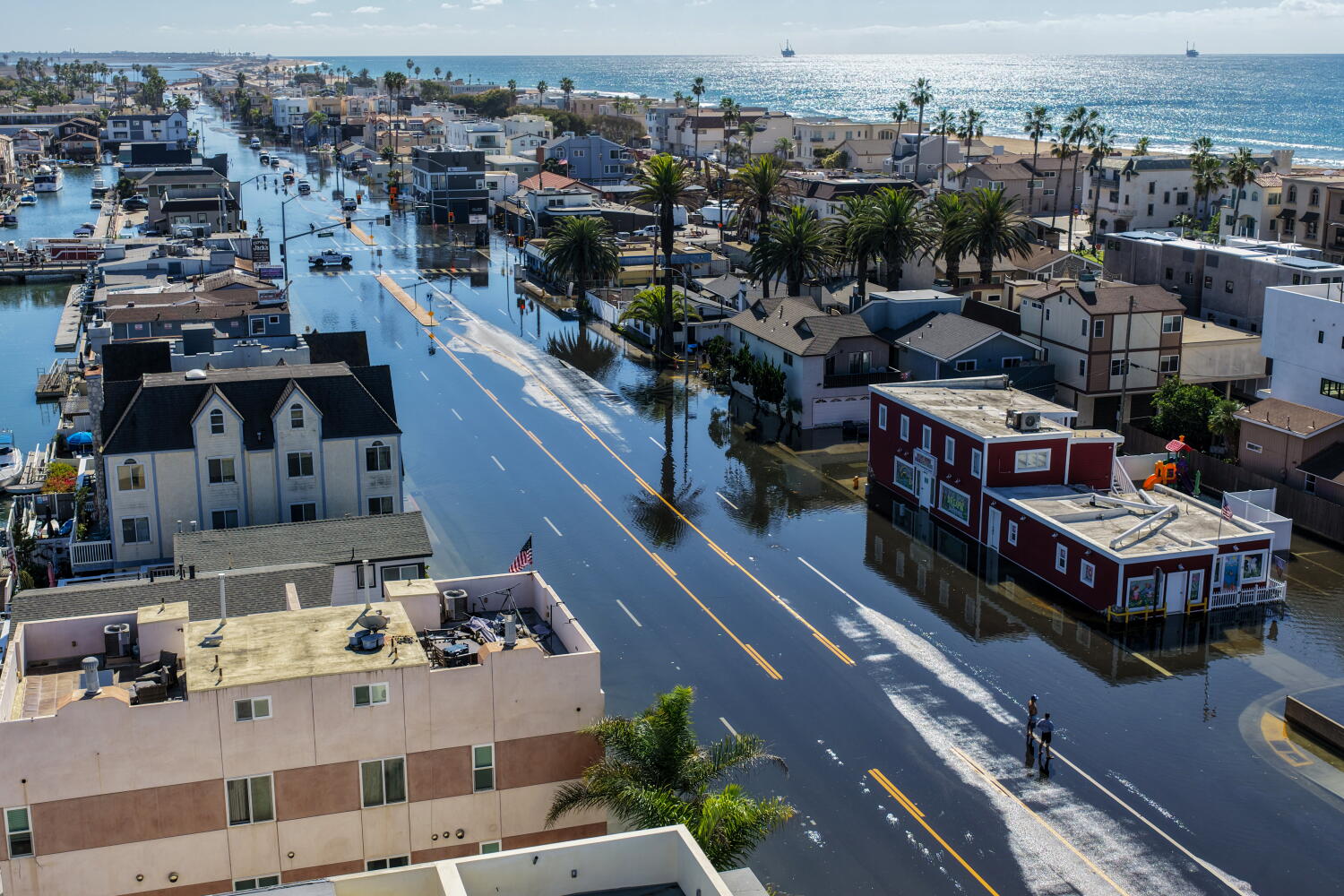
One hundred and fourteen damaged structures in Huntington Beach represent a predictable systemic failure of coastal civil engineering rather than an isolated meteorological anomaly. When municipal authorities issue warnings of impending secondary flooding following an initial tidal surge, they are acknowledging a fundamental shift in baseline hydrology: static perimeter defenses are failing against dynamic oceanographic forces. Evaluating this event requires stripping away sensationalist weather reporting to examine the mechanics of compound coastal flooding, the vulnerability of low-lying alluvial infrastructure, and the economic cost functions governing municipal adaptation.
The Physics of Compound Coastal Inundation
Standard municipal reporting treats high-tide damage as a single-variable problem—water rising above a fixed seawall. In reality, structural damage across 114 properties in a developed coastal zone like Huntington Beach is driven by a multi-variable hydrodynamic equation. Water elevation at the shoreline is the sum of four distinct physical inputs: astronomical tide, storm surge, wave setup, and seasonal steric expansion.
- Astronomical Tidal Forcing: Perigean spring tides—commonly referred to as king tides—occur when the lunar perigee aligns with the syzygy of the Earth, Moon, and Sun. This gravitational alignment increases tidal range by roughly 15% to 20% above mean higher high water (MHHW). While predictable decades in advance, these tides eliminate the vertical buffer zone that coastal infrastructure relies upon to absorb energy.
- Barometric and Wind-Driven Surge: Low-pressure atmospheric systems off the Pacific coast reduce downward barometric pressure on the ocean surface, allowing water levels to rise roughly one centimeter per millibar of pressure drop. When paired with onshore wind stress, water piles up against the continental shelf, creating a localized surge that stacks directly atop the astronomical peak.
- Wave Setup and Swell Energy: Long-period Pacific swells carry immense kinetic energy. As these waves shoal and break near the Huntington Beach shoreline, the transfer of momentum pushes water shoreward, elevating the mean water level at the beach face—a phenomenon known as wave setup. Individual wave run-up then surges far beyond the static water line, delivering high-velocity hydraulic loads directly against foundations, bulkheads, and seawalls.
- Steric Sea Level Anomalies: Thermal expansion of upper ocean waters and regional current shifts, such as El Niño-Southern Oscillation (ENSO) warm phases, elevate baseline Pacific sea levels by several inches for months at a time.
When these four variables synchronize, the resulting Total Water Level (TWL) exceeds the design elevations of legacy coastal infrastructure. The damage to 114 structures occurs not merely because water touches the buildings, but because high-velocity wave run-up scours unconsolidated sand beneath shallow foundations, while hydrostatic pressure forces saltwater upward through subterranean drainage networks.
Structural Vulnerability Profiles in Low-Lying Alluvial Zones
Huntington Beach sits atop a complex coastal plain characterized by historic river deltas, reclaimed wetlands, and artificial fill—most notably around the Santa Ana River mouth, Sunset Beach, and the Huntington Harbour channel system. Infrastructure built across these zones exhibits three distinct failure modes when subjected to extreme tidal forcing.
Sub-Surface Backflow and Drainage Inversion
Municipal storm drain systems rely on gravity flow to discharge runoff into the ocean or harbor channels. These outfalls are engineered for a specific hydraulic gradient. When ocean levels exceed the elevation of the outfall invert, the hydraulic gradient reverses. Saltwater flows backward through the subterranean pipe network, emerging through catch basins and street grates miles inland from the breaking surf. Even where duckbill check valves or flap gates are installed to prevent backflow, debris accumulation, biofouling, or differential pressure frequently prevents a complete seal. Once saltwater inundates the street grid, it pools in topographic depressions, saturating roadbeds and penetrating ground-floor slabs.
Seawall Overtopping and Scour Mechanics
In engineered harbor environments like Huntington Harbour, vertical bulkheads and seawalls form the primary boundary between private real estate and tidal channels. These structures are typically designed to withstand static hydrostatic loads up to a historical threshold. When TWL overtops the bulkhead cap, water cascades onto the unprotected soil behind the wall. This overtopping initiates rapid erosion of the backfill material, relieving the passive earth pressure that stabilizes the wall's base while simultaneously increasing the active hydrostatic pressure from the saturated soil. The result is structural rotation, bowing, or catastrophic collapse of the bulkhead, directly compromising the foundations of adjacent residential structures.
Saltwater Intrusion and Material Degradation
Damage assessments immediately following a tidal event typically capture acute physical destruction—breached doors, flooded garages, and eroded seawalls. However, the secondary damage vector is chemical and electrical. Saltwater is an aggressive electrolyte. When it infiltrates residential and commercial structures, it wicks up drywall via capillary action, corrodes structural rebar within concrete foundations, and short-circuits sub-slab electrical conduits and HVAC systems. A structure counted among the 114 damaged properties may remain standing after the tide recedes, yet suffer progressive structural and mechanical failure over the subsequent six to twelve months if salt-laden materials are not entirely remediated.
The Compounding Risk of Sequential Tidal Cycles
A municipal warning of "more flooding to come" highlights a critical operational vulnerability: the depletion of system resilience between sequential tidal peaks. Tidal cycles operate on a semi-diurnal schedule, producing two high tides roughly every 24 hours and 50 minutes, while perigean spring tide windows persist for three to five consecutive days.
During the first peak, coastal defenses absorb maximum energy, sand berms are flattened, and sacrificial dunes are eroded. Natural beaches act as dynamic energy dissipators; a wide, sloped sand berm forces incoming waves to break far offshore, expending their kinetic energy before reaching built structures. Once the first high-tide cycle strips away this protective sand prism, the beach profile becomes steep and concave.
When the second and third high tides arrive 12 to 24 hours later, waves no longer break offshore. Instead, deep water reaches all the way to the seawalls and building foundations, allowing unbroken swells to impact structures with exponentially greater force. Simultaneously, the municipal storm drain system remains pressurized and full from the initial inundation, leaving zero storage capacity for incoming water. Emergency response teams are forced into a reactive posture—deploying temporary sandbags and portable pumps that cannot match the volumetric flow rates of an incoming ocean tide.
The Economics of Coastal Defense and Risk Transfer
Evaluating the financial impact of 114 damaged structures requires looking beyond immediate repair invoices to the broader economic mechanics of coastal asset management. Every coastal municipality operates within an implicit cost function balancing capital expenditure on defense against expected annualized losses.
- The Capital Expenditure Trap: Hardening coastal infrastructure—raising seawalls, installing pressurized pump stations, and executing large-scale beach nourishment—requires tens of millions of dollars in upfront capital. Permitting under California coastal regulations involves multi-year environmental reviews, creating a severe temporal mismatch between accelerating physical risk and institutional execution speed.
- The Beach Nourishment Treadmill: Pumping offshore sand onto eroding beaches preserves recreational space and provides a temporary buffer against wave energy. However, sand nourishment is an operational expense disguised as a capital asset. A single severe winter swell event can strip away years of nourished sand in 48 hours, returning the shoreline to its vulnerable baseline without altering the underlying sea-level trajectory.
- Insurance Market Contraction: Private property insurers price risk based on forward-looking catastrophe models rather than historical loss averages. Repeated tidal inundation events trigger rapid repricing of coastal policies, higher deductibles, and outright non-renewals. As private coverage retreats, property owners are pushed onto state-backed insurers of last resort or the National Flood Insurance Program (NFIP), transferring localized real estate risk onto broader public balance sheets.
Limitations of Current Municipal Mitigation Strategies
No municipal engineering intervention offers absolute protection against rising baseline sea levels. Every available mitigation strategy carries structural trade-offs and hard physical limitations.
Vertical Seawall Elevation protects specific parcels from overtopping but accelerates erosion at the base of the wall through wave reflection. Reflected wave energy scours the seabed in front of the wall, deepening the nearshore water and enabling larger waves to strike the structure over time. Furthermore, raising a seawall on one parcel without continuous elevation across neighboring properties simply redirects floodwaters around the flanks of the wall, inundating adjacent lots.
Temporary Flood Barriers and Sandbags provide localized protection against minor nuisance flooding (under 12 inches of static water) but fail completely against high-velocity wave run-up or prolonged hydrostatic pressure. Sandbags are permeable; without a continuous impermeable membrane and mechanical pumping behind the barrier, water seeps through the gaps within hours.
Managed Retreat and Zoning Restrictions eliminate long-term exposure by removing structures from the hazard zone, yet face immense legal, political, and financial barriers in high-value coastal real estate markets. Buying out 114 waterfront or harbor-front properties in Orange County requires capital allocations far exceeding municipal budgets, rendering large-scale retreat operationally unviable in the near term.
Tactical Execution Framework for Coastal Resilience
To break the cycle of reactive emergency declarations and recurring structural damage, municipal planners, infrastructure operators, and commercial asset managers must shift from static defense to dynamic risk management.
- Instrument the Sub-Surface Drainage Network: Deploy real-time pressure sensors and automated sluice gates across all coastal storm drain outfalls. Relying on passive mechanical flap gates guarantees backflow failures when debris lodges in the hinge. Automated gates tied to real-time tide gauges must close proactively two hours prior to predicted astronomical peaks, paired with high-capacity stormwater pump stations capable of discharging inland runoff against high ocean head pressures.
- Enforce Elevation and Wet-Floodproofing Standards: Update municipal building codes within the 100-year coastal floodplain to mandate freeboard requirements—elevating the lowest habitable floor at least three to five feet above base flood elevation. For existing structures where elevation is structurally impossible, enforce wet-floodproofing on ground levels: replace drywall with marine-grade concrete or masonry, relocate electrical panels and HVAC units above the surge line, and install engineered hydrostatic flood vents to equalize interior and exterior water pressures and prevent foundation collapse.
- Transition from Reactive Sandbagging to Engineered Dune Systems: Abandon ad-hoc sandbag deployment in favor of vegetated, cobble-core dynamic revetments along vulnerable beach corridors. Unlike vertical concrete walls, a cobble-core dune mimics natural coastal morphology, absorbing wave energy through internal friction while remaining flexible enough to adjust to shifting sand levels without catastrophic structural failure.
- Establish Trigger-Based Capital Allocation: Link municipal infrastructure maintenance budgets directly to quantitative tidal thresholds. When beach width narrows below a critical protective buffer—measured via quarterly LiDAR surveys—pre-approved emergency sand placement or bulkhead reinforcement contracts must execute automatically, bypassing standard multi-year procurement delays before the winter swell season arrives.