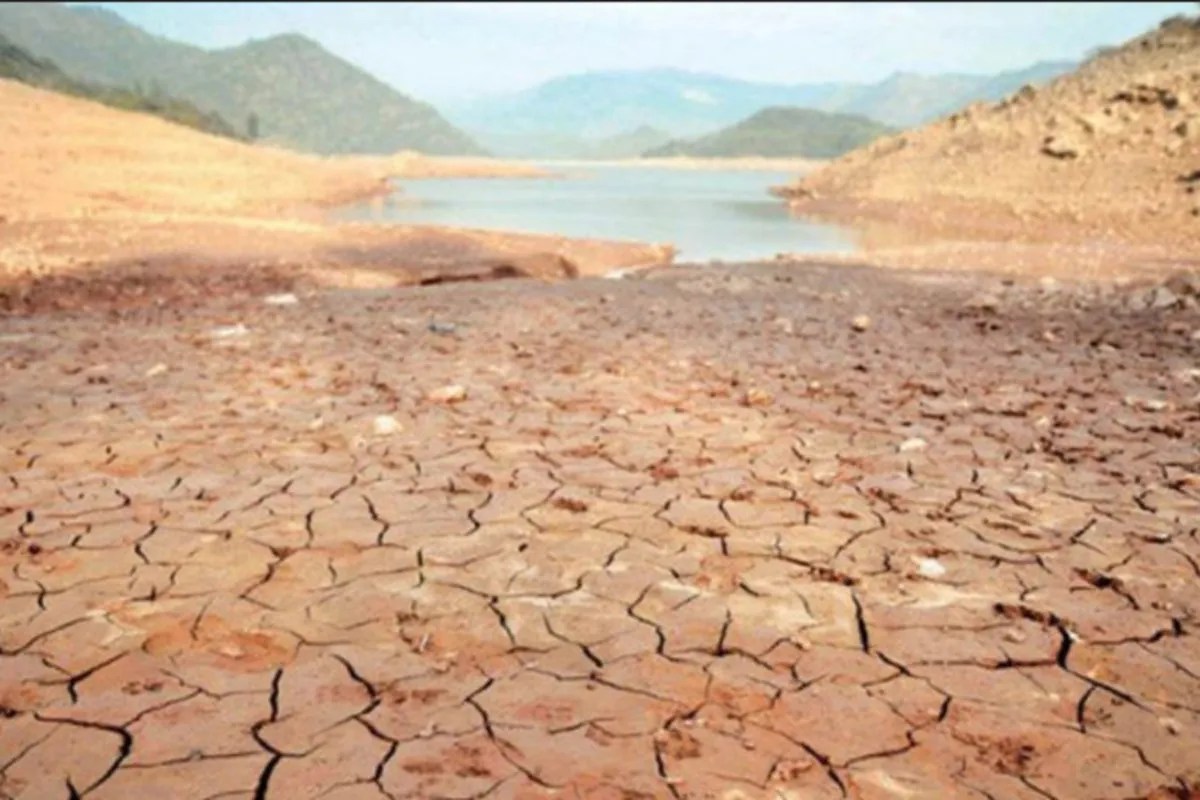
Per capita water availability in the Indus Basin has dropped from over 5,000 cubic meters in 1950 to under 860 cubic meters, pushing the nation below the absolute scarcity threshold defined by international hydrological standards. While external narratives routinely attribute this trajectory to cross-border hydro-politics or accelerated climate volatility, an examination of institutional metrics reveals an internal structural failure. The core crisis is not an absolute deficit of moisture, but an institutionalized systemic loss driven by distorted economic incentives, unlined conveyance networks, and hyper-subsidized agricultural misallocation.
The Architecture of Structural Loss
The primary mechanism of resource depletion operates through massive transmission leakage. Approximately ninety percent of freshwater withdrawals are directed into the agricultural sector, which accounts for roughly one-quarter of the national output. However, the conveyance efficiency of the canal infrastructure is severely compromised. Read more on a related subject: this related article.
Unlined earthen canals and traditional watercourses lose between forty and sixty percent of their water volume via unmonitored seepage, structural evaporation, and operational tail-end losses before reaching farm gates. This loss function is compounded by absolute pricing distortions. Water tariffs are heavily underpriced and flat-rated rather than volumetric. Farmers face zero marginal cost for excessive extraction, completely removing any economic incentive to invest in precision irrigation or water-saving technologies such as drip and sprinkler systems, which currently cover less than five percent of total cultivated land.
Crop Selection and Macro-Level Misallocation
The hydrological mismatch is further exacerbated by the macro-economic choice of staple crops. Four water-intensive commodities—rice, wheat, sugarcane, and cotton—consume the vast majority of available irrigation water while yielding disproportionately low contributions to the gross domestic product. Additional reporting by Associated Press explores related perspectives on this issue.
[Traditional Flood Irrigation] ---> (40-60% Loss via Seepage/Evaporation) ---> [Low-Yield High-Consumption Crops] ---> [Aquifer Depletion]
Cultivating water-intensive cash crops in semi-arid and arid agro-climatic zones requires relentless reliance on groundwater abstraction. Pakistan ranks among the largest extractors of groundwater globally, operating millions of unmetered tubewells. This over-extraction exceeds natural recharge rates by wide margins, causing localized water tables to drop precipitously across the Indus Plain and resulting in widespread soil salinity, sodicity, and land subsidence.
Inter-Provincial Asymmetry and Institutional Friction
Downstream regions bear the disproportionate cost of upstream inefficiencies. The structural friction between Punjab as the primary upper riparian province and Sindh as the lower riparian terminus creates a zero-sum political dynamic.
- The Upstream Advantage: Upstream regions exercise direct control over major storage nodes and canal headworks, capturing high shares of seasonal flows.
- The Downstream Deficit: Lower riparian districts experience high water table salinity, diminished tail-end canal supplies, and severe coastal regression in the Indus Delta, where insufficient freshwater outflow fails to push back saline marine intrusion.
- Regulatory Fragmentation: Responsibilities for water quality, drainage, and canal maintenance are distributed across overlapping provincial and federal bodies, creating a regulatory vacuum where enforcement of environmental flows is systematically neglected.
Urban Leakage and Non-Revenue Deficits
Municipal water networks replicate the systemic decay observed in agriculture. Major urban centers like Karachi and Lahore suffer from high rates of Non-Revenue Water, where forty to fifty percent of treated municipal supply is lost due to physical pipeline corrosion, illegal commercial taps, and administrative theft.
Because municipal utilities operate on heavily subsidized, non-cost-reflective tariff models, capital budgets for maintenance and infrastructure modernization remain chronically underfunded. Consequently, urban households increasingly rely on unregulated private tanker mafias, paying multiples of piped-water costs for contaminated supplies, which triggers a public health burden characterized by high incidences of water-borne pathogens.
Strategic Redirection and Resource Re-Engineering
Resolving the structural deficit requires abandoning short-term political expedience in favor of strict economic and infrastructural reform. The immediate priority is the transition from volumetric underpricing to smart-metered pricing frameworks that penalize wasteful extraction. Concurrently, public capital expenditure must shift away from multi-decade political deadlocks over mega-dams toward localized lining of distributaries, laser land leveling, and the mandatory deployment of high-efficiency drip systems for high-consumption crops. Without institutional pricing reforms and enforced allocation caps, capital injections into supply-side infrastructure will continue to feed an unsustainable consumption loop.