The escalating conflict outside the Delaney Hall detention center in Newark, New Jersey, is not a localized civil disturbance; it is a structural failure at the intersection of private equity corrections, federal enforcement mandates, and municipal risk mitigation. When a private prison contractor operates a federal holding facility under a guaranteed-minimum contract, the incentives lean heavily toward aggressive cost cutting. When those cost reductions trigger collective labor and hunger strikes by detainees, the operational friction spills over the perimeter walls, transforming an internal logistical bottleneck into a high-intensity public safety crisis.
Understanding this dynamic requires abandoning the superficial narrative of a standard protest and analyzing the exact mechanisms driving the operational, legal, and financial feedback loops between the federal government, GEO Group, state leadership, and grassroots organizers.
The Private Prison Cost Function and Internal Leverage
The initial catalyst for the unrest inside Delaney Hall—which subsequently triggered the external blockades and over 80 documented arrests—stems directly from the economic model of privatized immigration detention. Under standard Immigration and Customs Enforcement (ICE) contracts, private operators like GEO Group rely on maximizing margins within a fixed per-diem rate per detainee.
The Subsistence Margin Compression
To optimize profitability, facility operators face structural incentives to compress variable costs, specifically nutrition, sanitation, and medical care. The allegations emerging from hand-written detainee letters—including expired food, lack of climate control in high heat, and withheld maintenance medications—represent the predictable output of extreme cost-minimization strategy.
When basic operational inputs fall below subsistence thresholds, detainees lose all bargaining power within traditional channels. This reality forces the adoption of asymmetric leverage: the collective hunger and labor strike.
The Asymmetric Mechanics of Hunger Strikes
A hunger strike functions as a direct attack on a private operator's compliance framework. Federal Performance-Based National Detention Standards (PBNDS) mandate specific medical monitoring protocols for striking detainees, including daily vitals, behavioral health checks, and potential involuntary medical isolation.
- The Administrative Burden: These mandates sharply escalate the labor costs of medical staff, converting a low-cost detainee into a high-cost asset.
- The Revenue Threat: Prolonged strikes trigger mandatory notifications to federal oversight bodies, threatening the facility’s compliance status and future contract renewals.
To mitigate this threat, operators deploy tactical deterrence. The immediate transfer of organizers—such as the documented removal of organizer Martin Soto to the Elizabeth Detention Center—is a textbook decapitation strategy designed to break the collective communication structure of the strike before it jeopardizes the facility's underlying cash flows.
Perimeter Warfare and the Logistics of Deterrence
When external advocacy groups, such as Cosecha and the Eyes on ICE coalition, integrated their actions with the internal strike, the strategic objective shifted from administrative disruption to physical asset interdiction. The resulting clashes highlight a fundamental mismatch in tactical doctrines.
[Internal Strike] ---> [External Blockade] ---> [Logistical Interdiction]
                                                      |
                                                      v
[Emergency Curfew] <--- [State Trooper Surge] <--- [ICE Tactical Response]
Logistical Interdiction Tactics
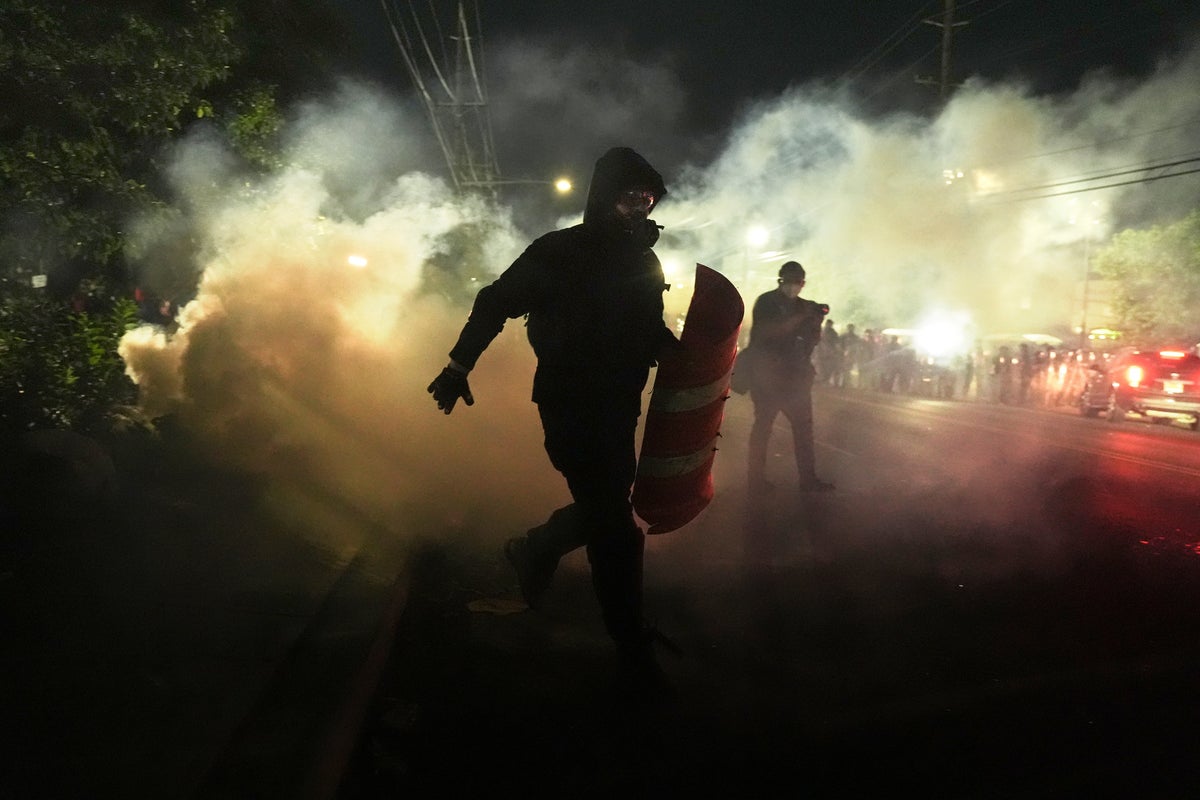
Protesters recognized that the weakest node in the detention ecosystem is the transport interface. By forming human chains, establishing physical barricades using mattresses and traffic cones, and attempting to block the gates of Delaney Hall, external actors sought to halt the entry and exit of DHS transport vehicles. This direct interdiction disrupts the transfer mechanism ICE uses to redistribute detainees, isolate strikers, or execute deportation flights.
The Law Enforcement Escalation Matrix
The tactical response from federal and state authorities moved systematically through three distinct phases of crowd management:
- Chemical and Kinetic Dispersion: Facing a coordinated physical blockade, ICE officers deployed pepper spray, pepper balls, and batons. The objective was immediate pain compliance to clear the roadway for operational vehicles.
- The Municipal Curfew Buffer: Recognizing the high political costs of sustained federal-civilian combat on municipal streets, Newark Mayor Ras Baraka instituted an emergency 9 p.m. to 6 a.m. curfew zone. This move legally reclassified any individual within the perimeter as a non-compliant actor, simplifying the legal mechanism required for mass arrests.
- The State Enforcement Buffer: The deployment of New Jersey State Troopers by Governor Mikie Sherrill illustrates a protective tactical isolation strategy. By replacing visible federal ICE agents with state troopers at the outer perimeter, the administration attempted to lower the ideological temperature of the protest while enforcing a hard physical cordon that blocked both press access and familial visitation.
The Jurisdictional Breakdown and Political Risk
The operational friction at Delaney Hall exposes a deep, systemic rift between municipal, state, and federal authorities, complicating the legal risk profiles for all involved parties.
| Jurisdiction | Primary Objective | Operational Action | Long-Term Political Risk |
|---|---|---|---|
| Federal (DHS/ICE) | Maintain detention throughput and enforce deportation mandates. | Tactical deployment, transfers of strike organizers, federal prosecution of rioters. | Direct conflict with local electorate; exposure of systemic medical neglect. |
| State (NJ Executive) | Minimize civil unrest and mitigate public safety hazards. | Cordoning the facility using State Troopers; balancing pro-immigrant rhetoric with law enforcement actions. | Alienation of progressive base; accusations of enabling federal overreach. |
| Municipal (Newark) | Prevent property damage, street fires, and local economic disruption. | Implementing a strict geographic curfew; limiting access to families and media. | Legal exposure via civil rights lawsuits; internal backlash from historically anti-ICE leadership. |
This jurisdictional fragmentation creates a volatile operational environment. While Homeland Security Secretary Markwayne Mullin maintains an undeterred stance, local authorities are left to manage the immediate financial and social costs of an militarized federal perimeter operating inside their boundaries.
Tactical Outlook and Recommendations
For corporate stakeholders, legal advocates, and risk managers analyzing this crisis, the situation at Delaney Hall underscores that immigration detention facilities are no longer isolated administrative environments. They are high-risk nodes subject to immediate, volatile operational disruptions.
The current strategy of deploying tactical curfews and transferring organizers provides only short-term operational stabilization. This approach fails to address the underlying economic drivers of the unrest. As long as private equity models demand aggressive margin compression on vital inputs like medical care and food quality, internal strikes will continue to generate highly disruptive external blockades.
Organizations operating within or adjacent to this supply chain must immediately price in the following operational adjustments:
- Incorporate Multi-Node Redundancy: Transport and logistics providers must assume that primary access points at urban detention centers can be fully compromised with zero notice, necessitating pre-vetted secondary and tertiary transfer hubs outside municipal borders.
- Account for Increased Legal and Compliance Overhead: Expect local municipalities to increasingly use zoning laws, public health mandates, and strict curfews to insulate themselves from federal enforcement actions, driving up the cost of compliance for private contractors.
- Anticipate Accelerated Counter-Mobilization: Activist networks have demonstrated high-speed scalability, converting localized internal grievances into coordinated, multi-state physical blockades within a 72-hour window. Risk assessments must evaluate facility vulnerabilities based on external choke points rather than internal security architecture alone.
The tactical play moving forward requires a complete re-evaluation of perimeter security frameworks. Treating these disruptions as simple First Amendment events overlooks the reality: they are highly coordinated asset-interdiction campaigns that will persist as long as the underlying contractual incentives remain unchanged.