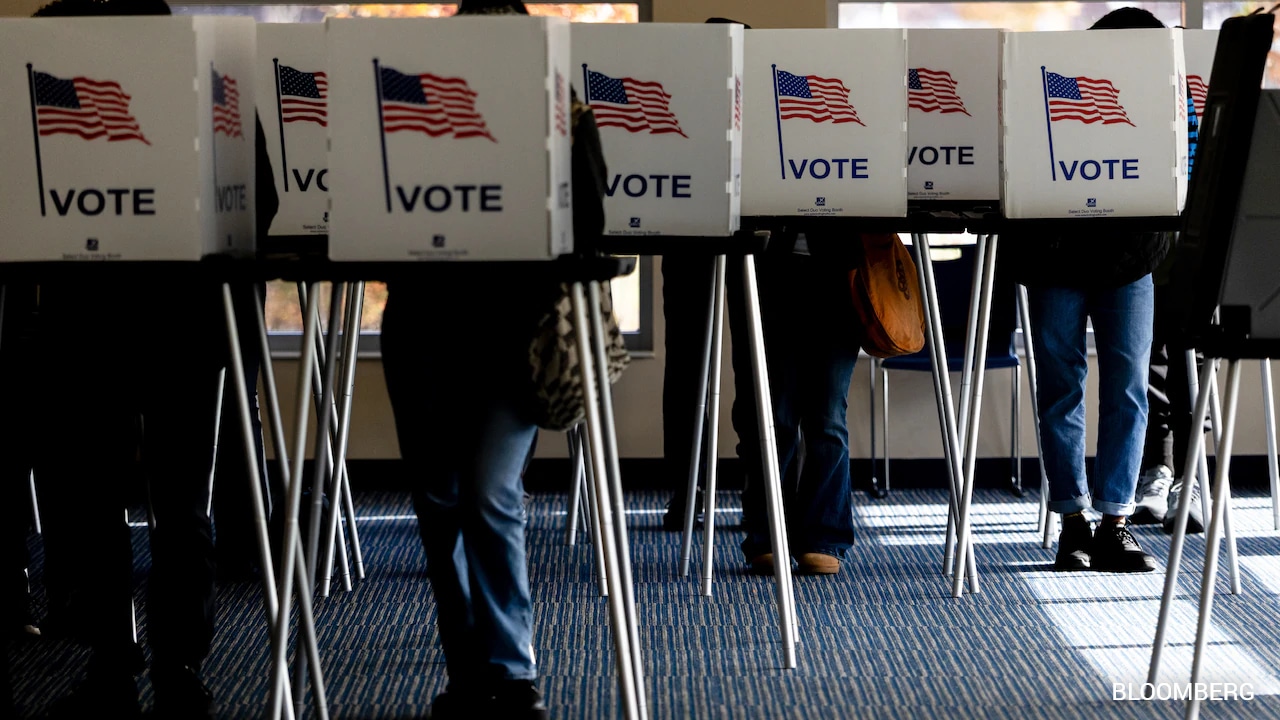
Midterm elections in the United States function less as independent legislative contests and more as structural audits of executive power. When voters enter the polling booths during a presidential term's second year, their ballots measure the delta between campaign promises and lived economic, institutional, and social outcomes. Framing the current election cycle merely as a referendum on Donald Trump obscures the underlying mechanics driving voter behavior. To understand the true electoral dynamics at play, analysts must decompose the electorate's decision matrix into three distinct vectors: retrospective economic evaluation, institutional friction, and asymmetric turnout mobilization.
The Mechanics of Retrospective Voting
Political science models consistently demonstrate that midterm electorates evaluate the incumbent administration through a retrospective lens rather than a prospective one. Voters do not weigh competing legislative blueprints; they assign blame or credit for current material conditions. This dynamic operates under a strict asymmetry: negative economic or social friction generates far stronger behavioral activation than positive stability.
In the context of the current administration, retrospective evaluation centers on the transmission mechanism between executive policy and household balance sheets. Voters track four primary indicators:
- Real Wage Growth vs. Consumer Price Elasticity: Nominal wage increases fail to generate political capital if inflation in non-discretionary categories—housing, healthcare, energy, and staple goods—erodes purchasing power. Voters perceive price increases as an immediate, daily tax, regardless of macroeconomic GDP growth or equity market performance.
- Trade Policy and Supply Chain Friction: Tariffs and protectionist measures operate on a delayed fuse. While executive action on trade yields immediate political optics for domestic manufacturing bases, the downstream cost pass-through to consumers and retaliatory tariffs on agricultural exports create localized economic pain. Swing districts with high exposure to global supply chains experience this friction directly, shifting independent voters away from the incumbent party.
- Fiscal Policy and Interest Rate Pressure: Expansionary fiscal policies paired with tight monetary conditions create a structural squeeze on credit-dependent sectors. Small businesses facing elevated borrowing costs and prospective homebuyers locked out of the mortgage market attribute these capital constraints directly to White House economic management.
- Labor Market Bifurcation: Aggregate unemployment numbers often mask regional and sectoral disparities. When job creation concentrates in specific metropolitan hubs while industrial or rural counties experience stagnation, the electoral map fractures along geographic lines, amplifying the weight of swing states and competitive House districts.
The standard media narrative treats voter sentiment as an emotional reaction to presidential rhetoric. In reality, swing-district outcomes correlate tightly with localized economic distress. When household liquidity tightens, the incumbent party absorbs the electoral penalty, irrespective of the president's personal approval rating among core supporters.
Institutional Friction and the Governance Deficit
Beyond material economics, midterm elections serve as a check on executive overreach and administrative competence. The modern presidency increasingly relies on unilateral executive actions, regulatory rollbacks, and judicial appointments to bypass legislative gridlock. While this approach delivers rapid policy wins for a partisan base, it introduces significant institutional friction that alienates moderate, process-oriented voters.
This governance dynamic manifests across three operational fault lines:
- Regulatory Volatility: Rapid shifts in federal rulemaking—spanning environmental standards, healthcare mandates, and financial oversight—force corporations and state governments into defensive postures. Capital expenditure slows when regulatory frameworks lack multi-year predictability. Suburban voters, particularly those employed in corporate, medical, and educational sectors, view administrative instability as a direct threat to institutional reliability.
- Executive-Legislative Alignment: When one party controls both the White House and Congress, the electorate holds that party solely accountable for legislative dysfunction. High-profile failures to pass flagship bills, prolonged government shutdowns, or public infighting between the executive branch and congressional leadership shatter the perception of governing competence. Voters punish unified governments that fail to execute basic administrative functions.
- Norm Erosion and Institutional Trust: A segment of the suburban electorate prioritizes institutional predictability over ideological alignment. Continuous conflict between the executive branch and the judiciary, intelligence agencies, or the press creates ambient political fatigue. For these voters, casting a ballot for the opposition party in a midterm election is a structural hedge—a deliberate attempt to restore divided government and force legislative compromise.
Asymmetric Turnout and the Mobilization Paradox
Presidential elections maximize participation across low-propensity voter demographics, pulling peripheral partisans into the electorate through high-decibel national media coverage. Midterm elections strip away this top-of-ticket gravitational pull, shrinking the electorate to high-propensity, ideologically committed voters. This structural contraction creates a mobilization paradox for the sitting president.
The president's persona acts as both a turnout engine and a counter-mobilization catalyst. For the core base, loyalty to the executive remains high, yet historical precedent shows that supporters of a sitting president exhibit lower urgency in non-presidential cycles. Having already secured the White House, the base experiences a natural drop-off in political activation.
Conversely, the opposition party benefits from an intense grievance-driven mobilization cycle. Voters who oppose the administration view the midterm election as their primary mechanism to arrest executive momentum. This creates a structural turnout gap that manifest in three measurable ways:
- Suburban Realignment: Well-educated, high-turnout suburban precincts—historically reliable bastions for conservative fiscal policy—shift toward the opposition when social volatility and institutional disruption outweigh tax cuts. Because these demographics vote consistently in off-year elections, their realignment carries disproportionate weight in battleground House districts.
- Youth and Minority Drop-Off vs. Targeted Surge: While younger and minority demographics traditionally exhibit steep participation declines in midterm cycles, intense polarization around civil rights, immigration enforcement, and healthcare access can selectively activate these cohorts in specific urban and sunbelt districts.
- The Straight-Ticket Ceiling: In an era of nationalized politics, split-ticket voting has largely collapsed. Senate and House candidates tied to the president cannot easily outrun the executive's approval rating in their specific district. Local candidate quality still matters at the margins—capable of shifting a race by two to four percentage points—but it rarely overcomes a double-digit structural deficit in the generic congressional ballot.
The Structural Limits of the Referendum Model
Treating a midterm election purely as a binary up-or-down vote on the president introduces analytical blind spots. First, gerrymandering and geographic self-sorting have insulated a vast majority of House seats from competitive pressure. Out of 435 congressional districts, fewer than 40 typically determine the balance of power. The national popular vote can swing dramatically while yielding relatively modest seat changes if those votes are inefficiently distributed across safe urban districts.
Second, the Senate map operates on a six-year cycle that rarely mirrors national sentiment. Because only one-third of the Senate faces voters in any given cycle, the structural composition of the states up for election—whether they lean heavily rural or predominantly urban—often dictates the upper chamber's outcome independently of the president's national standing. A president can preside over a significant loss in the House while simultaneously expanding their party's majority in the Senate if the map favors their geographic coalition.
Third, external shocks—geopolitical crises, public health emergencies, or sudden financial market corrections—can instantaneously rewrite the electoral calculus in the final weeks of a campaign. Retrospective models assume linear progression, yet voter prioritization can pivot overnight from domestic inflation to national security, rendering early polling obsolete.
Strategic Imperatives for Post-Election Positioning
Campaign strategists, policy analysts, and institutional observers must abandon broad national narratives and focus on district-level elasticity. To accurately forecast and navigate the post-midterm political environment, execute the following analytical steps:
- Isolate the Generic Ballot in Swing Districts: Ignore national presidential approval ratings. Track the generic congressional ballot specifically within the 30 to 40 competitive suburban and exurban districts where college-educated independents hold the balance of power. A generic ballot deficit exceeding five points for the incumbent party signals an almost certain loss of the House majority.
- Audit Localized Cost-of-Living Metrics: Map county-level consumer price pressures, housing affordability indices, and regional employment shifts against incumbent-held seats. Districts experiencing acute divergence between local wage growth and regional inflation represent the highest probability of partisan turnover.
- Prepare for Divided Government Gridlock: Assuming historical midterm reversion holds and the opposition captures at least one chamber of Congress, legislative output will halt immediately. Shift strategic planning away from anticipated statutory changes—such as major tax reforms or entitlement overhauls—and focus entirely on executive branch rulemaking, regulatory enforcement actions, and judicial confirmations, which remain insulated from House opposition.
- Monitor Subpoena and Oversight Risk: A flipped House transfers investigative authority and subpoena power to the opposition. Corporate sectors, federal agencies, and administrative officials aligned with the White House must prepare for prolonged congressional inquiries, which will dominate media cycles and divert executive bandwidth away from policy execution for the remainder of the presidential term.