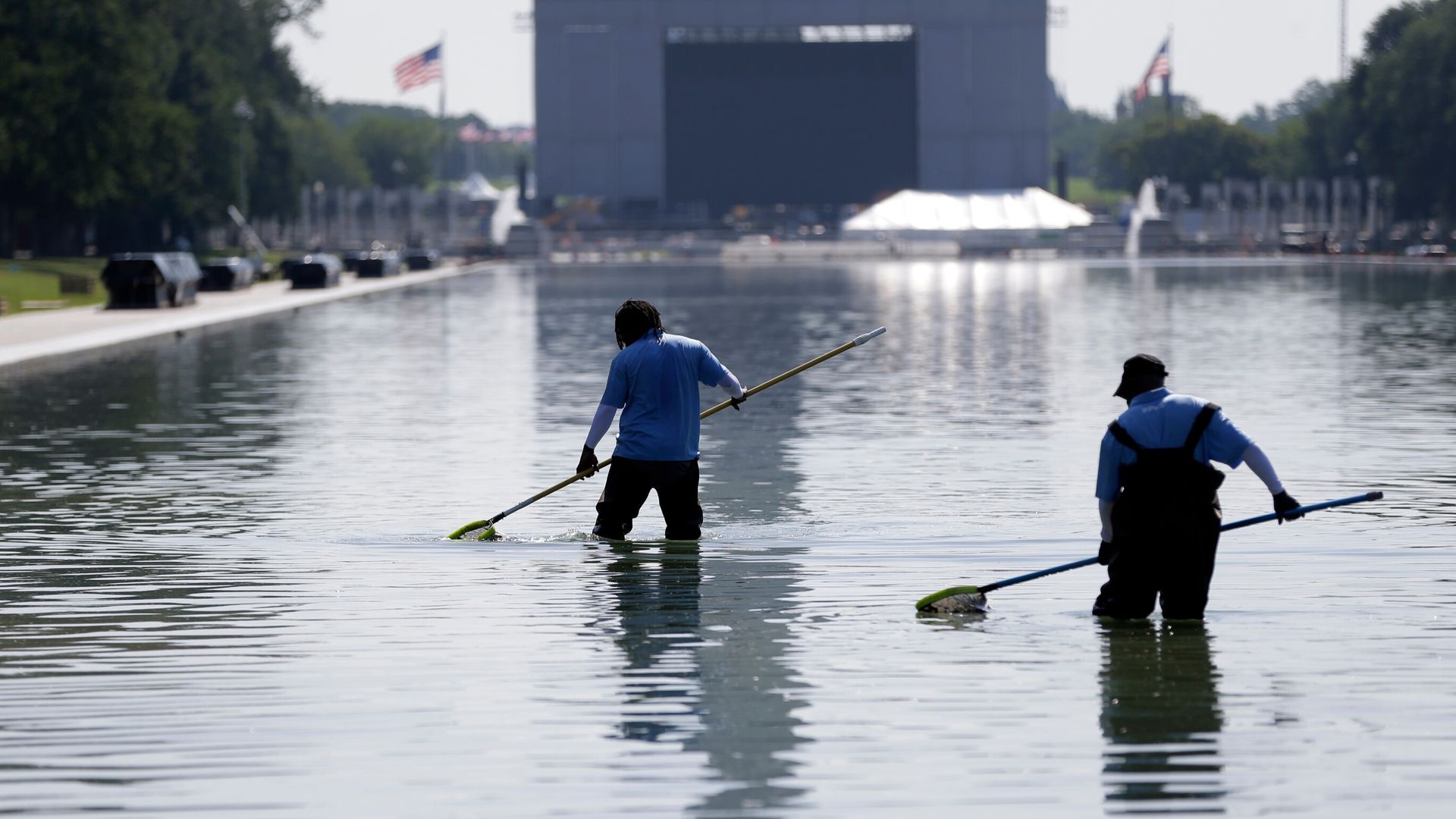
The federal felony indictment of three-time U.S. Olympic canoeist David Hearn for property destruction at the Lincoln Memorial Reflecting Pool presents a stark case study in how political timelines intersect with engineering failures. While the legal architecture frames the event as a malicious, high-value act of vandalism, a structural diagnostic of the infrastructure project reveals a deeper tension: the conflict between accelerated municipal procurement cycles and the fundamental chemical laws of polymer adhesion.
To understand the breakdown of this $14.7 million public works initiative, one must separate the political narrative from the physical mechanisms of the failure. The project, commissioned via a no-bid contract to replicate an aesthetic "American flag blue" surface ahead of the nation's 250th anniversary, suffered catastrophic substrate delamination within days of completion. By analyzing the engineering variables, procurement structures, and legal boundaries of this incident, we can map the exact points where municipal execution collapsed.
The Adhesion Cost Function: Why the Coating Failed
The core mechanical issue of the Reflecting Pool rehabilitation centers on the physical breakdown of a newly installed polymer liner. In high-volume water containment structures, the success of an elastomeric or epoxy-based sealant relies on three distinct chemical and physical variables, which dictate the long-term integrity of the system:
- Substrate Preparation: The concrete bed of the 1922 pool must be completely free of latent moisture, microscopic biological matter, and previous chemical treatments to achieve optimal mechanical interlocking.
- Curing Kinetics: Polymer coatings require strict temperature, humidity, and time windows to achieve full cross-linking density.
- Hydrostatic Pressure and UV Exposure: Once submerged, the material must withstand uniform hydraulic forces alongside thermal expansion from solar radiation.
When a public works project compresses these timelines to meet fixed political anniversaries—such as the July 4th holiday—the curing phase is frequently truncated. If a sealant is submerged before reaching its required glass transition temperature or full chemical cure, water molecules penetrate the polymer matrix. This leads to osmotic blistering and localized adhesion failure.
The physical outcome of this premature submersion is a rubbery, peeling film. From a material science perspective, a citizen or passerby interacting with a floating layer of delaminated sealant is not encountering a structural component intact; they are interacting with a material that has already experienced systemic bonding failure. Hearn, who operated a composite watercraft manufacturing firm and possessed technical familiarity with marine polymers, stated he merely touched the floating, rubbery membrane out of professional curiosity during a bicycle ride. The prosecution, led by U.S. Attorney Jeanine Pirro, alleges that Hearn used "both hands" to "forcefully and violently" remove the bottom liner, causing over $1,000 in property damage—the statutory threshold required to elevate the charge to a felony.
The Procurement Bottleneck and No-Bid Risk Profiles
The structural vulnerabilities of the project were compounded by the governance framework chosen for its execution. The administration bypasses standard competitive bidding protocols by awarding a no-bid contract to a firm with a historical portfolio tied to private commercial swimming pools rather than heavy-duty municipal civil engineering projects.
Competitive bidding processes act as an institutional risk-mitigation tool. They force transparent technical peer reviews and establish strict operational guarantees. By executing a no-bid contract, the project accepted three significant operational blind spots:
- Scale Asymmetry: A firm optimized for residential or private commercial pool maintenance operates under vastly different hydrostatic and environmental stresses than those governing a 2,000-foot-long public infrastructure monument holding millions of gallons of stagnant water.
- Lack of Independent Redundancy: Standard municipal contracts require multi-phase sign-offs from civil engineers. Fast-tracked execution structures often consolidate quality assurance and installation within the same entity.
- The Algae Acceleration Loop: When a lining system fails to adhere correctly, pockets of stagnant water form beneath the lifting membrane. Combined with chemicals and lack of proper circulation, these pockets become breeding grounds for biological matter. The subsequent rapid appearance of a massive algae bloom—which turned the pool green just days after filling—indicates that the water treatment parameters and the substrate conditions were fundamentally mismatched.
To combat the biological bloom, contractors deployed ozone nanobubbles and aggressive chemical treatments. However, these surface-level interventions fail to address the underlying root cause: the compromised physical bond between the liner and the concrete floor.
Legal Escalation as Political Risk Mitigation
The federal government's decision to pursue a grand jury indictment against an individual for a single count of property destruction is disproportionate to standard municipal code enforcement. This escalation can be explained through the framework of political risk mitigation.
When a highly visible, multimillion-dollar public infrastructure asset fails on the eve of a national celebration, the responsible administrative hierarchy faces severe reputational liabilities. To shift the public narrative from systemic execution failure to external sabotage, the governing authority must establish an external causal agent.
The administration’s public assertions—claiming that organized vandals used box cutters to slice a 300-foot gash in the liner and introduced agricultural fertilizer to trigger the algae bloom—serve this narrative purpose. By charging Hearn with a felony, the legal apparatus formalizes the "external sabotage" hypothesis. This strategy attempts to transform a predictable engineering failure into a crime scene, thereby insulating the procurement decisions and the contractors from immediate financial and political accountability.
The structural limitation of this legal strategy is the evidentiary burden. The defense team, led by the Democracy Defenders Fund, has characterized the prosecution as an abuse of government power built upon a manufactured narrative. Because the federal government has yet to release the public surveillance or photographic evidence confirming the alleged 300-foot intentional gash, the state’s case relies heavily on proving that Hearn’s physical intervention was the primary driver of the structural damage, rather than an incidental interaction with an already failing, delaminated polymer layer.
The Strategic Path Forward for Municipal Restoration
The current operational status of the Lincoln Memorial Reflecting Pool requires an immediate halt to superficial remediation efforts. Deploying chemical additives and ozone treatments while the liner is structurally compromised is an inefficient allocation of capital that yields only temporary aesthetic improvements.
The definitive engineering resolution requires a three-stage structural overhaul:
- Complete De-watering and Environmental Control: The pool must be fully drained and dried. Moisture-testing meters must verify that the concrete substrate reaches acceptable dryness levels to prevent future osmotic blistering.
- Mechanical Substrate Profile Cleansing: The existing failed blue polymer must be entirely scraped away, followed by industrial sandblasting to create an optimal concrete surface profile (CSP 3 to CSP 5) for maximum physical adhesion.
- Open-Bid Re-Specification: The contract must be re-packaged and opened to heavy civil engineering firms specializing in hydraulic structures, utilizing a multi-layered polyurea or crystalline waterproofing matrix specified for long-term submersion, completely divorced from compressed political deadlines.
Until the underlying material science and procurement flaws are addressed, any attempt to patch the existing liner under the guise of security or vandalism-prevention will result in a recurrence of delamination. Infrastructure yields only to physical and chemical laws, irrespective of the legal or political pressures applied to its surface.