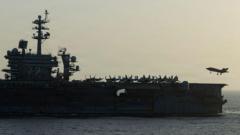
When a nuclear-powered aircraft carrier passes the threshold of 250 consecutive days at sea without a port call, the operational equation shifts from military projection to systemic attrition. The prolonged deployment of vessels such as the USS Abraham Lincoln in active combat zones exposes the hard limits of naval logistics, human endurance, and fleet readiness. Examining this operational reality requires moving past superficial crisis reporting to dissect the structural mechanisms that drive modern maritime overextension.
The Triad of Force Attrition
The stress placed on a 5,000-person floating military installation operating continuously under high-tempo combat conditions can be categorized into three distinct operational domains: human cognitive reserve, mechanical entropy, and logistical supply chain degradation.
Human Cognitive Reserve and Circadian Disruption
A modern aircraft carrier operates on an unyielding 24-hour cycle dictated by flight operations, nuclear propulsion safety, and defensive watch-rotation schedules. In extended deployments, watchstanders routinely execute shifts lasting between 12 and 16 hours. From a neurobiological perspective, eliminating shore leave and periods of true psychological detachment accelerates sleep debt accumulation.
The human cost manifests as degradation in executive function, reduced situational awareness, and a breakdown of emotional regulation. When sailors are isolated for more than eight months without setting foot on land, the absence of environmental variety removes standard psychological decompression valves. The resulting cognitive strain transforms routine operational friction into acute mental health crises.
Mechanical Entropy and Systemic Fatigue
Hardware operating in a marine environment is subject to accelerated corrosion, thermal stress, and continuous mechanical wear. Naval engineering plants and hotel services infrastructure—including sanitation systems, potable water distillation units, and climate control mechanisms—rely on preventive maintenance cycles that require secure port access and cold-iron periods.
When missions are extended repeatedly, planned maintenance schedules are deferred. This deferral creates a negative feedback loop:
- Component stress increases as machinery runs past recommended operational hours.
- Temporary repairs replace permanent fixes, consuming excessive man-hours from already exhausted engineering departments.
- Secondary failures cascade across dependent systems, such as plumbing networks and galley refrigeration units, directly impacting daily habitability.
Logistical Supply Chain Friction
Sustaining a carrier strike group far from home ports requires a complex maritime replenishment architecture. Replenishment-at-sea operations provide fuel, ordnance, and dry goods, but they cannot fully substitute for a scheduled port visit. Fresh provisions degrade rapidly, forcing a transition to preserved rations and constrained caloric distribution. Furthermore, specialized parts for high-failure subsystems face severe delivery bottlenecks when operational priorities shift unexpectedly across distant theaters.
The Institutional Cost Function
The decision to extend a carrier deployment is governed by a rigid institutional cost-benefit analysis. Naval headquarters weigh the diplomatic and tactical cost of a capability gap against the long-term degradation of human and material capital.
The primary variable driving this calculation is force structure scarcity. The United States Navy maintains a finite number of operational carrier strike groups. When global commitments stretch across multiple simultaneous theaters—such as concurrent operations in the Middle East and strategic deterrence patrols in the Pacific—the rotation pool shrinks.
The resulting mathematical reality is stark: maintaining continuous presence in a high-threat area requires either accepting coverage gaps or forcing existing hulls to absorb extended timelines. Leadership routinely selects the latter, externalizing the cost onto the crew and the ship's physical infrastructure. This choice preserves short-term geopolitical posture while eroding the long-term resilience of the force.
The Operational Feedback Loop
Extended deployments generate diminishing marginal utility for military strategy. While the physical presence of a carrier deck provides deterrence and strike optionality, the operational efficiency of the embarked air wing and support elements drops significantly past the standard six-month baseline.
Fatigued maintenance crews experience higher rates of diagnostic error. Exhausted flight deck personnel face elevated risks of procedural mishaps. The compounding weight of these micro-failures diminishes the overall combat effectiveness of the platform, even as the hull logs nominal presence days.
To break this cycle of overextension, naval strategy must transition from reliance on ad-hoc deployment extensions to strict adherence to rotational bounding. Force planners face a binary structural constraint: either accept reduced continuous regional presence or expand the underlying fleet inventory to accommodate realistic maintenance and crew recovery windows. Until structural expansion occurs, extended deployments will remain a high-cost mechanism for trading future fleet viability for immediate tactical presence.