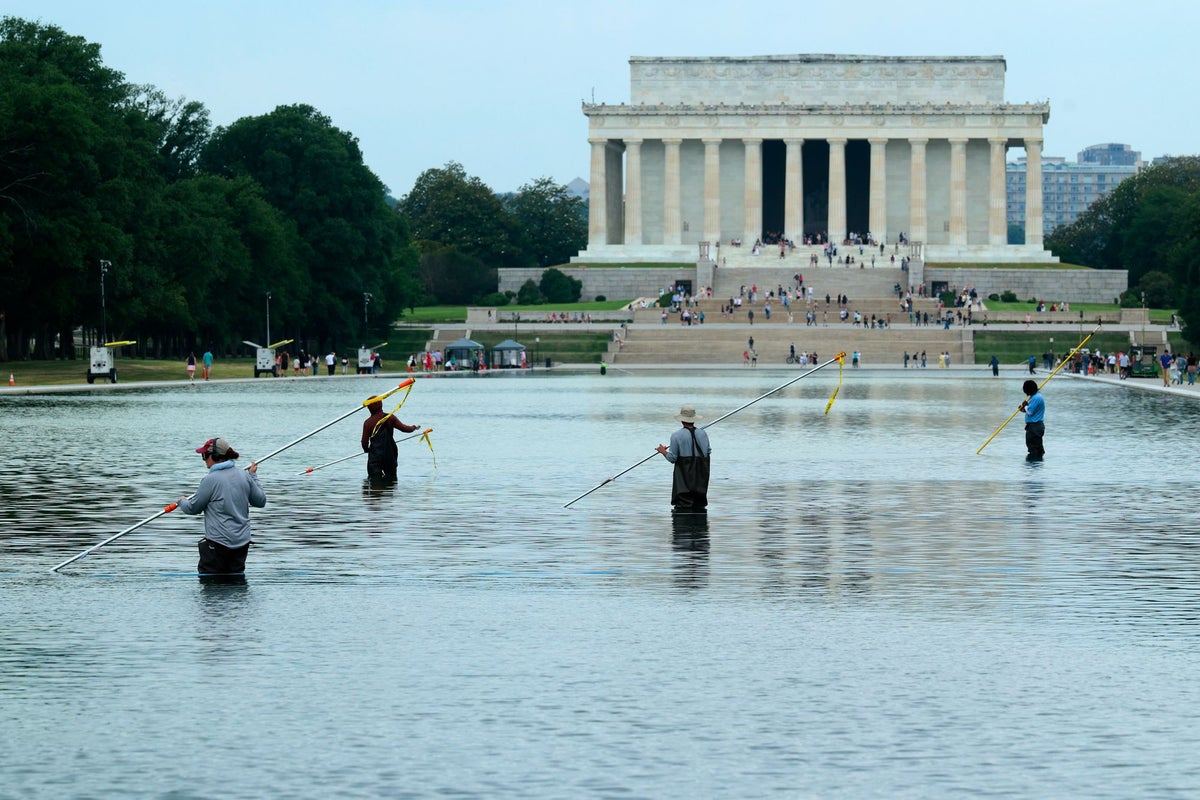
The physical deterioration of public monuments rarely stems from singular acts of malice, yet the political narrative surrounding infrastructure failure almost always demands a culprit. The recent arrest of three-time U.S. Olympic slalom canoeist David Hearn at the Lincoln Memorial Reflecting Pool highlights a profound disconnect between materials science and political damage control. While the state narrative attributes a bright green algae bloom and a delaminating basin liner to systemic sabotage, an objective examination of the $14.65 million renovation points to predictable chemical, biological, and engineering bottlenecks.
Understanding the failure of the Reflecting Pool requires separating the physical cost function of monumental masonry from the security apparatus deployed to defend it. When infrastructure projects are fast-tracked for symbolic deadlines, accelerated timelines frequently compromise material compatibility. The resulting engineering failures present a structural vulnerability that is easily exploited by political messaging, turning a routine municipal maintenance issue into an arena of state theater.
The Triad of Material and Biological Failure
The structural degradation of the Reflecting Pool can be categorized into three distinct, interacting vectors: polymer delamination, biological acceleration, and chemical counter-measures.
+-------------------------------------------------------+
|                 THE REACTION CASCADE                 |
+-------------------------------------------------------+
|  1. High Solar Radiation + Stagnant Water Volume      |
|     ↓                                                 |
|  2. Rapid Algae Proliferation (Eutrophication)        |
|     ↓                                                 |
|  3. Intensive Biocide/Algicide Chemical Shock Treatments |
|     ↓                                                 |
|  4. Accelerated Polymer Degradation & Bond Failure     |
+-------------------------------------------------------+
1. Polymer Delamination and Shear Stress
The renovation sought to coat the concrete basin of the pool in an "American flag blue" sealant. For a liquid-applied polymer liner to successfully adhere to a large-scale concrete substrate, it requires strict moisture mitigation, a profile surface preparation, and specific curing temperatures.
When a polymer coating peels away in large sheets, it indicates an adhesive failure at the substrate interface. This is typically caused by hydrostatic pressure—water vapor migrating upward through the porous concrete underneath the liner—or inadequate surface preparation that left latence or contaminants on the basin floor. Once a small section of the liner detaches, hydrostatic and hydrodynamic shear forces from water movement create a flapping effect, rapidly expanding the zone of delamination.
2. Biological Eutrophication
The immediate transition of the pool from a stark blue to a turbid green is a textbook case of eutrophication. The Lincoln Memorial Reflecting Pool is a massive, shallow, unshaded body of water holding approximately 6.75 million gallons. It acts as a highly efficient solar collector.
Without high-turnover filtration, continuous aeration, or advanced UV sterilization, the combination of stagnant water, summer solar radiation, and organic nutrient inputs (such as runoff from surrounding turf and avian waste) triggers exponential algal replication. The choice of a bright blue background did not cause the algae, but it mathematically amplified its visual signature, reducing the aesthetic threshold for perceived cleanliness.
3. Chemical Catalyst Effects
To counter the rapid proliferation of algae, maintenance crews applied heavy doses of algicides and oxidizing biocides. While these chemical interventions disrupt the cellular walls of the algae, they introduce aggressive chemical agents to the newly cured polymer liner. High concentrations of chlorine or specialized copper-based algicides can accelerate the polymer's chemical degradation, brittle the matrix, and weaken the adhesive bond to the concrete substrate. The remedy for the biological failure directly exacerbated the material failure.
The Mechanism of Selective Enforcement
The arrest of a 67-year-old materials specialist and former elite athlete illustrates the operational framework of deterrent policing when applied to symbolic infrastructure. Hearn, who operates a business specializing in composite watercraft manufacturing, stated his intervention was born of professional curiosity regarding the rubbery texture of the delaminated material.
From an operational standpoint, the deployment of the U.S. Park Police and the National Guard around the monument served a dual purpose. First, it established physical security around a high-profile federal asset ahead of national milestone celebrations. Second, it created a visible feedback loop validating the administration's claims of active vandalism.
The legal mechanics of the arrest—charging an individual with misdemeanor destruction of government property for touching a pre-existing, detached flap of lining—indicates a shift from compensatory justice to symbolic deterrence. By detaining a citizen for five hours without immediate access to counsel or formal articulation of rights, the security apparatus optimized for optics rather than empirical culpability.
The physical reality of a 250-foot tear or widespread delamination cannot be achieved by hand without significant mechanical leverage or industrial tools. The system failure was already baked into the curing phase of the polymer; the human interaction was merely the catalyst that brought the failure into public view.
Strategic Operational Forecast
The operational roadmap articulated by the administration involves a complete draining of the pool and a secondary deployment of contracting resources. This strategy carries high financial and structural risks that will dictate the site's utility over the next fiscal quarter.
- Substrate Moisture Bottlenecks: Draining a 6.75-million-gallon pool relieves downward pressure on the concrete floor, potentially increasing the rate of vapor transmission from the underlying water table. Attempting to reapply a polymer coating immediately after draining ensures a secondary failure loop, as the concrete substrate will retain a high moisture content that prevents proper polymer adhesion.
- The Filtration Disconnect: Unless the physical infrastructure is retrofitted with high-efficiency mechanical filtration and continuous chemical monitoring systems, any aesthetic remediation will be temporary. A failure to address the water turnover rate means that even a perfectly adhered blue liner will be obscured by biological growth within a 72-to-96-hour window during peak summer temperatures.
- Escalating Security Costs: Maintaining a permanent National Guard and U.S. Park Police presence to monitor a shallow body of water creates a structural deficit in municipal resource allocation. The opportunity cost of diverting federal law enforcement from systemic urban crime mitigation to static monument guard duty will yield diminishing returns as public attention shifts.
The structural play moving forward cannot rely on tactical repainting or heightened perimeter security. It requires an immediate pivot toward mechanical engineering remedies—specifically, high-volume ozone disinfection or ultrasonic algae control systems—combined with a transition away from monolithic, non-breathable polymer coatings toward historically accurate, breathable cementitious stains. Continued adherence to the vandalism narrative will only guarantee subsequent material failures under the guise of national security.