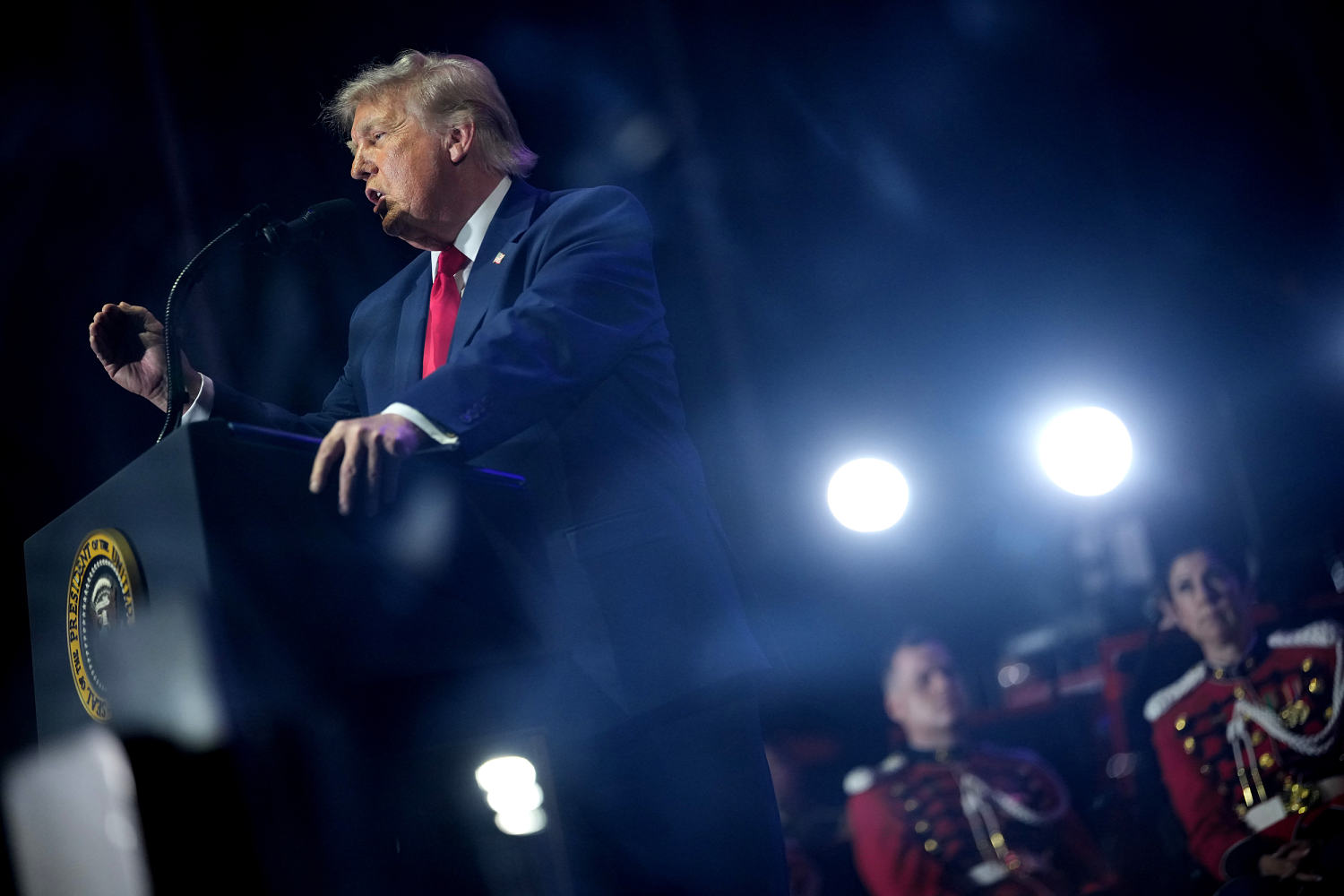
The operational failure of the Great American State Fair on the National Mall exposes a fundamental friction between two distinct asset classes: non-partisan civic brands and highly polarized personal political brands. When Freedom 250, the organizing entity behind the U.S. Semiquincentennial event, attempted to merge a broad, consensus-driven celebration of America's 250th anniversary with the political apparatus of Donald Trump, it triggered an immediate asset devaluation. The resulting mass exodus of mainstream musical acts—including Martina McBride, the Commodores, and Bret Michaels—reveals the exact mechanics of brand cannibalization when commercial contracts intersect with political risk asymmetric profiles.
To understand why this infrastructure collapsed before the opening ceremony on June 24, 2026, one must analyze the event not as a cultural misunderstanding, but as a structural failure in risk management. Entertainment acts operate under a commercial optimization framework designed to maximize total addressable market (TAM) while minimizing brand churn. Political entities, conversely, operate on a polarization framework designed to consolidate a highly motivated 51% majority by alienating the opposing 49%. When these two conflicting systems are forced into the same operational ecosystem, the commercial asset almost always experiences a catastrophic loss of utility.
The Risk-Asymmetry Matrix in Talent Acquisition
The withdrawal of over half the announced musical lineup highlights the vulnerability of multi-stakeholder events to sudden shifts in perceived political alignment. Talent agents book performances based on a baseline assumption of non-partisanship for public civic events. When an event is reclassified as a political vector, the internal risk-reward equation for the talent shifts instantly.
                  HIGH RISK
                  ┌───────────────────────┐
                  │                       │
                  │  Commercial Talent    │ (e.g., McBride, Commodores)
                  │  High TAM Churn Risk  │ -> Mass Withdrawal
                  │                       │
                  └───────────────────────┘
LOW REWARD                                         HIGH REWARD
                  ┌───────────────────────┐
                  │                       │
                  │  Niche Ideologues     │ (e.g., Vanilla Ice)
                  │  Low TAM Churn Risk   │ -> Retention
                  │                       │
                  └───────────────────────┘
                  LOW RISK
The underlying mechanism of this attrition can be broken down into three operational bottlenecks.
First, there is the Total Addressable Market Churn Function. For a mainstream artist like Martina McBride or the Commodores, the customer base spans a wide ideological spectrum. Affiliating with a highly polarizing political figure introduces an immediate threat of consumer defection, localized boycotts, and streaming algorithmic suppression. The math is simple: the marginal revenue from a single performance fee cannot offset the long-term capital loss of 30% to 50% of an artist's domestic consumer base.
Second, the system suffers from Information Asymmetry in Booking Pipelines. Promoters frequently mask the ultimate political backing of an event behind benign shell organizations or non-profit structures like Freedom 250 to clear initial talent agency compliance checks. Rapper Young MC and singer Freedom Williams both confirmed their representatives were briefed on a non-partisan civic anniversary, entirely scrubbed of its executive backing. Once the true capitalization and political orientation of the event became public via trade press, the structural reality broke the booking contract's implied covenant of neutrality.
Third, Physical and Digital Security Risk Adjustments must be factored in. As Bret Michaels noted upon his withdrawal, the transformation of a cultural festival into a political rally alters the security environment. The cost insurance function for the artist's crew, transport, and equipment spikes when an event transitions from a low-risk civic gathering to a high-threat environment prone to counter-protests and civil disruption.
The Substitution Effect: Monetizing the Empty Stage
The strategic pivot executed by Donald Trump following the talent departures offers a pristine look at political substitution mechanics. When an event organizer loses the primary programmatic supply (the musical acts), they face a choice: cancel the infrastructure spend or substitute the asset with an alternative crowd-pulling mechanism.
Trump’s intervention—threatening to cancel the event entirely before transforming it into a solo headlining rally—leveraged a low-cost, high-yield political asset to fill a high-cost commercial void.
[Commercial Concert Model] ──(Talent Exodus)──> [Supply Void] ──(Asset Substitution)──> [Political Rally Model]
High Cost / Fixed TAM                             Zero Music Fee                            Consolidated TAM
From an operational standpoint, substituting a multi-artist musical festival with a singular populist political rally fundamentally changes the financial and programmatic architecture of a public space event:
- Cost Structure Compression: Eliminating legacy musical acts removes significant line-item expenses, including individual performance riders, specialized sound engineering crews for disparate genres, and complex scheduling logistics.
- Audience Profiling Optimization: A diverse musical lineup attempts to aggregate fragmented sub-audiences (country, funk, 90s hip-hop). A political rally collapses these distinct segments into a single, high-homogeneity demographic. The audience density is maintained, but its polarization index peaks.
- Content Production Freedom: Rather than relying on a fixed, pre-cleared setlist of licensed intellectual property, the substituted political asset utilizes unscripted, highly responsive speech formats. This maximizes immediate digital media engagement metrics while lowering compliance friction.
This transformation highlights the ultimate vulnerability of civic initiatives managed by private, partisan-adjacent nonprofits like Freedom 250. Because the entity was separate from the officially established congressional commission (America 250), it lacked the structural institutional guardrails required to insulate the programming from executive capture.
The Limits of Brand Ingestion in Civic Ecosystems
The operational reality of the National Mall event from June 24 through July 10, 2026, establishes a concrete precedent for future civic infrastructure planning. A public space cannot easily accommodate a hybrid model of commerce and polarization. When a non-partisan shell is exposed as a partisan vehicle, the market forces governing commercial talent will consistently force a decoupling.
The long-term limitation of the strategy deployed at the Great American State Fair is the permanent narrowing of the event's utility. While a presidential rally successfully populates a physical venue and commands immediate media cycles, it completely neutralizes the original objective of a national milestone: broad-based civic cohesion. The substituted asset delivers high local intensity at the expense of macro-level distribution, turning what was designed as a multi-week inclusive revenue generator into a brief, highly concentrated ideological event.


