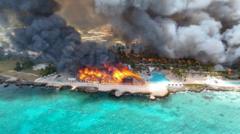
The catastrophic fire at the Viva Wyndham Dominicus Beach Hotel in Bayahibe, Dominican Republic, exposes a critical misalignment between architectural branding and systemic risk management in tropical hospitality. The incident resulted in the death of a 46-year-old Italian tourist, multiple injuries, and the emergency evacuation of 1,690 international guests. While public reporting treats the event as an isolated operational anomaly, an engineering and risk-modeling assessment reveals it as an expected outcome when specific structural vulnerabilities interact with coastal microclimates.
Resorts optimized for the "all-inclusive paradise" aesthetic frequently compromise fundamental thermodynamic safety principles. By analyzing the structural mechanics, thermodynamic variables, and supply chain liabilities highlighted by the Bayahibe incident, operators can quantify and mitigate the hidden cost functions of high-density tropical hospitality design.
The Triad of Accelerated Conflagration
The rapid destruction of the resort property was not a product of delayed emergency response, but rather an structural inevitability dictated by three interacting vectors. When these vectors align, standard containment strategies fail.
- Combustible Material Density: The architectural reliance on authentic palm-thatched roofing (cana) creates a continuous, un-compartmentalized fuel load. Thatch possesses a high surface-area-to-mass ratio, allowing for near-instantaneous ignition once the moisture barrier degrades under tropical UV exposure.
- Aerodynamic Venturi Effects: Coastal resorts are positioned to maximize onshore breeze interception for guest comfort. In a fire scenario, these structural orientations act as forced-induction systems. Wind velocity accelerates air through open-air pavilions, transforming corridors into high-velocity thermal flues that drive lateral fire spread.
- Thermal Radiation Proximity: High-density resort layouts place independent villa structures within critical radiant heat zones. When a single thatch structure ignites, the peak heat release rate generates sufficient radiant energy to trigger auto-ignition in adjacent structures without direct flame contact.
The combination of these elements explains why the emergency operations center (COE) observed an exponential rate of spread that quickly outpaced localized suppression systems.
Quantifying the Structural Cost Function
The choice to deploy natural organic roofing materials introduces a severe operational trade-off between aesthetic marketing value and asset preservation. To understand the economic and physical risk, developers must evaluate the structural life cycle through a rigid safety framework.
[Aesthetic Cana Roofing] -> High Flammability + Zero Fire Barriers -> Rapid Lateral Propagation
[Wind-Induced Venturi Effect] -> Active Oxygenation -> Accelerated Thermal Release Rate
[High-Density Spatial Layout] -> Radiant Heat Transmission -> Auto-ignition of Adjacent Structures
Natural thatch roofs lack internal fire-stopping barriers. Once ignition occurs on an exterior surface, the fire burns vertically through the thatch layer and simultaneously migrates horizontally across the contiguous roofline. This multi-directional propagation bypasses standard ceiling-mounted indoor sprinkler systems during the critical early stages of growth, as the primary combustion zone remains external to the pressurized water network.
The structural failure is further compounded by the degradation of fire-retardant chemical coatings. While chemical treatments exist to reduce the flame-spread index of organic materials, these surface applications suffer rapid leaching when exposed to high humidity, salt spray, and intense precipitation. Without semi-annual reapplication verifications, the nominal safety rating of the structure degrades to baseline flammability within months of occupancy.
Logistics, Evacuation Mechanics, and Document Vulnerability
The relocation of 1,690 guests to sister properties, such as the unaffected Viva Wyndham Dominicus Palace, highlights a critical bottleneck in international crisis management: identity asset destruction.
A primary driver of prolonged displacement and diplomatic friction during international resort disasters is the immediate loss of physical travel documents. The physical layout of beachside bungalows often places guest safes in zones highly vulnerable to total thermal destruction or structural collapse.
When a mass evacuation occurs, the administrative burden shifts immediately from local emergency services to foreign consulates. For example, the Italian embassy was required to establish emergency processing vectors to issue temporary travel documentation for hundreds of stranded citizens. This reality exposes a fundamental gap in resort safety design. Safe rooms and localized storage must be isolated from the combustible structural shell of the guest quarters, utilizing concrete or masonry cores decoupled from the primary timber and thatch envelopes.
The Regulatory and Operational Playbook
The assertion by local tourism officials that regional activities continue safely and normally demonstrates a classic economic containment strategy designed to protect macro-tourism metrics. The Dominican Republic welcomed roughly 5.6 million visitors in the first five months of the year; preserving consumer confidence takes precedence over systemic evaluation in public communications. However, internal corporate risk strategies must operate with absolute clinical detachment.
To insulate capital investments from catastrophic thermal losses, hospitality conglomerates must transition from passive code compliance to aggressive risk engineering.
- Imposition of Synthetic Substitutes: Transition all high-risk roof structures to Class A fire-rated synthetic thatch materials. Modern polymer alternatives replicate the aesthetic profile required by branding standards while incorporating proprietary flame retardants that achieve self-extinction upon fuel source removal.
- Structural Decoupling and Firebreaks: Enforce a minimum spatial separation distance between thatched architectural elements. Where spatial density demands contiguous structures, integrate automated, external high-volume deluge drenchers along the ridge lines to create verified wet-curtain firebreaks.
- Independent Pressurized Water Infrastructure: Coastal infrastructure cannot rely solely on municipal water pressure or standard grid power during a mass incident. Resorts must maintain dedicated, diesel-powered backup pump stations connected directly to independent raw water or graywater reservoirs to guarantee suppression capabilities during localized grid failures.
Relying on traditional design paradigms under volatile coastal weather conditions guarantees structural vulnerability. Operational resilience requires an immediate pivot toward hardened materials and aggressive mechanical isolation strategies.