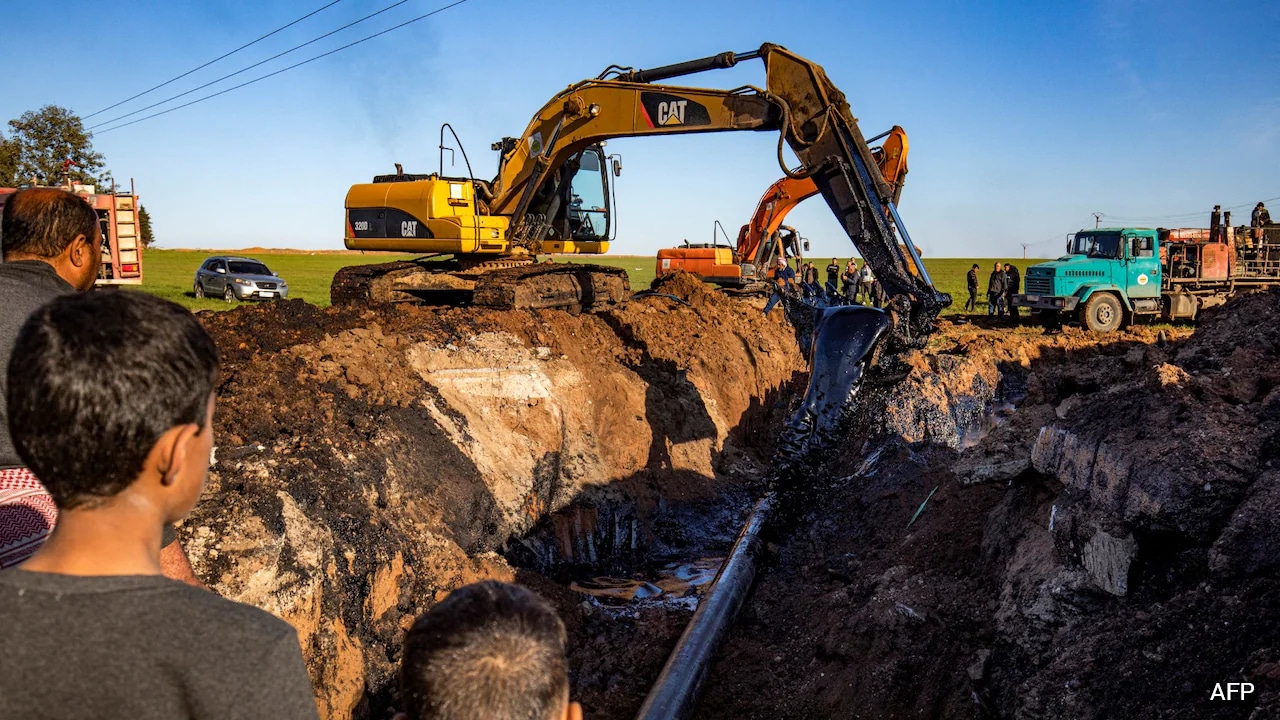
The physical security of energy infrastructure serves as the ultimate bottleneck for post-conflict state rebuilding. When the Syrian Petroleum Company reported a targeted explosive strike on a strategic crude pipeline near Tal Hamis in Hasakah province, the event exposed far more than a localized security breach. It laid bare the structural fragility inherent in attempting to centralize national resource extraction across fragmented territories.
To understand why localized pipeline attacks have an outsized impact on national macroeconomic stability, one must examine the cost function of energy transport networks.
The Cost Function of Linear Infrastructure
Pipelines are high-fixed-cost, low-variable-cost assets characterized by extreme geographic vulnerability. Unlike maritime shipping or localized trucking, a pipeline cannot reroute around a hostile zone. It represents a fixed vector of supply.
When a transmission line is severed, the economic damage manifests across three distinct vectors:
- The Capital Replacement Latency: The physical repair requires heavy machinery, specialized welding teams, and secure access corridors. In an environment constrained by sanctions and material shortages, the downtime between the blast and the resumption of flow stretches from days into weeks.
- The Refining Deficit: Refineries in Homs and Baniyas depend on a continuous, uninterrupted volume of feedstock to maintain operational thermal efficiency. Intermittent supply shocks force refineries to operate below capacity, driving up the per-barrel cost of refined products and exacerbating domestic fuel shortages.
- The Capital Allocation Diversion: Every dollar spent repairing blast damage is capital diverted from modernization, expansion, or wellhead rehabilitation. Security expenditure crowds out productive investment, trapping the state in a defensive holding pattern.
The Mechanics of Resource Insecurity in Hasakah
The northeastern corridor, particularly Hasakah province, occupies a central position in national energy logistics. The integration of fields like Rmelan and Suwaydiyah into domestic refining channels requires maintaining hundreds of kilometers of trunk lines passing through diverse demographic and security zones.
When state authorities report a succession of attacks—spanning gas transmission lines near Damascus that knock power stations offline, alongside crude pipeline breaches in the northeast—a pattern of systemic vulnerability emerges. These incidents are driven by distinct operational motivations:
- Illicit Extraction and Theft: Unauthorized tapping points and localized sabotage are frequently tied to crude theft operations. Criminal networks puncture lines to siphon fuel, transforming public infrastructure into private, illicit revenue streams while leaving the structural liabilities to the state.
- Economic Coercion and Extortion: In regions with contested control, infrastructure targeting functions as an economic lever. By disrupting energy supplies, bad actors extract protection rents from local traders or undermine confidence in central governance.
- Socioeconomic Friction: Unrest sparked by rising fuel prices creates an environment where physical attacks merge with broader public grievances. When energy transport becomes the tangible symbol of scarcity, it attracts localized hostility.
Systemic Resilience Deficits
The official response to these incidents—characterizing them as sabotage followed by security sweeps and arrests—highlights a reactive posture. While apprehending perpetrators addresses immediate tactical liability, it fails to alter the systemic risk profile of the network.
A linear asset spanning hundreds of kilometers cannot be defended purely through static-posture guarding. Without real-time telemetry, fiber-optic acoustic leak detection, and decentralized valve-isolation protocols, the network remains exposed to asymmetric disruption. Every successful strike reinforces a negative feedback loop: disrupted energy supplies constrain electricity generation, depressed electricity output slows industrial and agricultural recovery, and economic stagnation deepens the local grievances that feed instability.
Strategic Infrastructure Hardening
Securing long-distance energy corridors requires shifting from punitive deterrence to systemic resilience engineering. State authorities and energy operators must implement a three-tier defense architecture:
- Automated Isolation: Deploying automated shut-off valves tied to pressure-drop sensors to instantly isolate breached segments, limiting environmental spillage and preserving internal line pressure.
- Distributed Surveillance: Integrating aerial drone monitoring with ground-sensor grids along high-risk stretches of the Hasakah-Homs transit routes to detect unauthorized tampering before detonation.
- Asset Redundancy: Establishing modular bypass loops around known choke points to ensure that a single localized explosive event cannot completely sever the lifeline between extraction fields and coastal refineries.
Until these structural safeguards are embedded into the national energy strategy, the security of the pipeline network will remain at the mercy of asymmetric actors, dictating the ceiling of the nation's economic recovery.