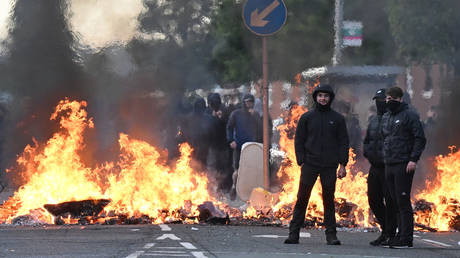
The outbreaks of urban disorder in Belfast during the summer of 2024 cannot be accurately evaluated using standard right-versus-left political taxonomies. Mainstream commentary consistently mischaracterizes these events by deploying a top-down ideological framework, assuming the friction was driven by a cohesive, digitally mobilized right-wing apparatus matching the patterns observed in mainland Great Britain. This analytical model fails because it ignores the unique structural mechanics of Northern Ireland’s socio-spatial landscape, the friction of post-Brexit economic adjustments, and the localized cost functions governing paramilitary territorial control.
By treating the Belfast riots as a mere franchise of British anti-immigration unrest, external analysts miscalculated the true operational drivers. A rigorous, data-driven diagnostic reveals that the disorder was not an ideological monoculture, but rather the cross-section of three distinct structural pillars: deep-seated spatial segregation, localized paramilitary gatekeeping, and the manipulation of post-Brexit institutional friction.
The Tri-Causal Framework of Spatial Unrest
To understand why traditional political commentary failed to predict or accurately map the Belfast disorder, the event must be deconstructed into three distinct, measurable vectors.
+-----------------------------------------------------------------------+
|                       THE SPATIAL CONTAGION MODEL                     |
+-----------------------------------------------------------------------+
|                                                                       |
|   [Pillar 1: Spatial Friction]     --> Asymmetric Urban Interfaces     |
|                                        (Interface Barriers / Peacelines) |
|                                                                       |
|   [Pillar 2: Paramilitary Rent]    --> Territorial Gatekeeping        |
|                                        (Command-and-Control Monopolies)  |
|                                                                       |
|   [Pillar 3: Institutional Tension]--> Post-Brexit Border Friction    |
|                                        (The Protocol / Windsor Framework)|
+-----------------------------------------------------------------------+
Pillar 1: Asymmetric Spatial Friction and Interface Barriers
Unlike typical metropolitan areas in Great Britain where ethnic or political enclaves feature fluid boundaries, Belfast remains architecturally segregated by interface barriers, historically designated as "peacelines." These physical structures dictate the cost function of local crowd dynamics.
In a standard urban environment, a protest crowd disperses along a radial gradient. In Belfast's working-class districts, the built environment forces a linear, high-density concentration of opposing factions along fixed geographical coordinates. The 2024 disorder demonstrated that when anti-immigration sentiment was introduced into these highly combustible, localized interfaces, it did not manifest as a purely ideological rally. Instead, it immediately defaulted to historical territorial contestation, where the physical defense or violation of a specific street corner carries disproportionate symbolic value.
Pillar 2: Paramilitary Rent-Seeking and Territorial Gatekeeping
The conventional narrative asserts that the riots were organized via decentralized digital platforms like Telegram and X, mirroring the mechanics seen in Southport or Sunderland. This hypothesis collapses under operational scrutiny.
In working-class Loyalistic and Republican enclaves, territorial command-and-control structures remain highly monopolized by legacy paramilitary elements, specifically factions of the Ulster Defence Association (UDA) and the Ulster Volunteer Force (UVF). Social media can act as a catalyst for narrative distribution, but physical mobilization inside these zones requires either the explicit sanction or tactical calculation of local paramilitary leadership.
The disorder in Belfast occurred precisely because localized paramilitary elements calculated that a controlled breakdown of public order would serve as a tactical leverage point against law enforcement. This strategy allows these groups to reassert their role as community gatekeepers and protect localized illicit economies from state policing interventions.
Pillar 3: Post-Brexit Institutional Friction
The structural background of the 2024 unrest is inextricably linked to the unresolved constitutional ambiguities generated by the United Kingdom's withdrawal from the European Union. The implementation of the Northern Ireland Protocol and the subsequent Windsor Framework created an administrative border in the Irish Sea.
This institutional shifts fundamentally disrupted the identity-equilibrium of the unionist working class. The perceived erosion of constitutional parity of esteem acted as a systemic economic and psychological stressor. When anti-immigration rhetoric weaponized the concept of "uncontrolled borders," it directly resonated with a population already primed by years of political mobilization centered on the vulnerability of Northern Ireland's maritime border.
The Failure of the Importation Hypothesis
Commentators on both the political left and right operated under the "importation hypothesis," assuming that the standard British anti-immigration narrative was seamlessly adopted by Belfast working-class youth. The operational mechanics of the riots disprove this symmetry.
| Variable | Mainland Great Britain Unrest | Belfast Urban Disorder |
|---|---|---|
| Primary Actor Network | Decentralized, digitally coordinated networks | Centralized, localized command structures with paramilitary overlap |
| Tactical Objective | Direct attacks on asylum seeker infrastructure and mosques | Territorial positioning along interface zones and retail corridors |
| Historical Counterpart | Standard post-industrial racial friction | Sectarian zero-sum territorial contestation |
| State Interaction | Uniform policing model | Highly scrutinized, multi-tiered community policing constraints |
The data points to a highly anomalous structural development during the initial phases of the Belfast unrest: the brief, highly publicized tactical convergence of individuals from traditionally antagonistic Loyalistic and Republican backgrounds under a unified anti-immigration banner. Right-wing commentators celebrated this as a paradigm shift toward a post-sectarian, class-based populist awakening. Left-wing analysts viewed it as a dangerous consolidation of fascist organizing across traditional divides.
Both interpretations missed the operational reality. This convergence was temporary and geographically confined to specific commercial sectors, such as the lower Ormeau Road and parts of central Belfast. The moment the disorder drifted toward established residential interfaces, the transient alignment fractured along historical sectarian lines. The underlying structural reality is that in Northern Ireland, local identity markers are defensive, zero-sum frameworks; they cannot be permanently overwritten by an imported digital narrative.
Quantifying the Cost of Public Disorder
A critical omission in the prevailing analysis of the riots is the quantification of the economic and operational strain imposed on the state apparatus. Evaluating the disorder through a strict resource-allocation lens reveals the limits of localized policing.
The Police Service of Northern Ireland (PSNI) operates under unique operational constraints. Unlike police forces in England and Wales, which can rapidly leverage mutual aid agreements to draw down thousands of officers from neighboring jurisdictions via the National Police Coordination Centre (NCSC), the PSNI is geographically isolated. Mobilizing reinforcing units requires an explicit political and logistical lead time, rendering the state's initial response function highly inelastic.
$$C_{\text{ops}} = \sum (M_t \cdot R_w) + D_{\text{spatial}} + I_{\text{friction}}$$
Where:
- $C_{\text{ops}}$ represents the total operational cost of containment.
- $M_t$ is the mobilization time of specialized riot units (Tactical Support Groups).
- $R_w$ is the wage and logistical premium of prolonged deployment.
- $D_{\text{spatial}}$ is the economic degradation of localized commercial corridors.
- $I_{\text{friction}}$ is the long-term depletion of community policing trust capital.
When paramilitary elements trigger localized unrest, they exploit this inelasticity. By spreading disorder across multiple disconnected interfaces—for example, Sandy Row, East Belfast, and the Antrim Road concurrently—the crowd dynamic forces a strategic over-extension of the PSNI's Tactical Support Groups. This exposure limits the state's capability to execute targeted arrests during the event, shifting the burden of justice entirely to post-incident forensic and digital investigations.
Strategic Recommendations for Risk Mitigation
To prevent the recurrence of spatial contagion in deeply divided urban centers, policymakers and law enforcement must abandon purely ideological monitoring models and focus on material, structural interventions.
1. Architectural Dissolution of Interface Vulnerabilities
The state must accelerate the phased, community-led removal of physical interface barriers, replacing them with high-definition digital surveillance corridors and integrated green spaces. Maintaining permanent physical walls provides an architectural anchor for riot dynamics, lowering the logistical barrier for crowd synchronization at historical flashpoints.
2. Disruption of Paramilitary Financial Ecosystems
Law enforcement must pivot from public order containment to aggressive financial interdiction targeting the mid-tier leadership of localized paramilitaries. Because these organizations use street disorder as a tool to negotiate operational autonomy for their illicit enterprises, suppressing the unrest requires targeting the revenue streams—such as extortion, illegal gambling, and drug distribution networks—that fund these command structures.
3. Granular Digital Threat Profiling
The PSNI's intelligence framework must differentiate between cross-channel digital noise and hyper-local mobilization signals. Monitoring global right-wing hashtags yields little actionable intelligence in a Belfast context. Instead, analytical models must track localized geolocation data, community sentiment shifts within specific housing estates, and the communication vectors used by known proxy figures associated with legacy paramilitary networks.
The final strategic reality is stark: the Belfast riots were not a sign of Northern Ireland joining a unified British right-wing movement. They were a vivid reminder that when global ideological trends enter a deeply divided society, they are quickly shaped by long-standing local conflicts, spatial divisions, and historical power structures.