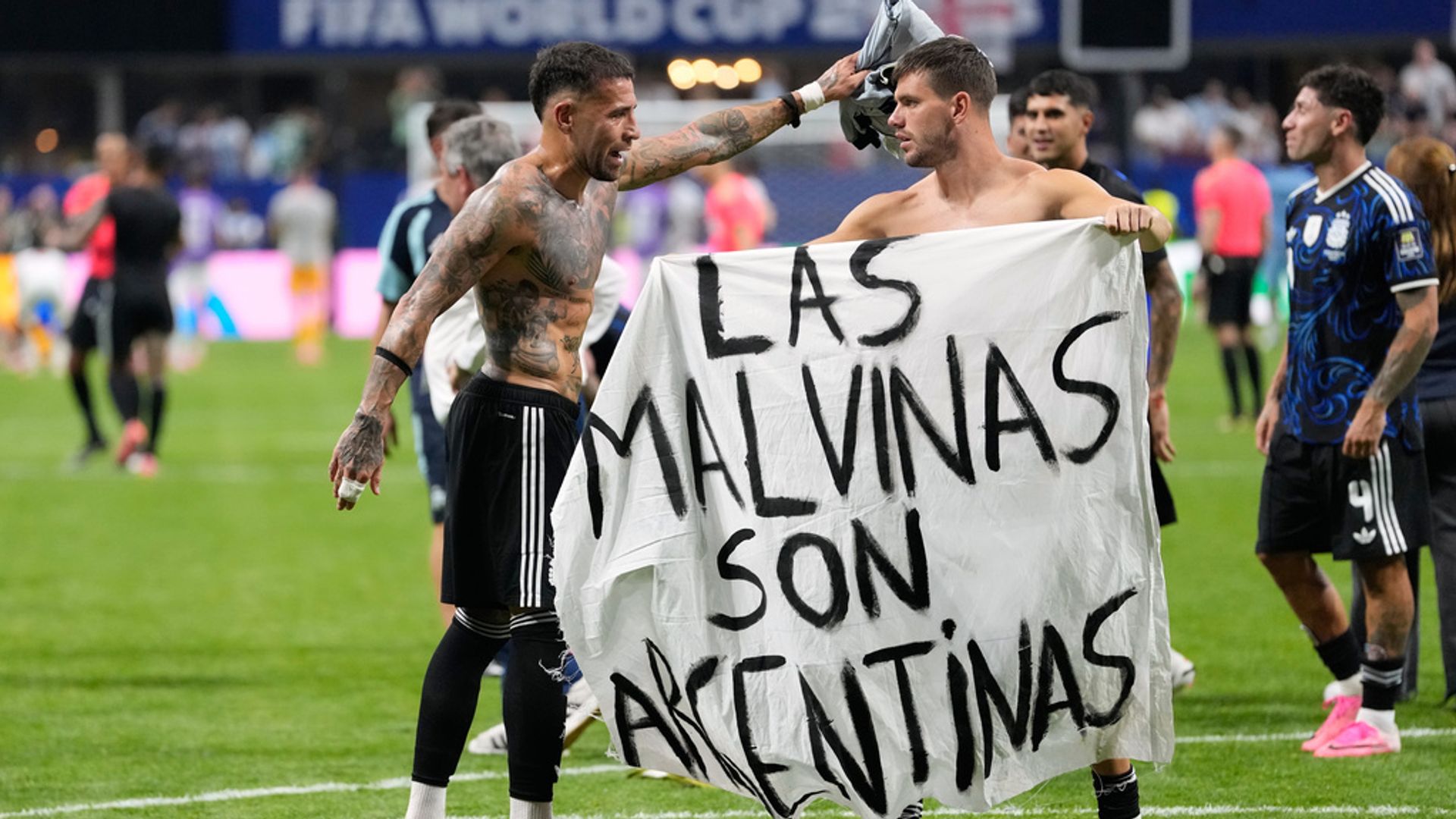
Regulatory enforcement within international sports governing bodies operates under a fundamental tension: the mandate to maintain political neutrality clashes directly with the commercial and cultural incentives of member associations. When the international governing body of association football initiates disciplinary proceedings against a national federation for geopolitical displays, the action exposes vulnerabilities in the existing judicial architecture.
The disciplinary case opened against the Argentine Football Association following public exhibitions involving Falklands War iconography and related chants provides a clear window into how regulatory bodies handle jurisdictional boundaries. Understanding this case requires moving past the immediate surface controversy to analyze the governance mechanics, the incentive structures of national federations, and the enforcement constraints of the governing body's disciplinary code.
The Jurisdictional Boundary Problem
Governing bodies derive their authority from delegated jurisdiction. Member associations voluntarily submit to a private legal order defined by statutes, disciplinary codes, and regulatory frameworks. This private legal order functions effectively only when disputes remain internal to the sport.
When national politics intersect with athletic competition, the boundaries of the regulatory framework stretch. The foundational statutes of international football prohibit political interference and political statements on the pitch or during official functions. However, enforcement mechanisms rely heavily on post-hoc reporting, subjective interpretation of intent, and discretionary sanctioning.
[Geopolitical Event] ---> [Member Association Action] ---> [Regulatory Trigger] ---> [Discretionary Enforcement]
This pipeline reveals a structural bottleneck. The governing body lacks real-time prevention capabilities for off-pitch or pre-match displays controlled by players, fans, or affiliated bodies outside the strict perimeter of the match protocol. Consequently, the regulatory response is inherently reactive. It treats symptoms rather than managing the environmental inputs that produce nationalist demonstrations.
The Economic and Cultural Incentives of National Federations
National football associations operate under dual pressures. Economically, they function as commercial enterprises maximizing broadcast rights, sponsorship revenue, and tournament performance bonuses. Culturally, they act as vectors of state identity and nationalist sentiment.
For associations representing countries with active territorial disputes or deeply embedded historical narratives, nationalist displays offer high domestic utility. The political capital gained within the domestic constituency frequently outweighs the marginal financial cost of a disciplinary fine levied by the international body.
- Domestic Legitimacy: Aligning with popular sentiment regarding sovereignty or historical grievances shields leadership from internal criticism.
- Cost-Benefit Asymmetry: A standard monetary sanction or stadium capacity restriction operates as a flat tax rather than a behavioral deterrent when weighed against the value of populist alignment.
- Plausible Deniability: Associations often partition responsibility between official administrative organs, player groups, and organized fan factions, creating legal insulation during investigations.
This strategic alignment means traditional deterrence models fail. If the penalty imposed by the disciplinary committee is lower than the political return generated by the infraction, the regulation ceases to function as a deterrent and instead becomes a predictable operational expense.
The Mechanics of Disciplinary Enforcement
The operational workflow of the disciplinary committee follows a standardized judicial process, yet its structural efficacy is limited by evidentiary hurdles and precedent constraints.
Initiation and Investigation
Proceedings begin via reports submitted by match officials, security officers, or independent monitoring organizations. In cases involving geopolitical banners or chants captured outside the immediate ninety minutes of match time, gathering admissible evidence requires coordination with local law enforcement and venue operators. This introduces friction and latency into the enforcement timeline.
Legal Categorization
The committee must map the observed behavior to specific articles within the disciplinary code. Typically, infractions of this nature fall under provisions concerning discriminatory behavior, bringing the game into disrepute, or using sports events for political demonstrations. Each category carries distinct evidentiary thresholds. Proving intent to discriminate differs significantly from proving a political demonstration, yet public discourse often conflates the two.
Sanctioning Discretion
The range of available penalties spans from private warnings and financial fines to point deductions, playing matches behind closed doors, or tournament exclusion. Because regulatory bodies prioritize commercial continuity and diplomatic equilibrium with powerful member associations, maximum penalties are rarely deployed for introductory or isolated infractions. This creates a graduated sanctioning curve that heavily favors leniency for major federations compared to smaller entities with less geopolitical leverage.
Systemic Vulnerabilities in International Sports Governance
The recurrence of geopolitical incidents in football highlights three structural weaknesses in the current governance model.
First, the enforcement mechanism is decentralized and uneven. Because investigations depend on external reporting and committee discretion, enforcement appears arbitrary. Similar infractions committed by different associations frequently yield divergent punitive outcomes based on the prevailing political climate or the commercial weight of the federation involved.
Second, the definition of political neutrality lacks operational clarity. While explicit slogans are easily identifiable, historical iconography, regional maps, and cultural chants occupy a gray zone where legal interpretation becomes subjective. Without quantitative metrics or explicit baseline definitions for what constitutes a political violation, judicial consistency remains impossible.
Third, the institutional design separates rule-making from enforcement capacity. The body that writes the statutes is insulated from the day-to-day enforcement reality managed by independent committees, yet the executive leadership retains political influence over broader governance trajectories. This structural separation can create institutional paralysis when high-profile federations are implicated.
Strategic Reform Vectors
Resolving the friction between international sport and geopolitical expression requires a pivot from punitive deterrence to structural containment.
- Automated Baseline Standards: Replace subjective committee discretion with strict liability thresholds, where specific categories of banners or chants trigger automatic, non-negotiable administrative penalties regardless of the federation's size or political influence.
- Operational Decoupling: Insulate the judicial bodies entirely from executive commercial interests through tenure-protected appointments and transparent, publicly accessible jurisprudence records.
- Pre-Match Compliance Audits: Shift the intervention window upstream by requiring certified venue security plans that actively screen for prohibited geopolitical artifacts before stadium gates open, shifting liability directly to match organizers for oversight failures.
The ongoing disciplinary proceedings against the Argentine Football Association are a symptom of a deeper governance design flaw. Until regulatory frameworks align enforcement costs with the actual domestic political value of non-compliance, international bodies will remain trapped in a reactive cycle of fines and appeals, unable to alter the underlying incentives driving nationalist expression within the sport.