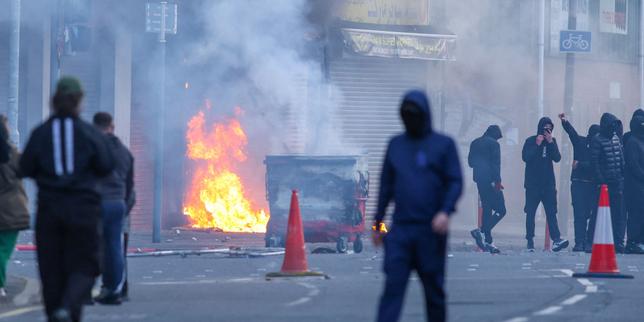
Civil unrest following high-profile violent incidents follows a predictable, non-linear progression. The recent disturbances in Belfast, triggered by a stabbing incident, represent a textbook manifestation of a threshold-driven cascade. When a community experiences a sudden, traumatic event, the immediate aftermath creates an information vacuum. In the absence of verifiable data, localized grievances and pre-existing socio-political friction points accelerate the transition from online rhetoric to physical property destruction. To understand this phenomenon, analysts must bypass superficial media narratives and instead dissect the underlying mechanics: the trigger event, the digital amplification vectors, and the physical mobilization thresholds that govern urban riots.
The Tripartite Framework of Civil Escalation
Urban unrest does not materialize in a vacuum; it requires the convergence of three distinct structural pillars. If any single pillar is absent, the system remains volatile but stable. When all three intersect, a localized incident rapidly scales into systemic disorder.
1. The Catalyst and Information Asymmetry
The lifecycle of a riot begins with a high-salience trigger—typically an act of violence that violates core societal expectations of safety. In this instance, a knife attack serves as the catalyst. During the initial hours of such an event, official communication channels operate under strict legal and investigative constraints, producing minimal public data. This creates an information asymmetry. Speculative actors exploit this void by injecting unverified details regarding the perpetrator's identity, nationality, or legal status. The speed of narrative adoption during this phase is inversely proportional to the volume of verified facts available.
2. Digital Contagion and Network Clustering
The transition from a localized shock to widespread mobilization occurs via digital networks. Algorithmic distribution systems on social platforms prioritize engagement, which correlates heavily with high-arousal negative emotions such as outrage and fear.
- Network clusters form around hyper-partisan nodes.
- Decentralized coordination channels (e.g., encrypted messaging apps) allow distributed actors to synchronize logistics without centralized leadership.
- Spatial coordination markers, such as specific street intersections or public landmarks, are established rapidly through viral geotagging.
3. Structural Vulnerability and Spatial Friction
The physical manifestation of a riot requires a receptive urban environment. Areas characterized by long-term economic stagnation, high youth unemployment, and historical friction with state institutions possess a lower threshold for mobilization. The physical geography of Belfast, with its historical segregation markers and highly localized community identities, compresses the spatial footprint required for a crowd to achieve critical mass. Arson, specifically targeting commercial properties or vehicles, serves an operational purpose for rioters: it creates physical barriers that disrupt law enforcement mobility and forces a redistribution of emergency response resources.
Threshold Models of Collective Behavior
To quantify how peaceful observers transform into active participants, economists and sociologists utilize threshold models of collective behavior. Every individual within a crowd possesses an internal threshold—the number of other people who must act before they decide to join.
[Trigger Event] ➔ [Information Vacuum] ➔ [Digital Amplification] ➔ [Low-Threshold Actors Move] ➔ [Cascade Effect] ➔ [Systemic Unrest]
In the early stages of the Belfast unrest, the crowd consisted primarily of low-threshold actors: individuals highly radicalized or pre-disposed to violence who required zero external validation to engage in arson. However, as the physical footprint of the crowd expanded and visible law enforcement resistance appeared constrained, the perceived cost of participation dropped. This shifts the calculation for medium-threshold actors. The visual cue of burning infrastructure signals a temporary suspension of legal consequences, drawing in individuals who would otherwise remain passive observers.
This cascade effect explains why counter-protests or secondary mobilizations occur in the days immediately following the initial event. The escalation is not a continuous line but a series of step-functions driven by visibility, perceived impunity, and narrative reinforcement.
Deconstructing the Economic and Logistical Cost Functions
The true impact of urban disturbances extends beyond immediate property damage metrics. The operational costs can be categorized into three primary vectors that compound over time.
Direct Infrastructure Depletion
The immediate financial toll includes the destruction of commercial storefronts, public transport assets, and private vehicles. Arson acts as a force multiplier for economic damage. A single vehicle fire requires multi-agency deployment, neutralizing fire service personnel who would otherwise manage broader property protection. For small businesses in the affected sectors, the capital expenditure required to rebuild often exceeds insurance caps, leading to permanent localized disinvestment.
Law Enforcement Operational Strain
Public order policing operates under strict resource constraints. Managing distributed, multi-focal riots requires shifting from community-oriented policing models to containment and dispersal tactics. This creates an operational bottleneck.
- Tactical units must be deployed in heavy protective gear, limiting their endurance and operational lifespan.
- Geographical dispersion forces commanders to dilute their presence across multiple flashpoints, increasing the vulnerability of static targets.
- The financial cost of sustained overtime, logistics, and mutual aid agreements rapidly depletes municipal budgets, diverting funds from long-term community stabilization initiatives.
The Friction of Reputation and Long-Term Disinvestment
The long-term economic consequence of highly publicized unrest is the inflation of risk premiums. Institutional investors evaluate political and social stability when allocating capital. Visual documentation of fires, clashes with police, and targeted attacks on infrastructure recalibrate the risk profile of a city. This manifests as increased commercial insurance premiums, depressed tourism metrics, and a contraction in localized real estate valuations.
Strategic Mitigation Frameworks for Urban Volatility
Managing and preventing the escalation of narrative-driven urban unrest requires a shift from reactive policing to predictive, systems-based intervention. Standard crowd control mechanisms are insufficient when dealing with decentralized, digitally mobilized networks.
Rapid-Response Information Stabilization
The primary vulnerability in the early hours of a crisis is the information vacuum. State authorities must establish a dominant information position immediately. While legal restrictions prevent the release of sensitive investigative details, agencies must communicate the process transparently. Nature abhors a vacuum, and so does the internet; filling the void with procedural updates reduces the shelf-life of malicious disinformation.
Network Decoupling and Spatial Containment
From a logistical standpoint, law enforcement must disrupt the physical and digital synchronization of rioters. Digitally, this involves monitoring open-source intelligence to identify coordination nodes before they manifest physically. On the ground, static containment (kettling) must be deployed selectively to prevent the merger of distinct crowd clusters. Isolating low-threshold agitators from medium-threshold observers prevents the cascade model from achieving critical mass.
Targeted Economic Resilience Corridors
Post-incident recovery must prioritize the immediate restoration of physical infrastructure. Leaving burnt vehicles or damaged storefronts visible serves as a continuous visual cue that reinforces the narrative of state incapacity. Rapid municipal cleanup crews must operate in tandem with public order forces to erase the physical signatures of unrest within hours, signaling a return to structural control and reducing the psychological likelihood of secondary cascades.
The Predictive Trajectory of Fractured Jurisdictions
The events in Belfast are indicative of a broader systemic trend where localized criminal acts are instantaneously weaponized to serve macro-level political narratives. As digital communication tools become more sophisticated, the latency between a physical trigger event and coordinated urban unrest will continue to compress. Municipalities that rely purely on reactive, brute-force policing models will find themselves perpetually behind the operational curve. Future stability depends entirely on a state's capacity to manage the information ecosystem with the same speed and strategic precision that it deploys on the physical streets. The baseline requirement for modern governance is no longer just physical security, but the cognitive stabilization of the public square under conditions of acute asymmetric stress.