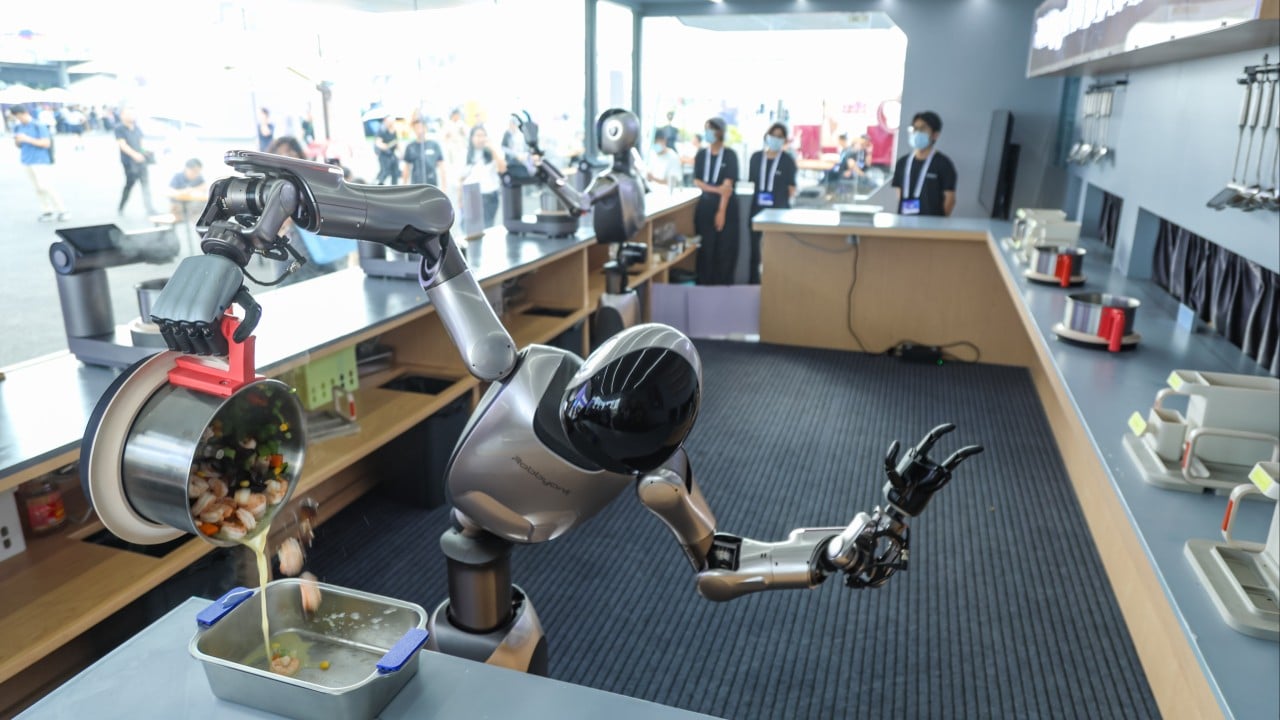
Everyone wants software that talks. Few know how to build hardware that walks.
Ant Group didn't get rich by sticking to mobile wallets and payment buttons. They built an empire on digital trust, and now they want to own the physical manifestation of intelligence. Enter Robbyant, Ant Group's dedicated embodied AI arm. While tech headlines obsess over chatbots, companies like Robbyant are quietly securing capital, spinning out initiatives, and building the foundational platforms required to bridge digital logic with physical reality.
If you are wondering why a fintech giant suddenly cares about actuators, sensors, and bipedal movement, you have to look past the spreadsheets. The real play isn't software anymore. It's the physical world.
The Shift From Chat to Action
For years, artificial intelligence lived behind a glass screen. You typed a prompt. The model spat out text. It was clean, predictable, and entirely disconnected from physical labor.
That era is over. Robbyant operates on a simple premise: intelligence needs a body to change the world.
Building a robotic foundation requires solving problems that code alone cannot touch. You need spatial perception, real-time causal reasoning, and hardware durable enough to handle messy human environments. Ant Group's entry into this arena isn't a random corporate hobby. It is a calculated infrastructure play. They spent decades mastering transaction data and large-scale concurrency. Applying those same architecture principles to robot swarms and spatial computing models is the next logical step.
When Robbyant kicks off external funding and opens up its technical stack via platforms like Hugging Face and GitHub, they aren't just looking for venture capital. They are building an ecosystem.
Why Embodied AI Changes the Venture Math
Traditional hardware startups fail because physical products are expensive to iterate. Software moves fast and breaks things. Hardware breaks bones, bends metal, and eats cash reserves.
So why are investors lining up to fund embodied AI projects like Robbyant and its industry peers?
- The Labor Gap: Global demographics are shifting. Aging populations mean fewer workers for manufacturing, eldercare, and logistics.
- Model Maturity: Foundation models finally possess enough general spatial reasoning to navigate unstructured environments without crashing into walls.
- Data Flywheels: Robots that interact with the physical world generate proprietary training data that text models can never replicate.
Ant Group's aggressive posture in this sector—backing multiple robotics startups alongside building internal powerhouses like Robbyant—signals a race for supply chain control. Whoever defines the standard operating system for physical AI will dictate terms to every hardware manufacturer on the planet.
What Developers and Founders Need to Know
If you are building in the robotics or AI space, you cannot afford to ignore what is happening in Hangzhou. The playbook is changing.
Stop treating hardware and software as separate buckets. The companies winning funding rounds right now are those integrating perception models directly with actuation layers. If your pitch deck relies entirely on a better LLM wrapper, investors will ghost you. You need to show how your software interacts with gravity, friction, and real-world unpredictability.
Robbyant's open-source contributions—ranging from 3D scene reconstruction models to video-action world models—lower the barrier to entry while raising the ceiling for performance. They are giving developers the bricks. They expect the market to build the cathedral.
The gold rush for digital screens ended a decade ago. The scramble for physical intelligence is happening right now, and the capital is following the code into the real world.


