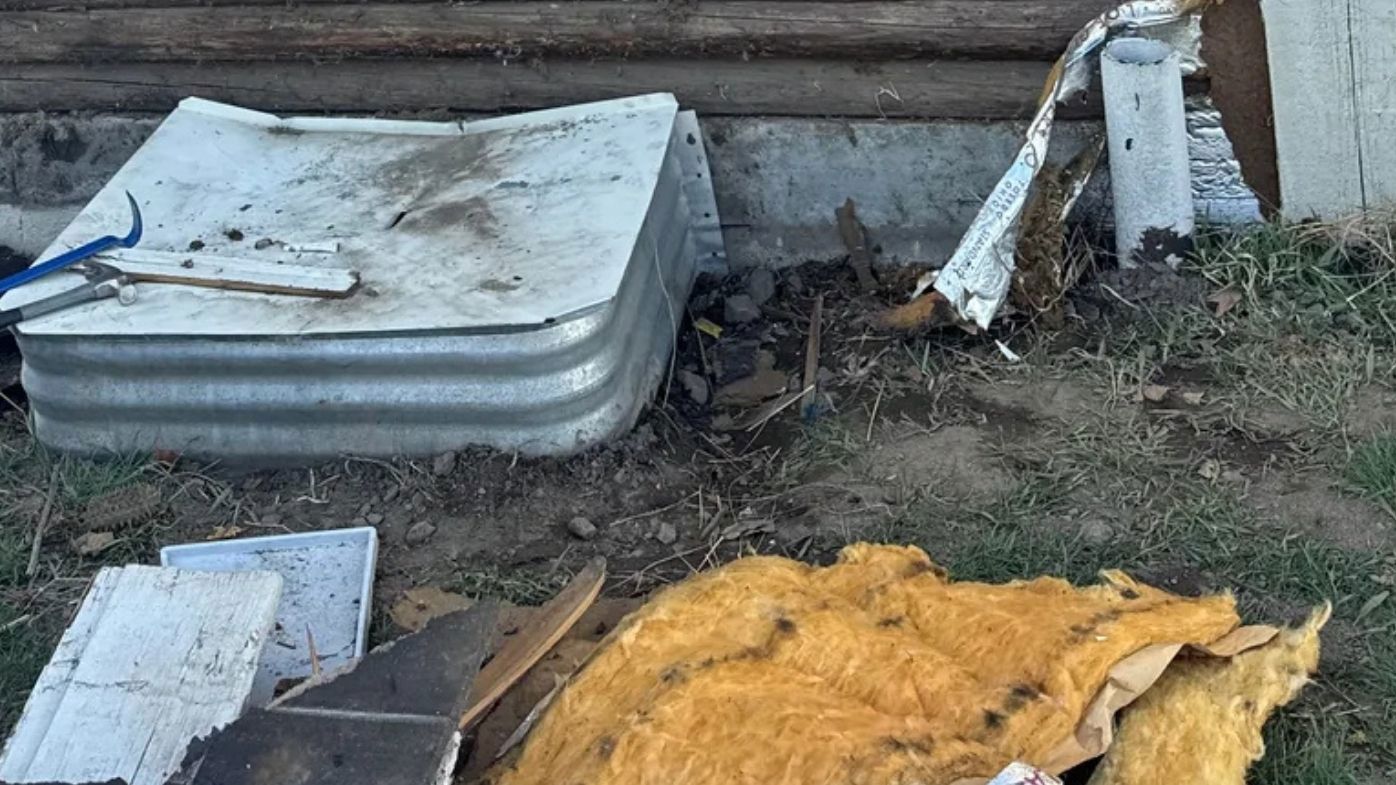
When a construction crew peeled back the dated drywall of an unremarkable commercial space last week, they didn't just find mold or insulation. They found a century of history that had been effectively erased by the aesthetic choices of the 1980s. Behind the beige, textured surfaces lay a pristine, hand-carved mahogany interior and original stained glass that had been suffocated by a false wall for over forty years. This isn’t an isolated incident of luck. It is a symptom of a broader, systemic trend in urban development where "modernization" often means burying the past under cheap, temporary fixes.
The phenomenon of finding a century-old secret hidden behind a 1980s covering speaks to a specific era of architectural insecurity. To understand why someone would choose to board up priceless craftsmanship in favor of plywood and linoleum, you have to look at the economic and cultural pressures of the late twentieth century. Property owners weren't trying to preserve the past for a future generation; they were trying to escape it. They saw the intricate details of the early 1900s not as assets, but as liabilities that signaled age, decay, and high maintenance costs.
The Great Erasure of the Eighties
The 1980s represented a radical departure from the ornamental. It was a decade defined by the "clean slate" mentality. In a rush to look corporate, efficient, and futuristic, developers across the country took a hammer to the Gilded Age. If a feature was too expensive to polish, they didn't remove it—that cost too much in labor. Instead, they built over it.
They used furring strips and gypsum board to create flat, sterile boxes. This created a literal "dead space" between the 1920s and the 1980s. This gap, often measuring only a few inches, became a vacuum-sealed time capsule. For forty years, these hidden interiors remained untouched by UV rays, cigarette smoke, or the wear and tear of human hands.
The irony is thick. The very materials used to "update" these buildings—cheap drywall, synthetic adhesives, and plastic moldings—are now the first things to be ripped out during modern restorations. The 1980s layers have aged poorly, while the craftsmanship they sought to hide has only gained value. We are currently witnessing a massive reversal of this trend as property values in historic districts are increasingly driven by the "authenticity" of exposed brick, original woodwork, and high ceilings.
Why We Bury the Best Parts
There is a psychological component to these discoveries that goes beyond simple construction. It’s about the "modernity trap." Every generation believes its current aesthetic is the final, most refined version of taste. In the 1980s, the goal was to eliminate the "clutter" of the past.
The Cost of Convenience
In 1984, it was significantly cheaper to install a drop ceiling than to repair 100-year-old plaster crown molding. A drop ceiling hides HVAC ducts, electrical wiring, and the cracks of a settling building. It was a functional choice. However, as an industry analyst, I see this as a form of architectural debt. By choosing the easy path, those owners deferred the true value of the building. They traded long-term equity for short-term utility.
The Preservation Paradox
When we find these hidden rooms or facades today, we treat them as miracles. But they are actually failures of stewardship. The only reason these features survived is that they were forgotten. Had they remained exposed during the 1990s or early 2000s, they likely would have been "refurbished" into oblivion—sanded down, painted over with white semi-gloss, or stripped for parts.
The Economics of the Reveal
Uncovering a hidden 19th-century interior isn't just a win for local historians. It is a massive financial windfall for property owners. In the current real estate market, "original features" can command a premium of 20% to 30% over standardized modern renovations.
But the "reveal" process is fraught with risk. You cannot simply swing a sledgehammer at a 1980s wall and hope for the best.
- Asbestos Risk: Most coverings from the late 70s and early 80s utilized joint compounds or floor tiles containing asbestos. Breaking into a hidden space can release fibers that shut down a site for months.
- Structural Integrity: Sometimes, the 1980s "skin" is the only thing holding up a crumbling 1900s interior. When the drywall comes down, the history often starts to fall with it.
- Environmental Degradation: Once you expose wood or fabric that has been sealed away for forty years, the sudden change in humidity and temperature can cause rapid warping or rot.
The "why" behind the discovery is often as interesting as the "what." In many cases, these coverings were installed to meet fire codes of the era. The thick, ornate woodwork of the Victorian or Edwardian eras was seen as a fire hazard. Covering it in fire-rated drywall was the only way to keep the building legal without a total gut job. Today, with modern sprinkler systems and fire-retardant clear coats, we can finally let these rooms breathe again.
A Ghost in the Walls
I recently spoke with a contractor who found a fully intact soda fountain behind a wall in a Midwestern pharmacy. It wasn't just the counter. The glasses were still on the shelves. The owner in the 80s didn't even bother to clear the inventory before sealing the wall. This highlights the sheer speed of the cultural shift. We went from a society that valued the "third place"—the social hub—to one that valued the cubicle and the drive-thru.
The 1980s covering wasn't just a physical barrier; it was a cultural one. It represented a desire to look forward so intensely that we became blinded to the ground we were standing on.
The Industry Shift
We are now entering a "Post-Drywall Era." High-end retail and luxury residential projects are moving away from the "white box" look. The demand for "raw" and "honest" materials has led to a surge in investigative demolition. Architects are now hired specifically to find what might be lurking behind the renovations of the 1970s and 80s.
This isn't just nostalgia. It’s an acknowledgment that we have lost the ability to build with that level of detail at scale. To recreate a hand-carved mahogany bar today would cost ten times what it did in 1910, even adjusting for inflation. The labor doesn't exist. The old-growth wood doesn't exist. These hidden treasures are non-renewable resources.
The Future of the Hidden Past
As we continue to strip away the mistakes of the late twentieth century, we have to ask what we are installing in their place. Are we just creating another layer that a journalist in 2060 will mock as "cheap 2020s minimalism"?
The trend of "industrial chic" often involves stripping buildings down to their bones. While this honors the original structure, it also risks removing the soul of the building if not handled with care. The goal should not be to turn every building into a museum, but to integrate these high-quality historical elements into a functional, modern space.
The lesson of the century-old secret is simple. Quality lasts. Trends die. The 1980s tried to bury the 1900s, but the 1900s won the long game.
Check the hollow sound of your office walls. There might be a masterpiece waiting for the light of day.


