The frost on the iron rail of the balcony does not care about doctrine. It clings to the gray metal in the quiet hours before dawn, turning the perimeter fence of a courtyard in Pyongyang into a jagged row of white teeth. Down on the street, a tram hums, its spark catching blue against the overhead wire. People move through the morning mist with the heavy, practiced tread of those who have learned to measure their lives in centimeters of clearance. They pull their coats tight. They buy small paper bags of roasted sweet potato from a cart. They do not look up at the gray hills surrounding the city, hills that conceal things made of steel and concrete, things designed to split the sky.
We talk about geopolitics as if it were a game of chess played by ghosts on a polished mahogany board. We move abstractions across a map. We use terms like deterrence, escalation, and strategic parity. We forget the weight of the air inside a concrete bunker when the countdown reaches zero.
Consider what happens next when a state decides that mere defense is an invitation to its own erasure.
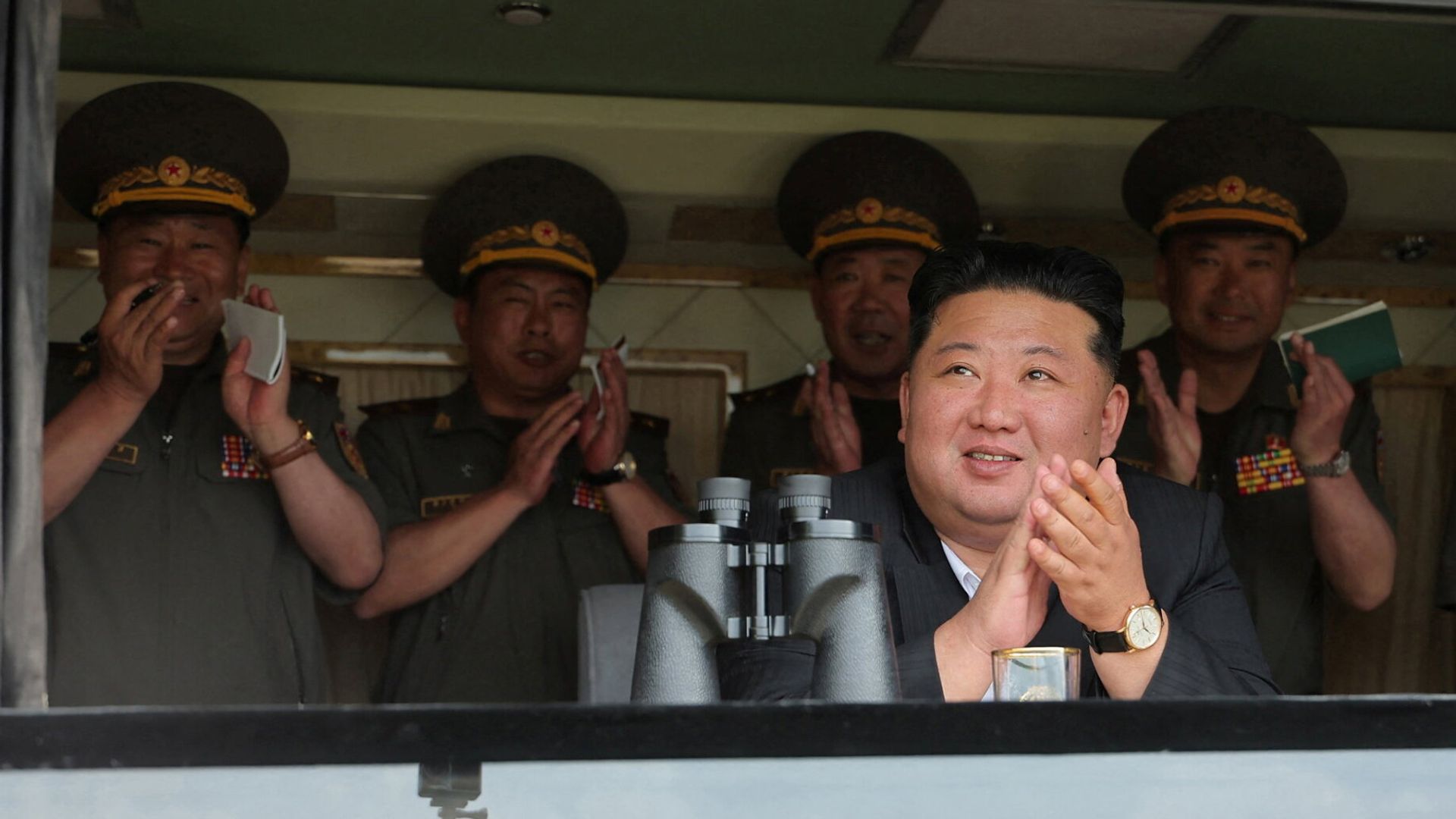
In the state-run newsrooms of North Korea, the vocabulary is always absolute. There is no room for hesitation. When a missile leaves its cradle, tearing through the cloud cover with a sound that flattens the grass for half a mile, the official pronouncements that follow are not just announcements of technological milestones. They are existential declarations. The recent launch—timed precisely to the sharpening rhetoric that the country must possess the means to render an enemy's survival impossible—is a symptom of a much deeper, much older terror.
Fear breeds symmetry. If you convince yourself that the other side is sharpening a knife to sever your throat, you do not look for a shield. You look for a longer blade.
I remember standing near the border in the late autumn, years ago, watching the horizon blur into a single, indifferent wash of gray. The silence there is not peaceful. It is loaded. It feels like holding your breath underwater, waiting for your lungs to burn so badly that the pain overrides the instinct to stay quiet. That is the daily climate of the Korean peninsula. It is a psychological pressure cooker where every diplomatic stall, every joint military exercise across the water, and every sanction package signed in a distant capital adds another degree of heat to the vessel.
The official line from Pyongyang is stark. It is built on a simple, terrifying deduction: if the cost of an attack is total annihilation, the attack never comes.
This is the logic of mutual exclusion pushed to its absolute limit. It rejects the idea of limited war. It rejects the idea of proportional response. By stating openly that its strategic capability must be capable of making an opponent's survival impossible, the regime is not merely rattling sabers for domestic consumption. It is codifying a doctrine of extreme finality. It is drawing a circle in the ash and daring anyone to step across it.
Look closer at the mechanics of this escalation.
For decades, the standard playbook of international relations relied on graduated deterrence. You show strength to prevent a fight, but you leave an exit ramp. You keep the stakes low enough that both sides can back down without losing their dignity or their regime security. But what happens when one side concludes that exit ramps are illusions? What happens when they believe that any compromise is simply a delayed defeat?
They build bigger rockets. They test solid-fuel engines that can fire without hours of cumbersome preparation. They miniaturize warheads not because they want to use them on a Tuesday morning, but because they believe that possessing them is the only remaining guarantee of tomorrow.
It is a tragic misreading of security, shared by all parties involved. Washington sees a rogue state acquiring the keys to global instability. Seoul sees a gun pointed directly at its suburbs, where millions live within range of conventional artillery, let alone strategic systems. Pyongyang sees a historic empire of capital waiting to finish the war that started in the summer of 1950.
Nobody is entirely wrong. Everybody is trapped.
Let us step inside a hypothetical control room during one of these launches, grounded in the known procedures of state-managed missile programs. The light is fluorescent and sickly green. The technicians wear tunics that smell faintly of machine oil and institutional detergent. Their fingers move across analog switches and modern glass displays with the precise, mechanical grace of pianists who have practiced the same dark sonata a thousand times. There are no cheers when the telemetry locks in. There are only narrow eyes and tight jaws. Success here is not a celebration; it is a temporary reprieve from disgrace.
When the news breaks internationally, it arrives stripped of this atmosphere. It becomes a headline on a smartphone screen between a weather update and a celebrity gossip column. We scroll past it. We process the phrase missile launch the same way we process a traffic report.
That is the real danger. Not just the physical fallout of a miscalculation, but the numbness that settles over the rest of the world. We have grown accustomed to the edge of the precipice. We treat the brink as a permanent address.
The declaration that an enemy's survival must be made impossible is not just a military benchmark. It is a confession of profound weakness. It is the language of a nation that believes it is entirely alone in the dark, surrounded by shadows that want to swallow it whole. When a government backs itself into that kind of corner, it stops caring about the furniture. It starts stacking the kerosene cans against the door.
We map out defense shields. We station aircraft carriers in the blue waters of the Pacific. We draft resolutions that pass through the United Nations like dry leaves through an iron grate. And still, the smoke rises from the testing grounds. Still, the technicians solder their circuits in the green-tinted light. Still, the frost forms on the iron rails of Pyongyang while the world sleeps, indifferent to the math of its own undoing.
The winter wind sweeps down from the Yalu River, carrying the scent of coal smoke and frozen earth across the fields. Somewhere in the dark, a tracking radar rotates in a slow, silent circle, sweeping the empty sky for ghosts that never arrive, and enemies that are always waiting.