The coffee in the glass cup had gone cold hours ago, forming a thin, oily ring around the rim. In New York, beneath the cavernous, vaulted ceilings of the United Nations headquarters, the air smelled of floor wax, bottled water, and the quiet panic of men whose spreadsheets measure human catastrophe in percentages. Outside, the autumn wind whipped down First Avenue, but inside, the climate was carefully controlled, sterile, and entirely divorced from the mud freezing over the trenches five thousand miles away.
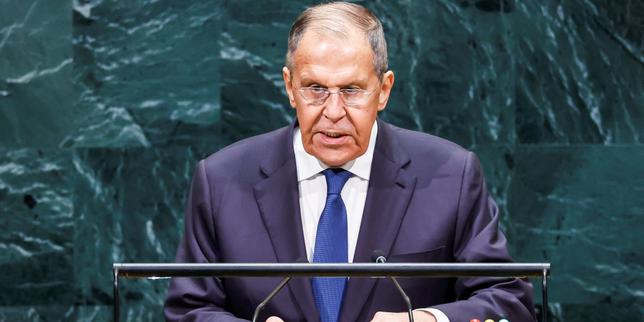
Sergei Lavrov stood at the podium. His voice carried the gravelly, practiced cadence of a man who has survived decades of diplomatic knife-fights. He did not raise his voice. He did not need to. When you hold the veto, you can afford to whisper.
Europe, he told the room, was doing "everything" to thwart negotiations.
The phrase hung in the chamber like smoke. To a casual observer sitting in the gallery, it sounded like standard diplomatic theater—the routine, rhythmic trading of blame that has characterized every major conflict since the League of Nations dissolved into whispers. But beneath the polished veneer of the UN press briefing room, the accusation struck a raw nerve. Because behind the closed doors of foreign ministries from Berlin to London, a grim calculation was taking place. The diplomats were not merely managing a war; they were managing the agonizing, structural reality of a continent trapped between a fire it cannot extinguish and an outcome it cannot bear to accept.
Consider what happens when a war stops being a sudden emergency and hardens into the weather.
In a small village in the Donbas—let us call it Hrafivka, though it could be any collection of shattered brick and blown-out windows—there is no diplomacy left. There is only the cellar. A woman named Olena sits by the faint glow of a battery-operated lantern, listening to the rhythmic thud of artillery six kilometers to the west. Her kitchen roof collapsed three winters ago. She has not spoken to her son in Zaporizhzhia since the cellular towers went dark during the offensive of twenty-three.
When Olena hears that statesmen in Geneva or New York are arguing over the architecture of peace, she does not feel hopeful. She feels a cold, hollow dread. Because in her world, peace has become a bargaining chip used by men who sleep in soft beds, a theoretical construct debated by people who have never had to scrape ice off the inside of a pantry door.
The accusation leveled at the United Nations was not born in a vacuum. It was the public manifestation of a deeper, quieter fracture point between Western capitals and the wider international community. For months, European capitals have maintained a posture of absolute solidarity: no talks without Kyiv, no compromise on sovereignty, no premature freezing of the lines. It is a stance born of moral clarity and existential self-preservation. If a sovereign border can be erased by artillery, the map of the entire continent becomes a draft in pencil.
Yet, as the economic strain of sanctions deepens, and as the industrial capacity to churn out artillery shells strains against the sheer attrition of the front lines, a quiet anxiety has bled into the corridors of power.
There are two kinds of peace. There is the peace of the victor, which requires the complete collapse of one side's will to fight. And there is the peace of exhaustion, where both sides simply bleed out until the cost of continuing exceeds the value of the objective.
Right now, Europe is terrified of the second kind.
A negotiated settlement born of exhaustion—a partition, a ceasefire along current lines, a jagged scar carved permanently across the fertile plains of Ukraine—would not be peace. It would be a ceasefire with a stopwatch attached. It would reward the aggressor with stolen acreage, validating a template for modern conquest that would leave every nation from the Baltic to the Black Sea sleeping with one eye open. This is why European leaders stiffen their spines whenever whispers of backchannel talks begin to circulate. It is why every diplomatic initiative floated by neutral third parties is met with immediate, polite, but absolute resistance.
From Moscow's perspective, this refusal is framed as obstinacy—a deliberate prolongation of suffering driven by distant capitals that pay for the war in currency while Ukraine pays in blood. From Brussels and London, it is framed as the ultimate defense of the international order.
Both narratives contain a terrifying kernel of truth.
Walk through the streets of Warsaw or Riga, and you will see the tension etched into the faces of policy analysts and ordinary citizens alike. They know what happens if the line gives way. They remember the archives. They know that dictatorships do not stop because they are asked politely; they stop when they hit a wall they cannot climb. Consequently, the European diplomatic corps has locked itself into a posture of uncompromising defense, treating any suggestion of immediate compromise not as a path to relief, but as a slow-acting poison.
Meanwhile, the Global South watches this choreography with a mixture of frustration and alienation. In capitals from Nairobi to Jakarta, the war in Ukraine is not viewed through the lens of a historic existential struggle for European democracy. It is viewed as a localized European fire that is currently scorching global supply chains, driving up the price of grain, inflating the cost of fertilizer, and threatening millions with food insecurity. To an ambassador from a developing nation, the diplomatic gridlock at the UN is not a principled stand against aggression; it is a stubborn refusal by wealthy nations to acknowledge that the rest of the world is starving while Europe debates the metaphysics of sovereignty.
This is the invisible fault line of our era.
It is a collision between absolute principles and absolute necessity. Principles do not burn calories. Sovereignty does not fill a grain silo. But pragmatism without principles is merely an invitation for the strong to devour the weak.
Back in Hrafivka, Olena does not know the word geopolitics. She only knows that the walls of her cellar are damp, that the tea is bitter, and that the distant thudding has started up again, rhythmic and uncaring, marking the passage of another hour in a war that everyone knows how to start, but nobody knows how to finish.
The speeches at the United Nations finished by evening. The delegates packed their leather portfolios, stepped into waiting town cars, and vanished into the Manhattan traffic, leaving behind a trail of press releases and translated transcripts that would be filed away in cabinets before midnight. The transcripts recorded accusations of bad faith, defenses of international law, and warnings about the fragility of global security.
None of them recorded the sound of the wind sweeping across the eastern plains, rattling the loose corrugated iron on a ruined roof, where a woman sat in the dark, waiting for a morning that felt entirely indistinguishable from the night before.


