Stand on the ice of Baffin Bay in January. The air does not merely chill; it bites with teeth of salt and frost, turning every breath into a plume of gray smoke that vanishes into the polar dark. Beneath your boots, the ocean moves in heavy, black swells, sealed under a lid of frozen salt three feet thick. It is a place of absolute stillness and crushing weight.
And then, a sound.
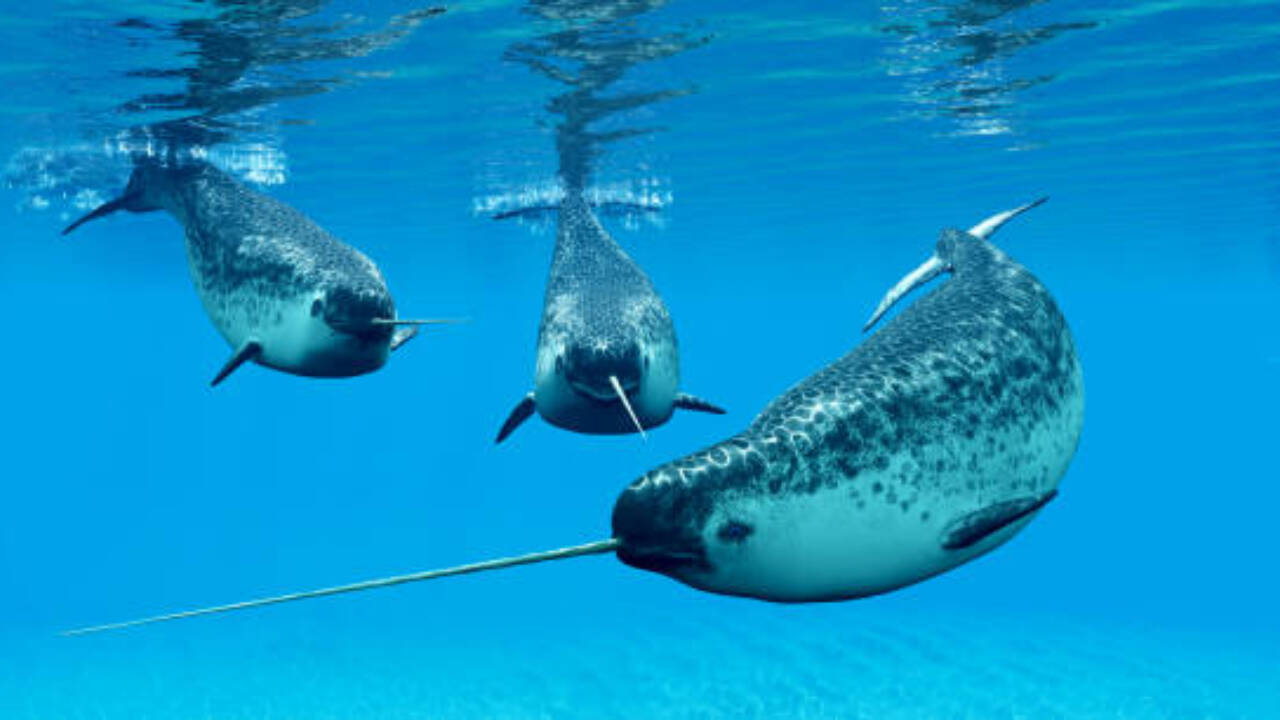
It is a sharp, breathy gasp—the phooosh of compressed air escaping an icy lung. You turn. Ten yards away, breaking the skin of a newly formed lead in the ice, rises a creature that belongs to ancient myth. A whale. But not just any whale. A pale, ghost-like apparition of the high north, bearing a weapon that defies the basic rules of biological engineering.
Projecting straight out from its upper jaw is a ten-foot tusk, spiraling counterclockwise like a drill bit forged from ivory.
Imagine standing before a human being who grew a twelve-foot javelin directly out of their mouth—a javelin half their own body length, heavy, dense, and exposed to the salt, the cold, and the violent thrashing of Arctic seas. Now imagine that this javelin does not curve, does not droop toward the water, and does not snap under the immense hydrodynamic drag of swimming at five knots. It stays straight. Remarkably, terrifyingly straight.
For centuries, this canine tooth—yes, it is a tooth, an erupted left incisor—has baffled naturalists, sailors, and modern biomechanists alike. We look at it and see a physical contradiction. Long things warp. Bone grows under stress. Teeth are meant for chewing, not for acting as a massive, asymmetric prow on a swimming torpedo of flesh.
To understand how the narwhal solves this structural nightmare is to witness an incredible masterclass in material science written in ivory and collagen.
We have all tried to build something long and slender, only to watch it fail. A plastic ruler pressed too hard against a desk. A wooden dowel sagging under its own weight. Gravity and physics are relentless critics of the slender.
When marine biologists first brought fragments of narwhal tusks back to southern laboratories, they expected to find a solid rod of dense, heavy bone. They expected a battering ram. Instead, they found something far stranger.
Consider what happens next: scientists slice open the tusk. Under the microscope, the internal architecture reveals a design so counterintuitive it feels like an engineering joke. The outside of the tusk—the shell—is remarkably soft and elastic. The inside—the core—is brittle and hard.
Every architect you have ever met builds it the other way around.
Think of a reinforced concrete pillar on a modern bridge. The outer layer is hard, rigid concrete, designed to take the brunt of the load, while the inner core contains flexible steel rebar to keep the whole thing from snapping. We put the rigid stuff on the outside because that is where the bending stress is highest. If you bend a stick, the outer edges stretch and compress the most. Common sense dictates that you put your strongest armor on the perimeter.
The narwhal does the exact opposite.
Its tusk is a biological paradox. The outer cementum and dentin layers are rich in organic proteins and collagen, giving them a surprising degree of give—almost like rubber. As you move inward toward the pulp cavity, the dentin becomes heavily mineralized, densely packed with tightly locked crystals of hydroxyapatite. It gets brittle. It gets hard.
Why would evolution choose a design that seems destined to crack under pressure?
Because the ocean is a cruel master, and a rigid spear in a flexible body is a disaster waiting to happen.
Picture a bull narwhal patrolling the icy fjords of Greenland in the dead of polar night. He is not alone. Around him, other males are crossing tusks in a ritual known as "tusking"—a slow, hypnotic rubbing and clicking of their long incisors that looks less like combat and more like an icy fencing match.
During these encounters, the tusks bend. They flex. A rigid, glass-like rod of pure mineral would shatter at the first heavy nudge from a rival. A purely soft, rubbery rod would droop toward the ocean floor, rendering precision navigation and social signaling impossible.
The narwhal tusk needs to be flexible enough to bend without breaking, yet stiff enough to maintain its heroic geometry over a lifetime of growth.
The secret lies in the helix.
That iconic left-handed spiral is not merely decorative. It is a tension-equalizing marvel. When a narwhal swims forward, water rushes past the tusk, creating uneven hydrodynamic pressures. The spiral shape forces the water to flow smoothly around the cylinder, shedding vortices that would otherwise cause the tusk to oscillate, vibrate, and eventually fatigue-crack.
Furthermore, the spiral acts as a spring. When a force hits the tip from any angle, the helical grain distributes the torsional stress across the entire ten-foot span. The soft outer layer absorbs the shock, bending and absorbing energy, while the hard inner core prevents the bend from turning into a permanent warp.
It is a composite material centuries ahead of anything we currently use in aerospace engineering. We use carbon fiber wraps to achieve similar strength-to-weight ratios in helicopter blades and racing bicycles. The narwhal has been growing it in freezing seawater using only fish, shrimp, and cod for raw materials.
There is another layer to this mystery, one that pulls us away from mechanics and into the realm of sensation.
For a long time, Victorian naturalists thought the tusk was a weapon for breaking ice, or a jousting lance for winning mates, or perhaps even a breathing snorkel. We now know it is something far more intimate.
It is a sensory organ.
Peel back the surface layers of that ivory spear, and you find a dense network of millions of microscopic tubules—tiny liquid-filled channels that run from the core all the way out to the external seawater. These channels connect directly to nerve endings deep within the pulp.
The tusk is essentially a giant, naked tooth exposed to the ocean, capable of detecting changes in water temperature, pressure, and salinity. When a narwhal approaches the edge of an ice shelf, his tusk can taste the melted freshwater trickling down from above, telling him where the breathing holes are opening up. It can sense the subtle salinity shifts of approaching spring.
Imagine walking through a dark room where your teeth can feel the temperature of the walls before your hands touch them. That is the sensory reality of the narwhal.
And because the tusk is constantly growing—sometimes up to seven feet in a lifetime, continuing to add material year after year—it requires a delicate, dynamic maintenance system. If the tusk grew unevenly, if the mineralization rate faltered on the left side or sped up on the right, the entire structure would warp like a drying wooden plank left in the sun.
To keep it straight, the animal's body must regulate mineralization with microscopic precision across a ten-foot lever arm. Every millimeter of growth is an exercise in biological equilibrium.
We look at the natural world and often demand utility. We want to know what things are for. We want neat boxes, simple answers, and clear evolutionary checkboxes.
The narwhal tusk refuses to be neatly boxed. It is a weapon, yes. It is a sensory antenna, absolutely. It is a social badge of status, worn by males and occasionally by rare females. But above all else, it is a triumph of structural physics over the hostile geometry of the sea.
When you watch a narwhal slip beneath the black waves of the Arctic, leaving behind only the vanishing ripple of a slate-gray fluke, consider the invisible engineering required for that creature to exist. Ten feet of ivory, reaching out into the cold, holding its shape against the tides, the ice, and the weight of time itself.
An impossible spear, kept straight by the quiet, unrelenting genius of life.