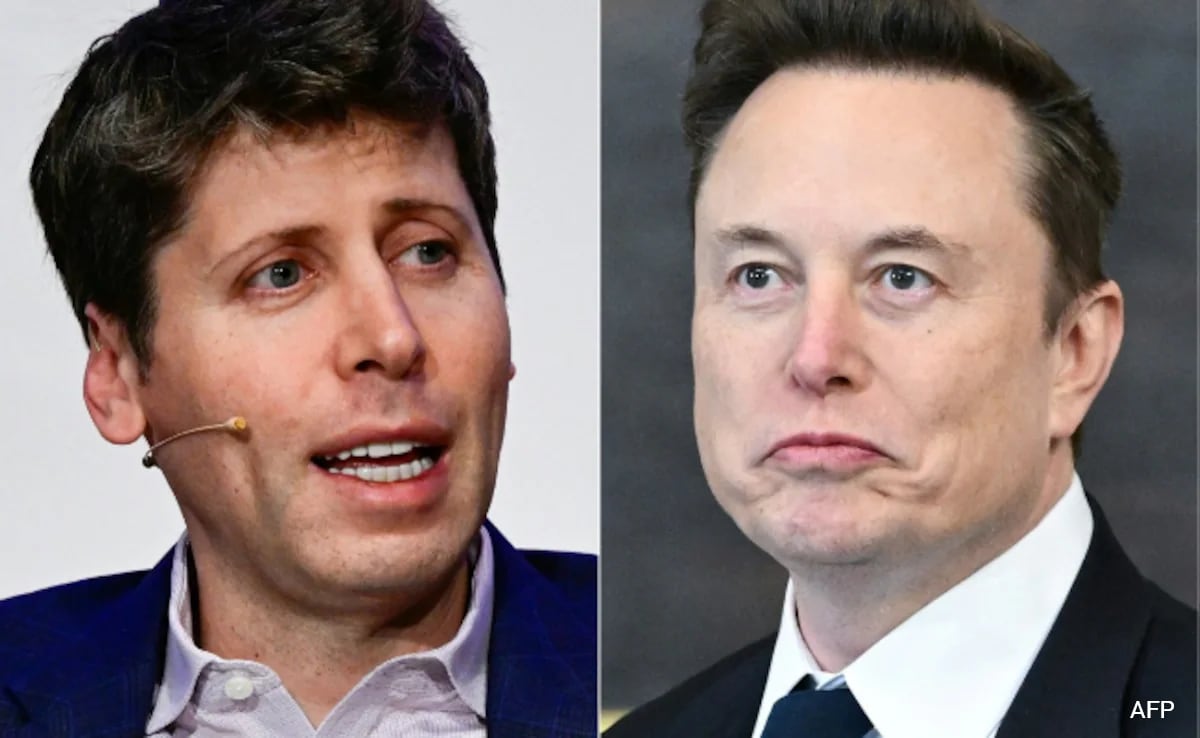
Elon Musk’s legal and rhetorical offensive against OpenAI centers on a fundamental structural tension: the transition of a tax-exempt entity into a profit-maximizing engine. This conflict is not merely a personal dispute between founders but a case study in Institutional Drift. When an organization’s primary mission (the development of Artificial General Intelligence for the benefit of humanity) becomes decoupled from its operational incentives (capital intensive scaling and investor returns), the resulting friction manifests as allegations of "looting" and "unsafe" development cycles.
Analyzing this friction requires deconstructing the transition from a 501(c)(3) nonprofit to the "capped-profit" model that currently governs OpenAI’s relationship with Microsoft.
The Mechanics of Institutional Drift
OpenAI was founded on the principle of transparency and a "safety-first" development mandate. The current friction emerges from three distinct structural pivots that Musk characterizes as a betrayal of the original charter.
1. The Resource-Incentive Paradox
The compute requirements for training Large Language Models (LLMs) scale exponentially. Training costs for state-of-the-art models have transitioned from the millions to the billions of dollars.
- Nonprofit Constraint: Standard charitable donations are insufficient to fund $100 billion compute clusters.
- For-Profit Solution: Creating a subsidiary allows for equity-based fundraising, attracting the necessary capital from entities like Microsoft.
- The Friction Point: This creates a fiduciary duty to investors that may conflict with the original "open" mandate. Musk’s allegation of "looting" refers to the transfer of intellectual property—developed under a tax-exempt status—to a vehicle designed to generate private wealth.
2. The Definition of AGI as a Contractual Threshold
The partnership agreement between OpenAI and Microsoft contains a critical "AGI Clause." Microsoft’s license to OpenAI’s technology applies only to "pre-AGI" software. Once OpenAI achieves Artificial General Intelligence, the intellectual property reverts or is excluded from the commercial agreement.
- The Incentive Misalignment: There is a massive financial incentive for the board to define AGI narrowly or delay its official recognition to maintain the flow of commercial revenue and partnership support.
- The Risk: If the definition of AGI is subjective, the transition from "safe research" to "productized power" becomes a matter of internal politics rather than objective safety benchmarks.
The Safety-Velocity Tradeoff
Musk’s second primary accusation focuses on "unsafe AI." In a data-driven framework, safety is often viewed as a Cost Function that slows down the Velocity of Deployment.
The Cost of Alignment
Ensuring that a model does not hallucinate, exhibit bias, or provide instructions for harmful activities requires Reinforcement Learning from Human Feedback (RLHF) and extensive red-teaming. These processes are:
- Time Intensive: Each week spent in safety testing is a week lost to competitors (Google, Anthropic, Meta).
- Performance Tax: Highly aligned models can sometimes become "lobotomized," losing creative or technical utility because the safety guardrails are too restrictive.
The Profit-Driven Acceleration
When a company is valued at $80 billion or more, the pressure to maintain market leadership necessitates rapid shipping cycles. The "move fast and break things" ethos of Silicon Valley is fundamentally at odds with the "precautionary principle" required for AGI development. Musk’s critique posits that OpenAI has prioritized "product market fit" over "existential risk mitigation."
Quantifying the Value of Intellectual Property Transfers
To understand the "looting" allegation, one must evaluate the valuation of the assets held by the nonprofit versus the equity value of the for-profit subsidiary.
- The Seed Assets: The nonprofit held the original patents, the "OpenAI" brand, and the initial talent pool funded by Musk and other donors.
- The Valuation Gap: If those assets were leveraged to create a for-profit entity now worth nearly $100 billion, the "charitable" portion of the mission has been diluted by several orders of magnitude.
- The Governance Factor: The 2023 board upheaval, which saw the brief ousting and return of Sam Altman, signaled a shift in power from the safety-oriented nonprofit board to an operationally-focused leadership team supported by major investors.
The Philosophical Divergence: Closed vs Open Source
The "Open" in OpenAI was originally a commitment to open-source research to prevent a single entity from monopolizing AGI. The shift to a "Closed" model (proprietary API access) is justified by OpenAI as a safety measure—preventing bad actors from fine-tuning powerful models for malicious use.
Musk’s counter-argument is that "security through obscurity" is a fallacy in the context of AGI. He suggests that a closed, profit-driven model creates a Centralized Risk Profile, where a single company’s internal biases or security failures could have global catastrophic consequences. By contrast, an open-source approach distributes the "immune system" of AI, allowing the global research community to identify and patch vulnerabilities.
The Regulatory Capture Hypothesis
A recurring theme in the critique of OpenAI’s current strategy is the pursuit of "Regulatory Capture." By advocating for government licensing and heavy regulation of high-compute models, OpenAI may inadvertently (or intentionally) create barriers to entry for smaller competitors.
- The Mechanism: High safety standards and compliance costs are manageable for a company with a $13 billion backing from Microsoft but are prohibitive for startups.
- The Result: A duopoly or oligopoly where a few firms control the most powerful technology in human history under the guise of "public safety."
Strategic Implications for the AI Sector
The conflict reveals a structural flaw in the "Nonprofit/For-Profit Hybrid" model. This model attempts to satisfy two masters: the altruistic goal of safe AGI and the capitalistic requirement for exponential growth.
Optimization for the Future
Entities entering this space must decide on a singular optimization metric.
- The Research Path: Pure nonprofit status, requiring massive sovereign wealth or government funding to solve the compute bottleneck without commercial pressure.
- The Market Path: Transparent for-profit status from day one, with safety regulated by external agencies rather than internal "mission-driven" boards.
The attempt to bridge these two via a capped-profit subsidiary creates an inherent "Agency Problem." The managers of the for-profit arm will always seek to maximize the "cap," while the nonprofit board will struggle to maintain oversight without direct control over the capital.
The strategic play for observers and competitors is to anticipate the eventual dissolution of this hybrid model. As AGI capabilities approach the contractual thresholds defined in partnership agreements, the legal battle over what constitutes "AGI" will become the most significant litigation in the history of the technology sector. Companies should prepare for a landscape where "Safety" is not just a technical requirement, but the primary legal lever used to re-allocate billions of dollars in intellectual property.