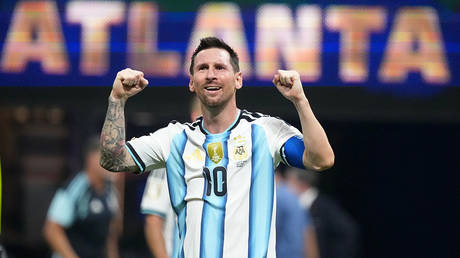
"Dejaremos hasta la última gota de sudor para llegar a la final."
Lionel Scaloni’s viral battle cry is the ultimate football cliché. It is exactly what fans want to hear. It conjures images of gladiators, blood-stained jerseys, and heroic triumphs born of sheer, unadulterated suffering. Meanwhile, you can explore similar developments here: Why Spain Did Not Save Football by Beating France.
It is also a massive lie.
The idea that championship-level international football is decided by who "sweats the most" is a romantic myth designed to sell newspapers and keep fans emotionally invested. In the high-altitude pressure cooker of modern elite sports, relying on grit, effort, and "leaving it all on the pitch" is not a strategy. It is a confession of tactical and structural bankruptcy. To understand the bigger picture, we recommend the recent article by Sky Sports.
When Scaloni promises to drain every last drop of sweat, he is playing to the gallery. But if Argentina actually plays that way, they will lose.
The Romantic Fallacy of "La Nuestra" and "Garra"
Latin American football, particularly in Argentina, has long suffered from a split personality. On one side is la nuestra—the elegant, poetic, improvisational style. On the other is garra—the gritty, hyper-aggressive, survive-at-all-costs mentality.
Scaloni’s rhetoric leans heavily into the latter. It suggests that when tactical systems fail, raw human will will bridge the gap.
This is structurally impossible in 2026.
Modern football is a game of micro-spaces, kinetic energy management, and cognitive load. The team that wins is almost never the one that runs the hardest; it is the one that runs the smartest.
Consider the data from recent major tournaments. The teams covering the highest absolute distance on the pitch are rarely the ones lifting the trophy. High physical expenditure is frequently a symptom of poor positioning. If you are constantly sprinting, sliding, and "sweating," it means you are chasing the ball because your structural press or possession cycle has broken down.
"If you have to make a tackle, you have already made a mistake." — Paolo Maldini
Maldini’s legendary maxim remains the ultimate antidote to the cult of sweat. A perfect defensive block does not look heroic. It looks boring. It looks like eleven players shifting three yards to the left in unison, cutting off a passing lane without a single drop of dramatic perspiration.
The High Cost of Emotional Overdrive
Having spent years analyzing the tactical evolutions of international tournaments, I have watched national teams burn themselves out by playing at a constant emotional maximum.
When a manager demands "every last drop of sweat," they are asking players to operate in a state of hyper-arousal. Physically, this triggers a massive cortisol and adrenaline spike. While useful for a ten-minute blitz, maintaining this state over a 90-minute match—let alone a grueling tournament schedule—leads to catastrophic failures in decision-making.
Imagine a scenario where a central midfielder, blinded by the demand to "leave it all on the pitch," lunges into a high-intensity press in the 78th minute. He wins the crowd's applause. He also leaves a yawning chasm behind him that a disciplined opponent exploits with a single, cool-headed pass.
That is the price of emotional football.
- Cognitive fatigue: High emotional states degrade spatial awareness and passing accuracy.
- Tactical drift: Players chase the ball to prove their commitment, destroying the team's shape.
- Physical depletion: Burning energy reserves early guarantees a drop in defensive intensity during the critical final fifteen minutes.
Why Scaloni’s Rhetoric is a Defensive Shield
So why does Scaloni say it? Because it is the perfect shield.
If Argentina wins playing ugly, the "sweat" narrative justifies the lack of aesthetic quality. If they lose, the players are absolved of tactical failure because "they gave everything." It shifts the post-match analysis from technical critique to a moral evaluation of the players' patriotism and effort.
But let us look at the actual football that won Argentina their recent titles. It was not built on mindless running. It was built on a highly sophisticated, asymmetrical mid-block designed to conserve the energy of their aging talisman, Lionel Messi.
[Opponent Build-up]
       |
       v
  [De Paul / Mac Allister] <-- High-intensity screening
       |
  [Messi / Target Man]     <-- Tactical rest zones (No running)
       |
  [Scaloni's Defensive Low-Block]
The magic of Scaloni’s actual coaching—not his press conferences—lies in his ability to create "rest zones" on the pitch. Argentina won because they knew exactly when not to sweat. They excelled at slowing the tempo to a crawl, passing sideways, killing the opposition's momentum, and then striking with lethal precision.
To rebrand this calculated, almost cynical game management as a triumph of "sweat and tears" is an insult to the tactical intelligence of the coaching staff itself.
The Counter-Intuitive Truth: Laziness as a Virtue
The best teams in the world do not sweat; they make the ball do the running.
This is not a new concept, but it is one that international managers are increasingly forced to ignore because of public pressure. Pep Guardiola’s Manchester City or Carlo Ancelotti’s Real Madrid do not rely on emotional speeches about dying on the pitch. They rely on positional superiority.
If you want to win a tournament, you need to cultivate a culture of calculated laziness.
| Metric | The "Sweat" Approach (Cult of Grit) | The "Lazy" Approach (Positional Discipline) |
|---|---|---|
| Defensive Style | Reactive, high-intensity lunges | Proactive, cutting passing lanes |
| Energy Curve | Peak in first 30 mins, sharp decline | Consistent throughout 90 mins |
| Decision Making | Emotional, rushed, crowd-pleasing | Analytical, deliberate, risk-averse |
| Tournament Longevity | High risk of late-stage injuries | Managed load, fresh for the final |
When you prioritize physical sacrifice over spatial discipline, you are essentially gambling on your opponent making more mistakes than you. Against top-tier European opposition, that gamble fails. Teams like France, Spain, or Germany will gladly let you run yourself into the ground while they circulate the ball with two-touch passing, waiting for the exact moment your physical exhaustion translates into a mental lapse.
Demolishing the "People Also Ask" Myths
The football media loves to feed the beast of heroic narrative. Let's dismantle the underlying premises of the questions fans actually ask during these high-stakes tournaments.
"Don't players need to show passion to win?"
Passion is a byproduct of success, not the cause of it. Players show "passion" when they are winning because their tactical plan is working. When a team is disorganized, "passion" quickly mutates into frustration, reckless tackles, and red cards. The most passionate player on the pitch is often the one who gets sent off in the 35th minute for a desperate, lunging tackle.
"Can grit overcome a superior tactical setup?"
Only if the tactically superior team suffers a collective mental collapse. In modern football, a well-drilled zone press will beat individual "grit" nine times out of ten. Believing that willpower can overcome a structural mismatch is like believing a boxer can win a fight purely because he wants it more, ignoring the fact that his opponent has a longer reach and a better jab.
"Isn't Scaloni just motivating his players?"
There is a fine line between motivation and desperation. When a manager publicly demands "every drop of sweat," he is setting a standard where physical exertion is valued over execution. If a player tries to play a difficult, line-breaking pass and fails, is he criticized for lack of effort? Usually, yes. So, to protect themselves, players resort to safe, high-effort actions—like sprinting fifty yards to chase a lost cause—just to satisfy the optics of "giving everything."
Stop Applauding the Slide Tackle
If we want to see the pinnacle of the sport, we have to stop romanticizing the struggle.
The next time you watch Argentina, or any elite team, do not look for the player diving headfirst into a challenge or screaming at the referee. Look for the midfielder who quietly steps two yards to his left, intercepts a pass without breaking a jog, and plays a simple five-yard pass to keep possession.
That is the player who wins tournaments.
Scaloni’s rhetoric might make for great television, but his tactical board is what actually keeps Argentina alive. Let the fans believe in the sweat. The players had better rely on their brains.