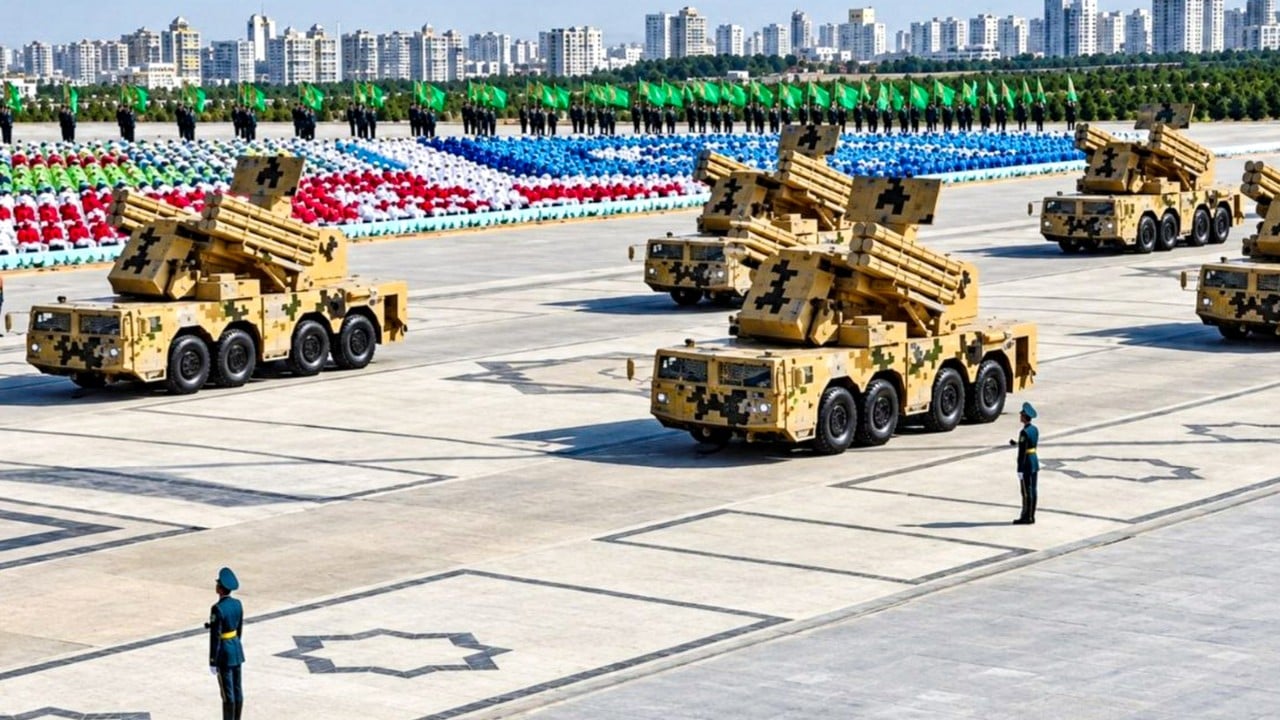
Every defense analyst in the Western hemisphere is currently suffering from a severe case of pattern recognition poisoning. Give them a headline about Turkmenistan acquiring Chinese hardware—say, the FD-2000 or newer high-altitude surface-to-air systems—and they instantly reach for the lazy narrative. Moscow is weak. Putin is overstretched in Eastern Europe. Beijing is moving into Russia’s traditional Central Asian backyard like a landlord foreclosing on a struggling tenant.
It is a neat, tidy story. It is also completely wrong.
I have spent the better part of two decades watching foreign policy commentators map Cold War mental models onto post-Soviet republics, missing the actual mechanics of sovereignty in the region every single time. Ashgabat is not thumbing its nose at the Kremlin, nor is Beijing executing a stealthy geopolitical takeover. What we are witnessing is something far more pragmatic, far colder, and entirely divorced from the tired narrative of declining Russian hegemony.
Turkmenistan is playing a masterclass in diversification born of absolute paranoia. And the analysts calling this a Sino-Russian turf war simply do not understand how permanent neutrality actually functions in the Karakum Desert.
The Myth of the Imperial Backyard
Let us dismantle the foundational fallacy of modern defense journalism: the idea that Central Asia is a zero-sum game between Moscow and Beijing.
For thirty years, Western think tanks have operated under the assumption that if a Central Asian state buys Chinese military gear, Russian influence drops by a measurable percentage. This assumes that Ashgabat views international relations through a binary lens. It does not. Turkmenistan’s foreign policy is codified by the United Nations as permanent neutrality—a status so strict that Ashgabat refuses to join the Collective Security Treaty Organization, NATO’s Partnership for Peace, or even the economic integration branches of the Eurasian Economic Union.
When Turkmenistan bought Chinese air defense systems, it was not because they lost faith in Russian engineering. Russian surface-to-air missile technology remains among the most lethal in the world. The S-300 and S-400 architectures are legendary for a reason. But relying on a single supplier for strategic air defense is a geopolitical death wish for a small nation wedged between unstable borders, specifically Afghanistan to the south.
Procuring Chinese hardware is not about pivoting away from Moscow. It is about vendor independence. If you only buy from one superpower, you hand that superpower a veto over your national security. Ashgabat learned this lesson by watching how weapon supply chains can be choked off overnight by political pressure or shifting alliances. By integrating Chinese systems alongside existing Russian and Western-sourced logistics, Turkmenistan ensures that no single foreign capital can turn off their sky-shield with the flick of a diplomatic switch.
The Economic Reality Behind the Hardware
To understand why Turkmenistan writes multi-million-dollar checks to Beijing while keeping Moscow at arm's length, you have to look at a balance sheet, not a map.
Russia does not buy Turkmenistan’s primary export in the volumes required to keep the regime solvent. China does. The Trans-Turkmenistan pipeline network funnels massive quantities of natural gas straight eastward. Beijing pays for this gas, and a portion of those petrodollars inevitably circles right back into Chinese state-owned defense conglomerates.
This is not a strategic alignment born of ideological brotherhood; it is a closed-loop economic ecosystem. When you supply a country's primary source of national revenue, you become their primary commercial partner. Defense procurement follows trade flows, not the other way around. Analysts screaming about declining
Why Turkmenistans Pivot to Chinese Air Defences is a Structural Illusion
news, technology
The lazy narrative making the rounds in defense circles is neat, tidy, and entirely wrong. Analysts look at Ashgabat acquiring Chinese anti-aircraft systems like the FD-2000 and cheer for a dramatic geopolitical soap opera. They write long, breathless columns about how Turkmenistan is supposedly breaking free from its historical security patron, Moscow, swapping out aging Soviet legacy gear for sleek Beijing-built hardware as Russian influence supposedly shrivels up.
It is a comforting bedtime story for people who treat international relations like a spectator sport. It assumes that defense procurement is a zero-sum game, that weapon compatibility dictates loyalty, and that buying a radar battery from one vendor means you are tearing up your marriage certificate with another.
The truth is much colder, much more pragmatic, and entirely detached from the Western fantasy of a grand strategic realignment.
I have watched defense ministries across Central Asia operate for over a decade. I have seen how procurement budgets are actually spent behind closed doors, far away from the press releases and the defense exhibition floors. The idea that Turkmenistan is executing some sweeping anti-Russian geopolitical pivot ignores the operational reality of how neutral states maintain power. Ashgabat is not dumping Moscow. They are simply building an insurance policy against a collapsing Russian defense export sector while keeping their primary security architecture intact.
The Sovereign Neutrality Myth
To understand why the common commentary on Turkmenistan misses the mark, you have to look past the hardware and examine the doctrine of permanent neutrality. This is not a convenient diplomatic label; it is a rigid state ideology codified into the constitution.
Western analysts constantly try to force Central Asian nations into a Cold War binary. You are either with the Western bloc, aligned with Beijing, or tethered to Moscow. Turkmenistan rejects this framework entirely. When Ashgabat buys Chinese air defense systems, they are not picking a side. They are filling a gap.
For decades, the Turkmen military relied on legacy Soviet systems like the S-200 and S-125. These platforms are older than many of the conscripts operating them. Maintenance has become an administrative nightmare. Spare parts are scarcer by the month, especially as Russian defense manufacturing prioritizes domestic consumption for the war in Ukraine. Moscow simply does not have the production capacity right now to supply tier-one export clients with replacement components on demand, let alone a minor, isolated neutral state like Turkmenistan.
So what does a sovereign state do when its traditional supplier is choked by domestic crisis and sanctions pressure? They look for the only alternative capable of mass delivery at a predictable price point. That is Beijing. It is a commercial and operational necessity, not a ideological divorce from Russia.
Dissecting the Hardware Fallacy
Let us talk about the specific systems usually cited in these breathless reports. When defense commentators point to Chinese air defense integration in Central Asia, they treat it as a plug-and-play operation. They imagine Turkmen generals sitting in command centers seamlessly merging Chinese radars with older Soviet command-and-control networks.
That is pure fiction.
Military hardware does not talk to disparate systems just because they share a border or a trade agreement. Air defense is an ecosystem. It requires data links, frequency hopping, cryptographic integration, and specialized training pipelines. Integrating a Chinese surface-to-air missile battery into an infrastructure historically built around Soviet doctrine is an engineering headache of monumental proportions.
Turkmenistan’s military forces are not suddenly transitioning to a People's Liberation Army operational model. They are creating isolated defense bubbles. Specific high-value assets—like the capital city or critical energy infrastructure—get protected by modern point-defense and medium-to-long-range systems from China, while the broader, lumbering Soviet-era radar blanket remains the baseline.
This is not a unified strategic shift. It is a patchwork quilt of emergency upgrades.
Furthermore, look at the training gap. Operating a modern Chinese phased-array radar system requires specialized technical fluency that takes years to cultivate. Turkmenistan’s military is famously insular, underfunded in human capital development, and plagued by bureaucratic opacity. Buying the gear is the easy part. Sustaining it, maintaining the software loops, and training operators without making your military entirely dependent on foreign contractor support is where the grand strategy usually collapses. Beijing sells the hardware, but they do not export their strategic doctrine along with it.
The Moscow Connection Remains Untouched
Those who claim Russia's role is shrinking in Turkmenistan are confusing export delivery statistics with actual geopolitical leverage. Defense procurement is only one sliver of bilateral state power.
Consider energy. Turkmenistan sits on the Galkynysh gas field, one of the largest natural gas reserves on Earth. For years, their economic lifeline has been tied to exports. While China has successfully captured a massive share of that gas flow via pipelines running through Central Asia, Moscow remains a heavy economic and political gravity well in the region.
More importantly, look at regional security perceptions. Ashgabat watches its northern and southern borders with extreme anxiety. The instability bleeding out of Afghanistan is a constant, lingering threat. When the Taliban makes noise or extremist networks probe the borderlands, Turkmen leadership does not call Beijing for urgent counter-terrorism coordination or boots-on-the-ground intelligence sharing. They rely on the broader security frameworks and intelligence-sharing architecture anchored by Moscow and regional bodies like the CIS.
Russian security guarantees, or at least the shadow of them, remain the ultimate backstop in the minds of Turkmenistan's leadership. A few batteries of surface-to-air missiles do not rewrite regional security dynamics. They just update the price tag of defense modernization.
The Real Danger of the Lazy Narrative
Why does this misinterpretation matter? Because bad analysis leads to bad policy expectations.
When Western think tanks and foreign ministries misread localized military procurement as a seismic geopolitical realignment, they waste diplomatic capital trying to court regimes that have no interest in changing their core foreign policy posture. Turkmenistan values its isolation above all else. They do not want to be a Chinese client state any more than they want to be a Russian satellite.
By framing every Chinese export contract as a defeat for Moscow, commentators misunderstand how middle and minor powers navigate a multipolar world. These states do not pick a permanent master. They shop around. They buy Chinese hardware because the price is right, delivery is fast, and the export controls are non-existent compared to Western alternatives. At the same time, they keep buying Russian energy infrastructure and maintaining diplomatic channels with Moscow because abandoning historical ties is geopolitical suicide.
Stop looking at a radar sale as a revolution. It is just a transaction. And in Turkmenistan, the only thing permanent is the sand, the gas, and the fierce, unyielding desire to keep everyone else at arm's length.