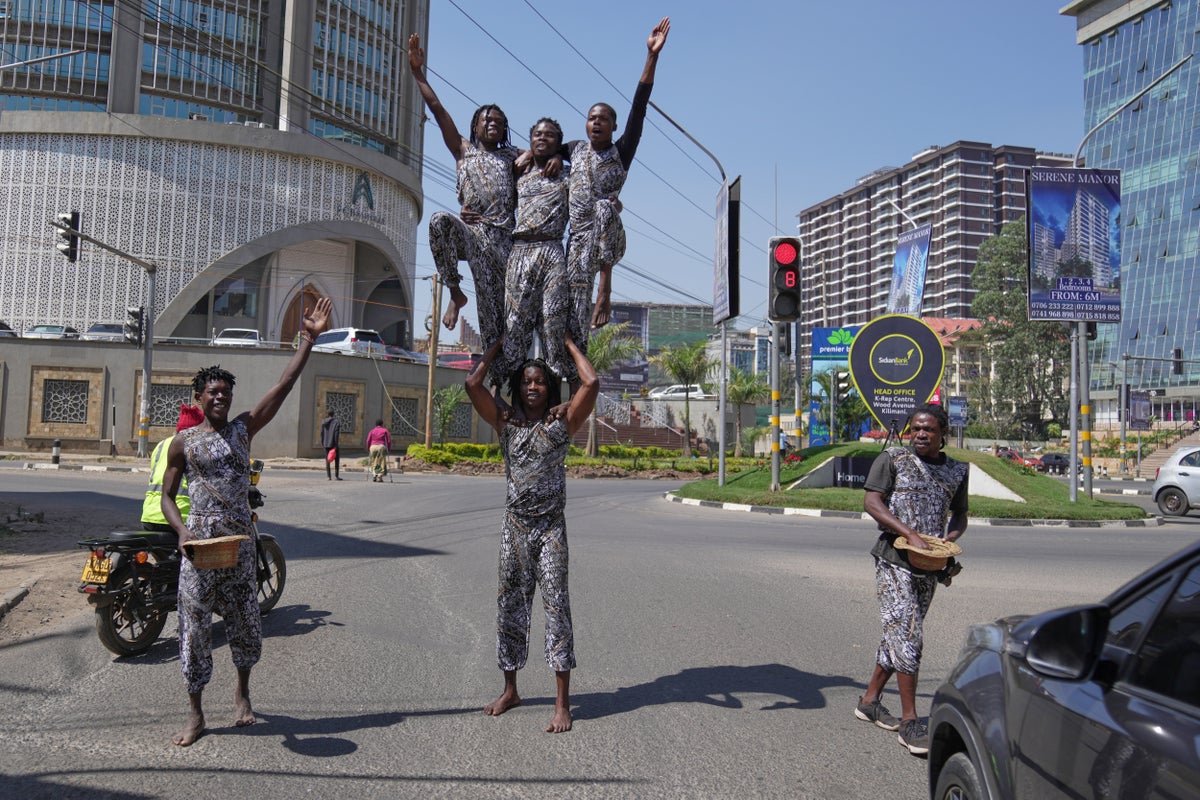
The traffic light turns red at a choked intersection in Kenya's capital. Before the exhaust fumes can settle, bodies are spinning through the air.
This is not a sanctioned street festival or a government-sponsored cultural showcase. This is the raw, high-stakes economy of Nairobi traffic intersections, where troupes of young acrobats have converted the city's notorious gridlock into an open-air theater.
For years, mainstream coverage has romanticized these performers as plucky optimists making the best of a bad situation. They are often framed as heartwarming roadside novelties that bring a smile to tired commuters. Strip away the charm, however, and a much sharper economic reality emerges. These asphalt stages are monuments to structural failure, pointing directly to a youth unemployment crisis that has forced high-level artistic talent out of formal venues and down into the exhaust-choked gutters of urban transit corridors.
The Economics of the Red Light
To understand how a human pyramid comes together between lanes of idling SUVs, you have to follow the math. A typical performance window lasts precisely as long as the red signal—roughly forty to sixty seconds.
Performers like twenty-two-year-old Mohammed Nyale do not have the luxury of slow artistic build-ups. Their routines are tightly compressed bursts of tumbling and juggling engineered to capture attention before impatient motorists start creeping forward. Once the physical display ends, a designated member weaves frantically between stationary vehicles, cap or woven hat in hand, begging for pocket change.
The returns are meager. Donations rarely surpass fifty Kenyan shillings—roughly forty US cents. In a clever adaptation to Kenya's heavily digitalized financial ecosystem, many troupes now hand out slips of paper printed with mobile money numbers. On an exceptional day, a performer might clear the local equivalent of six dollars.
That figure matches the daily wage of manual laborers on construction sites or agricultural plots. Yet construction work requires heavy machinery or raw muscle; street acrobatics requires elite physical conditioning, precise timing, and a high tolerance for blunt trauma.
Talent Without a Safety Net
Most of these performers did not start their lives with ambitions of dodging matatus and private sedans. They migrated from coastal towns and regional counties with dreams of packed theaters, international circus tours, and structured cultural contracts.
Those venues evaporated long ago. Economic contractions, shifting public arts funding, and the lingering aftershocks of the pandemic shuttered formal performance spaces. Left without institutional backing or commercial sponsorship, young artists faced a stark binary choice. They could sit at home in informal settlements like Kawangware accumulating debt and idle frustration, or they could take their physical training to the tarmac.
The shift represents an informal privatization of public space. City streets are designed for vehicular transit, but they have functionally transformed into municipal job centers. Without formal labor protections, these performers absorb 100 percent of the operational risk.
The Cost of Doing Business on Concrete
Working an intersection comes with severe hazards that romantic profiles frequently gloss over. Asphalt is an unforgiving surface for high-velocity tumbling. Joint damage, chronic muscular strain, and severe impact injuries are treated with cheap over-the-counter painkillers rather than professional medical care.
Then there is the physical danger of the traffic itself. Nairobi drivers are notoriously aggressive, and exhaust pollution creates a toxic microclimate for anyone engaging in heavy aerobic exertion.
"The biggest risk is cars and motorbikes because you need to be very, very alert," notes Leonard Wadu, a local performer navigating the chaos. "Some drivers are not careful, and some are drunk. So it is really dangerous, but we still do it".
City authorities view them with legal ambiguity. While police and county inspectors occasionally crack down on obstruction or unauthorized roadside vending, enforcement is erratic. The performers operate in a legal grey zone—too visible to ignore, yet too vital to a desperate populace to permanently eradicate.
Beyond the Novelty Narrative
Public reaction is predictably split. Business owners and daily commuters often express a paternalistic fondness for the troupes, viewing them as industrious youths who refuse to turn to crime. Other motorists find the sudden intrusions an irritating distraction in an already stressful commute.
Both perspectives miss the larger structural indictment. These acrobats are subsidizing their own survival because the formal economy has failed to generate absorptive capacity for young job seekers. When national statistics peg youth unemployment at significant levels across urban centers, the overflow ends up on the streets, turning every traffic signal into an audition for basic subsistence.
Until structural reforms provide predictable pathways for creative industries and youth employment, the asphalt remains their only stage. The music plays to the rhythm of honking horns, and the human pyramids rise and fall before the light turns green.