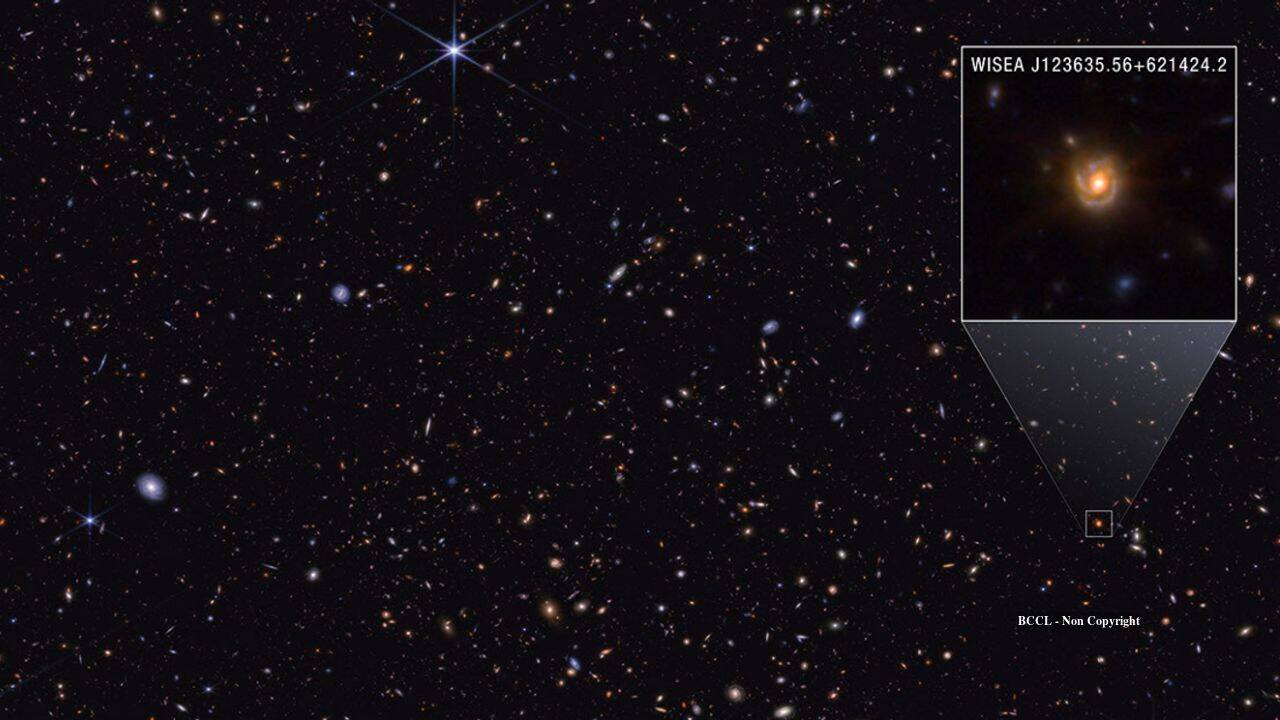
When the James Webb Space Telescope (JWST) first peered into the early universe in 2022, it stumbled upon something that shouldn't have been there. Astronomers saw tiny, ruby-colored specks scattered across the cosmic timeline. They started calling them "little red dots," or LRDs for short. Everyone from graduate students to veteran researchers scrambled to figure out what these things actually were. Were they supermassive black holes? Were they some bizarre new type of star?
For years, these dots have been a headache for astrophysicists. We’ve found roughly 300 of them, and they don't play by the rules we've established for galaxies. Recent data suggests we might finally be getting somewhere, but the answer isn't a single "aha!" moment. It’s a mix of observational bias and some truly strange physics.
The Saguaro Connection
One of the most frustrating things about LRDs is that they look so distinct at high redshifts—which is basically astronomer-speak for "really far away and really early in the universe." But as we look at later stages of the universe, they seem to vanish. This led to a burning question: where do these dots go as the universe ages?
A research team led by Pierluigi Rinaldi at the Space Telescope Science Institute recently hit on a possible bridge. They studied a spiral galaxy they nicknamed the "Saguaro," seen as it existed 3.3 billion years after the Big Bang. When they pointed JWST’s sensitive instruments at the heart of this galaxy, they found something familiar. It had a compact, red, energetic nucleus that looked exactly like a local version of an LRD.
Basically, the Saguaro suggests that LRDs don't just disappear. Instead, they might be the active, super-bright hearts of galaxies that we simply can't see properly when they are at extreme distances. When a galaxy is billions of light-years away, its outer arms and structure often fade into the background noise, leaving only that intense, glowing core visible. That’s what we’ve been calling a "little red dot." It’s not necessarily a separate class of object; it’s often just the brightest part of a galaxy that’s been hiding its true form from us.
The Black Hole Star Theory
While observational bias explains why they look like dots, it doesn't fully explain why they are so incredibly red and bright. Another theory gaining traction involves what researchers are calling "black hole stars."
A study published in Nature in August 2026 highlights an object dubbed MoM-BH*-1. This isn't just a regular black hole with an accretion disk. The researchers argue it’s a black hole swaddled in a dense, massive cocoon of gas. This isn't your typical stellar behavior.
Think of it like this: you have a black hole, but instead of a thin ring of orbiting material, it’s buried inside a thick, opaque cloud. This cloud glows with the intensity of a billion stars, but it’s fueled by the gravitational energy of the black hole rather than standard nuclear fusion. It’s a massive, confusing object that shouldn't exist according to our old textbooks.
Why It Matters
You might wonder why we care so much about these red specks. It’s because they challenge the fundamental "growth chart" of the universe. We’ve found supermassive black holes in the early universe that are way too big for their age. If these LRDs are indeed black hole stars or early active galactic nuclei, they provide a blueprint for how black holes might have bulked up so quickly.
If you’re looking at the latest data, here is what you need to keep in mind:
- Not everything is what it seems. The "dot" is often just a symptom of our telescope's current reach. As we get better data, we’ll see more of the host galaxies surrounding these nuclei.
- Dust is a major player. That iconic red color? It’s usually a sign of dust scattering light or a dense gas envelope. Don't assume every red dot is a unique, exotic object.
- The timeline is shrinking. We are finding these things closer to the Big Bang than we ever thought possible. Our models for galaxy formation are being rewritten in real-time.
Stop assuming that these LRDs are some uniform mystery. Some are likely just the centers of larger galaxies we haven't resolved yet. Others might be these strange, gas-shrouded black hole engines. The next year of JWST observations will likely show us even more "progeny" of these objects in the local universe. We’re finally moving past the initial shock of discovery and starting to see how these pieces fit into the larger cosmic puzzle. Keep your eyes on the upcoming spectroscopic surveys; that’s where the real answers are hiding.