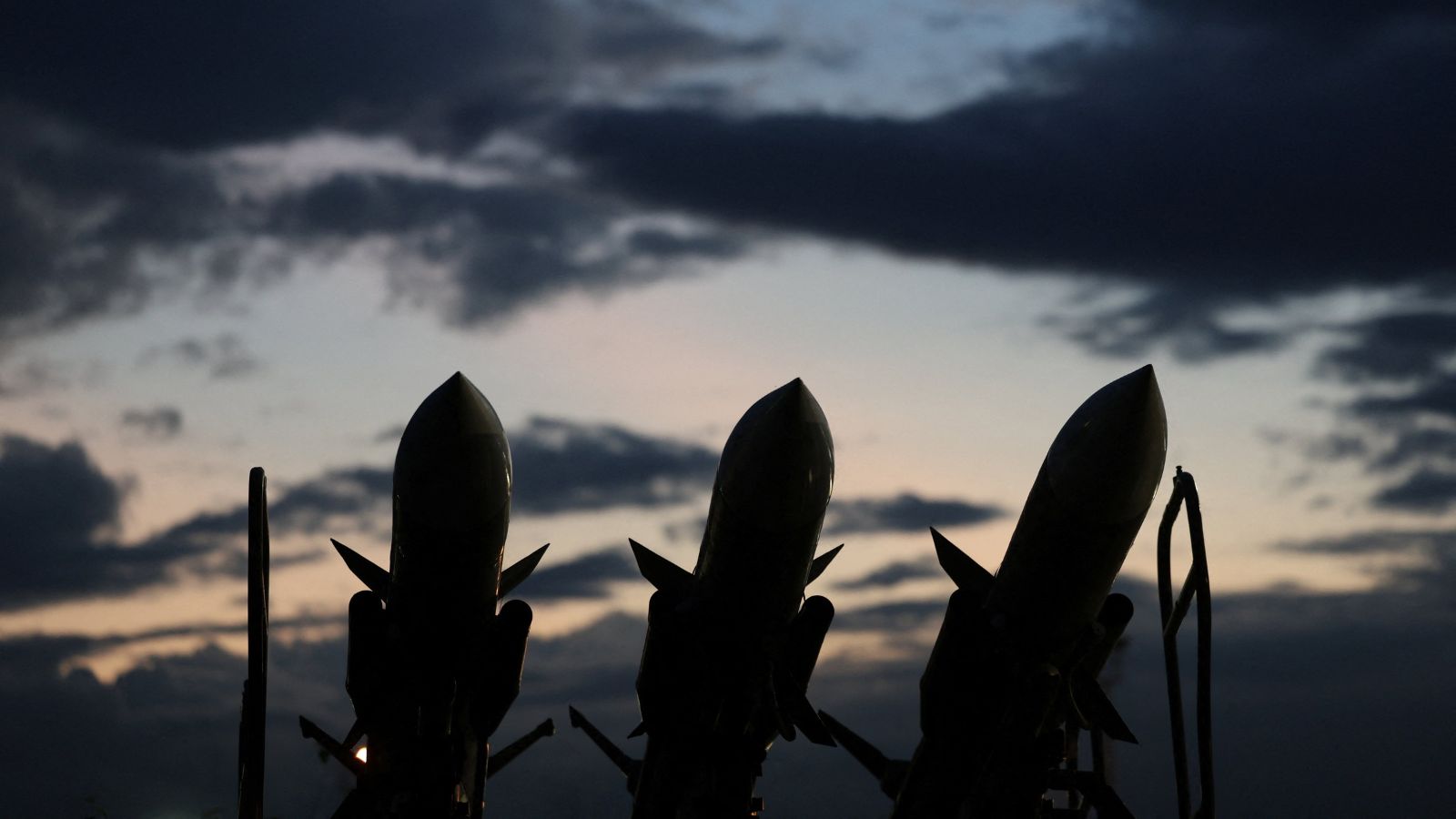
Claims by Tehran that its forces struck a United States early-warning radar installation in Bahrain in retaliation for an attack on the Iranian coastal district of Sirik expose a structural asymmetry in Persian Gulf deterrence. Rather than engaging in symmetric force-on-force exchanges, regional actors target the sensory nodes of an adversary’s integrated air and missile defense network to degrade situational awareness across an entire theater. Understanding the operational mechanics of this claim requires separating unverified battlefield assertions from the known physics of phased-array radar systems, the geographic vulnerabilities of the Strait of Hormuz, and the strategic calculus of calibrated escalation.
The Architecture of Forward Sensor Networks
Modern missile defense in the Persian Gulf relies on a distributed architecture of sensors, command-and-control nodes, and kinetic interceptors. An early-warning radar system—such as the AN/TPY-2 X-band radar or larger fixed-site phased-array installations deployed across Gulf Cooperation Council states—serves as the primary acquisition and tracking asset for ballistic and cruise missile threats.
These systems operate on three distinct functional tiers:
- Horizon Detection and Cueing: High-power, low-frequency or X-band phased-array radars detect ballistic targets during their boost or early mid-course phases, calculating trajectory vectors within seconds of launch.
- Discrimination: Advanced signal processing separates warheads from decoys, booster debris, and atmospheric clutter, passing a refined track to fire-control radars.
- Networked Fire Control: Through tactical data links such as Link 16 or the Integrated Battle Command System, a single forward sensor cues interceptors located hundreds of kilometers away, extending the defended footprint of Patriot, THAAD, or naval Aegis batteries.
Because these radars emit continuous or pulsed high-energy electromagnetic radiation, they function as bright beacons in the electronic warfare spectrum. While hardened against blast overpressure to a limited degree, their phased-array antenna faces—composed of thousands of delicate transmit/receive modules—cannot be buried underground without blinding the sensor. This physical requirement creates an inherent trade-off between sensory range and structural survivability.
Geographic Asymmetry Between Sirik and Bahrain
The reported linkage between an incident in Sirik, located in Iran’s southern Hormozgan province, and a strike in Bahrain highlights the compressed geography of the Persian Gulf. Sirik sits directly along the northern littoral of the Strait of Hormuz, a maritime chokepoint roughly 39 kilometers wide at its narrowest point. This coastline is heavily fortified with coastal defense cruise missiles, mobile air defense batteries, subterranean drone storage facilities, and fast-attack craft bases operated by the Islamic Revolutionary Guard Corps Navy.
Bahrain, an island nation roughly 500 kilometers northwest across the shallow waters of the Gulf, hosts the headquarters of the United States Fifth Fleet and Naval Forces Central Command, alongside critical coalition air and missile defense infrastructure.
This spatial relationship dictates the tactical parameters of any exchange:
- Compressed Flight Times: A ballistic missile or high-speed cruise missile launched from southern Iran reaches Bahrain in under six minutes. One-way attack unmanned aerial vehicles traveling at lower altitudes take longer, roughly two to three hours, but exploit terrain masking and sea-skimming flight profiles to delay radar horizon acquisition.
- Sensor Saturation Mechanics: Short flight times compress the kill chain for defenders. If an early-warning radar is degraded or forced to shut down its emitters to avoid anti-radiation seekers, local terminal defense batteries lose their long-range cueing, forcing them to rely on organic, shorter-range radars with narrower fields of view.
- Attribution Ambiguity: Strikes in the Gulf frequently utilize deniable proxies, ambiguous launch vectors, or electronic warfare spoofing to obscure the precise origin of an attack, allowing the initiator to manage escalation thresholds while still signaling capability.
Separating Operational Fact from Information Warfare
In evaluating claims of a strike on a high-value U.S. sensor in Bahrain, analysts must distinguish between confirmed physical realities, technical plausibility, and strategic messaging. Without independent commercial satellite imagery showing structural damage to a radome or phased-array face, or official casualty and equipment loss disclosures from the Department of Defense, a kinetic hit remains an unverified assertion.
However, the claim itself serves a distinct operational purpose within Iranian military doctrine, often referred to as mosaic defense and deterrence by punishment.
- The Known Baseline: The United States maintains extensive early-warning and missile defense infrastructure across the Arabian Peninsula, including Bahrain, Qatar, the United Arab Emirates, and Saudi Arabia. Iran possesses an arsenal of short-range ballistic missiles, land-attack cruise missiles, and long-range loitering munitions capable of reaching every point on the western shore of the Gulf.
- The Technical Hurdle: Penetrating the multi-layered air defenses surrounding Bahrain requires overcoming electronic jamming, naval Aegis destroyers operating in the central Gulf, and point-defense systems. A single projectile rarely penetrates such an envelope unless masked by a larger salvo or routed through blind spots in radar coverage.
- The Information Objective: By explicitly naming an early-warning radar as the target rather than a generic barracks or port facility, Tehran signals to regional host nations that the technological shield protecting them is itself vulnerable. This messaging aims to raise the political cost for Gulf states hosting U.S. sensory and command infrastructure.
The Cost-Exchange Ratio of Sensor Attrition
The strategic logic behind targeting radar installations rests on an acute economic and industrial asymmetry. Modern phased-array early-warning radars cost hundreds of millions of dollars per unit and require years of specialized semiconductor and gallium nitride component manufacturing to replace. By contrast, a salvo of ten to twenty one-way attack drones and medium-range ballistic missiles costs a fraction of a single radar array.
This disparity creates an unfavorable cost-exchange ratio for the defender:
- Interceptor Depletion: Defending a fixed radar site against a saturated salvo requires expending multiple surface-to-air interceptors—such as Patriot PAC-3 MSE or SM-6 missiles—each costing between three million and four million dollars.
- Downtime Penalties: Even if an incoming munition fails to destroy the radar’s core electronics, blast fragmentation or power-grid disruption can force the system offline for weeks of recalibration and module replacement. During this maintenance window, the theater-wide missile defense network suffers a measurable reduction in tracking fidelity and warning time.
- Force Dispersal Costs: To mitigate the vulnerability of fixed sites, commanders must invest in mobile decoys, hardened shelters, frequent relocation protocols for transportable radars, and redundant sensor coverage—all of which increase operational tempo and wear on personnel and hardware.
Limitations of Passive and Active Defense
No air defense architecture is hermetically sealed, and relying exclusively on active kinetic interception to protect forward sensors is operationally unsustainable over a prolonged campaign. Active defenses face hard physical limits: radar horizon geometry prevents the early detection of low-flying cruise missiles or drones skimming just meters above the sea surface until they are within a few dozen kilometers of the coast. Furthermore, magazine depth—the finite number of interceptors loaded into vertical launch cells or ground canisters—can be exhausted faster than naval supply ships or airlift bridges can reload them.
Passive defense measures, such as electromagnetic emission control, physical hardening, and camouflage, carry their own operational penalties. Turning off a radar to survive an anti-radiation missile strike achieves the attacker’s objective by temporarily blinding the network. Hardening facilities with reinforced concrete and berms protects against near-misses but does not stop direct hits from precision-guided warheads utilizing terminal optical or infrared seekers.
Strategic Force Posture Adjustments
To neutralize the tactical vulnerability of forward early-warning sensors in the Persian Gulf, military planners must shift from static, centralized detection nodes to resilient, distributed sensing architectures.
First, theater commanders should accelerate the integration of space-based overhead persistent infrared sensors and low-Earth orbit tracking constellations directly into local fire-control networks. Offloading initial boost-phase detection and mid-course tracking to orbital assets removes the single-point-of-failure risk inherent to ground-based radars in Bahrain or Qatar.
Second, ground-based radar deployments must prioritize mobility and decoys over fixed installations. Replacing static radomes with transportable X-band systems that execute frequent shoot-and-scoot relocations, paired with high-fidelity electromagnetic decoys that mimic the exact frequency and pulse repetition intervals of active arrays, forces an adversary to expend scarce precision munitions on false targets.
Third, short-range terminal defense around critical sensor nodes must incorporate directed-energy weapons and high-rate-of-fire kinetic gun systems to handle low-cost drone swarms, preserving multi-million-dollar surface-to-air interceptors exclusively for high-velocity ballistic threats.