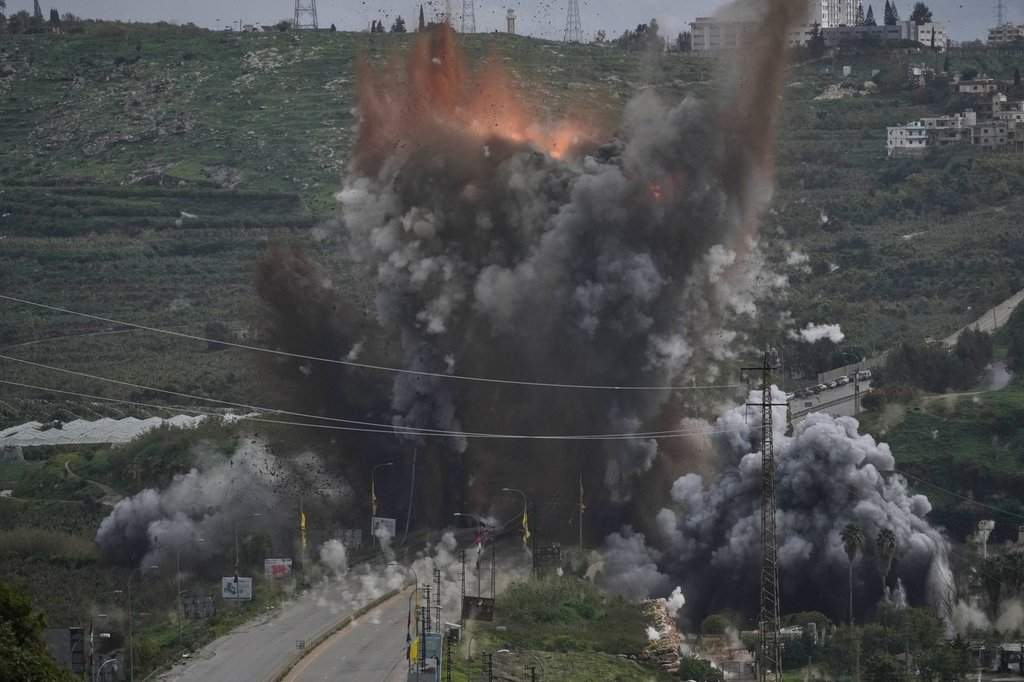
The survival of an urban center under persistent kinetic pressure is not a matter of morale, but a function of three intersecting variables: the integrity of supply chain nodes, the density of the remaining civilian population, and the frequency of precision-guided munitions (PGM) impact. Nabatieh, a critical administrative and commercial hub in southern Lebanon, provides a definitive case study in how a city transitions from a functioning economic unit to a hollowed-out tactical zone. When the frequency of strikes exceeds the rate of infrastructure repair, the city enters a state of structural insolvency.
The Triad of Urban Erosion
To understand the current state of Nabatieh, one must move beyond the emotional narrative of "life under fire" and examine the specific mechanisms that dictate urban collapse. The degradation of the city follows a predictable, non-linear decay model driven by three primary vectors. For an alternative view, check out: this related article.
1. The Logic of Targeted Attrition
Modern urban warfare in southern Lebanon is characterized by a high-frequency use of PGMs. Unlike the carpet bombing of the 20th century, these strikes are surgically applied to specific coordinates. However, the cumulative effect of these precision strikes on a dense urban grid creates a "cascading failure" in civilian logic.
Every strike on a residential or commercial structure in Nabatieh functions as a psychological and logistical deterrent. Even if a neighboring building remains untouched, the proximity of the strike resets the risk assessment for the inhabitants. This leads to a systematic emptying of the city, not through a single mass exodus, but through a granular, house-by-house calculation of "residual utility" versus "terminal risk." Further analysis on this matter has been shared by The New York Times.
2. Supply Chain Asphyxiation
Nabatieh historically served as the primary market town for dozens of surrounding villages. Its economy was built on the aggregation of agricultural goods and the distribution of imported commodities. Kinetic operations have severed these links.
- Logistical Blockades: Systematic strikes on arterial roads and bridges surrounding the city have increased the cost of transport to a prohibitive level.
- Wholesale Collapse: The destruction of the Nabatieh souk—a historical and commercial landmark—is not merely a cultural loss; it represents the removal of the city's primary liquidity engine.
- Utility Thresholds: When the frequency of strikes targets power transformers and water pumping stations, the city falls below the "minimum viable subsistence level." Without consistent electricity for refrigeration or water for hygiene, the cost of staying becomes higher than the cost of displacement.
3. Demographic Sifting
The population remaining in Nabatieh is not a representative sample of its original citizenry. A process of "demographic sifting" occurs during prolonged conflict. Those with financial mobility, dual citizenship, or family ties in safer regions (such as Beirut or the north) depart in the first 48 to 72 hours of escalation.
The remaining population is largely composed of two cohorts:
- The Economically Tethered: Individuals whose entire net worth is tied to immovable assets (land, livestock, or specialized machinery) that cannot be liquidated or moved.
- The Logistically Trapped: The elderly, the infirm, and the impoverished who lack the means of transport or a destination.
This shift transforms the city’s social fabric into a high-dependency environment, where the demand for emergency services skyrockets exactly as the capacity to provide those services (hospitals, civil defense) is being actively degraded.
The Cost Function of Civil Defense
The Lebanese Civil Defense and various NGO units operating in Nabatieh face a math problem that is increasingly impossible to solve. The operational capacity of an emergency response team in a war zone is governed by the formula:
$$C = \frac{R \cdot (1 - \alpha)}{V}$$
Where $C$ is the effective capacity, $R$ is the total available resources (fuel, ambulances, personnel), $\alpha$ is the attrition rate of those resources due to strikes, and $V$ is the volume of calls for service.
In Nabatieh, $V$ is increasing due to the severity of the strikes, while $R$ is shrinking and $\alpha$ is rising. This creates a "service gap" where the response time for a building collapse or fire exceeds the survival window for those trapped. The decision-making process for these teams is no longer about "saving everyone," but about a brutal triage dictated by fuel reserves and the perceived risk of "double-tap" strikes—where a second munition hits a site shortly after the first to target first responders.
The Strategic Miscalculation of "Safe Zones"
A recurring theme in the displacement from southern Lebanon is the search for safety in numbers. Residents often flee from the periphery of Nabatieh toward the city center, or from the city center toward schools and religious centers, under the assumption that these locations carry a lower tactical value.
The flaw in this logic is the shifting definition of "military necessity." In a high-intensity conflict, the distinction between civilian and military infrastructure becomes blurred if a combatant force uses urban cover. This creates a state of perpetual uncertainty. The "safe zone" is a psychological construct rather than a physical reality. When a shelter is hit, it triggers a secondary wave of displacement that is far more chaotic than the first, as it occurs under a total collapse of trust in traditional safety protocols.
Economic Hollowing and the Post-Conflict Trap
Even if kinetic operations were to cease immediately, Nabatieh faces a structural crisis known as the "Hollowing Effect." Urban centers are resilient only as long as they maintain a critical mass of diverse economic actors.
The current destruction of Nabatieh’s commercial core has led to:
- Capital Flight: Local business owners who have lost their inventory are unlikely to reinvest in a zone with a high "re-ignition" probability.
- Brain Drain: The professional class (doctors, engineers, teachers) who fled are the most likely to find employment elsewhere, meaning the city loses its intellectual and administrative backbone.
- Asset Devaluation: Real estate in Nabatieh, once a stable store of value for the local population, is currently effectively worthless as collateral, freezing the local credit market.
The recovery of the city will not be a simple matter of rebuilding walls; it requires the restoration of the "risk-return" profile that makes urban life viable. Without a sovereign guarantee of security, the city risks becoming a permanent "grey zone"—partially inhabited, largely dysfunctional, and perpetually on the brink of further collapse.
The Strategic Play for Regional Stability
The survival of Nabatieh as a functional entity depends on a pivot from emergency aid to structural preservation. If the goal is to prevent the permanent displacement of 100,000+ people, the intervention must move beyond food parcels.
The priority must be the "Hard-Wiring of Resilience":
- Distributed Utility Nodes: Moving away from centralized power and water stations which are easy to disable. Investing in micro-solar grids and localized well-filtration systems allows neighborhoods to survive even when the city's main arteries are severed.
- Secured Logistical Corridors: Establishing internationally monitored "green lanes" specifically for the movement of food and medicine into Nabatieh, decoupling civilian survival from tactical movements.
- Liquidity Injections: Providing direct cash transfers to the "economically tethered" to prevent the total liquidation of their assets, which would otherwise lead to permanent poverty and long-term displacement.
Failure to stabilize these variables will result in the total "tacticalization" of southern Lebanon, where cities like Nabatieh cease to be centers of life and instead become mere obstacles on a map.
Would you like me to analyze the specific economic impact on the Lebanese agricultural sector resulting from the displacement of the Nabatieh workforce?