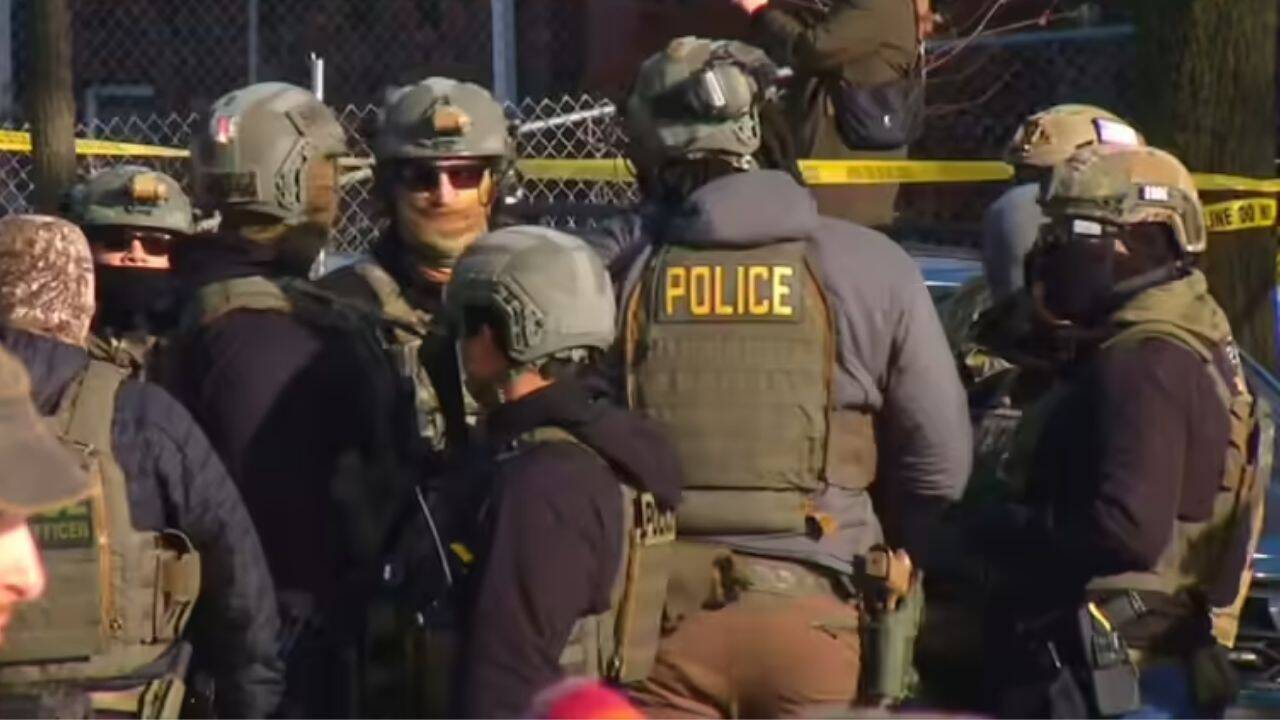
Asphalt holds heat long after the Texas sun drops behind the scrub brush. If you have ever stood on the shoulder of a border highway at dusk, you know the exact smell: baked tar, diesel exhaust, and the dry, metallic tang of dust kicked up by heavy tires. It is a sensory memory that stays in the back of your throat.
In the sterile language of a police blotter, the event takes two lines. An Immigration and Customs Enforcement officer in Texas used his vehicle to strike a migrant. Months later, a grand jury looked at the evidence, returned an indictment, and the officer turned himself in.
Clean. Clinical. Over.
Except nothing about a human body colliding with four thousand pounds of steel is clean, and the legal aftermath is rarely over when the handcuffs click shut at a county booking desk. When a federal agent surrenders to local authorities over a vehicular assault, we are witnessing a rare rupture in an unspoken shield—a moment where the vast, insulated machinery of federal enforcement suddenly has to answer to the messy reality of human vulnerability.
The Physics of an Unequal Encounter
To understand why this indictment matters, strip away the politics for thirty seconds and look purely at the physics.
Imagine a hypothetical scenario to picture the sheer asymmetry of the moment. On one side, you have a man on foot—let’s call him Mateo—wearing worn sneakers, carrying maybe a plastic gallon of water and a backpack with a spare shirt. He is exhausted, dehydrated, and operating on pure adrenaline. On the other side, you have a federal officer seated inside a climate-controlled, reinforced government SUV, backed by a badge, a radio, a firearm, and the full weight of the United States government.
When that SUV accelerates toward Mateo, the vehicle ceases to be transportation. It becomes a weapon.
For decades, law enforcement agencies across the country have trained officers that a moving car is a deadly threat when driven at them. Officers are routinely cleared for shooting drivers who use vehicles as battering rams. Yet, when the roles reverse—when the badge is behind the steering wheel and the unarmed civilian is on the asphalt—the moral and legal geometry suddenly gets blurry.
In Texas, where state and federal operations have surged to historic levels, the borderlands have become a high-speed theater of pursuit. According to data compiled by human rights organizations and journalistic investigations over the past several years, vehicle-related fatalities and injuries involving border enforcement have spiked dramatically. High-speed chases through residential neighborhoods and brushland have left dozens dead, often bystanders or migrants simply trying to run on foot.
Yet, prosecutions of federal agents for use-of-force incidents remain vanishingly rare. Historically, the Department of Justice and local district attorneys have deferred to federal immunity claims, operating under the assumption that split-second decisions in the field deserve near-total deference.
That is why the image of an ICE officer walking into a Texas facility to surrender on a grand jury indictment feels like an earthquake. It signals that a group of ordinary citizens—twelve neighbors sitting in a quiet room looking at dashcam footage, medical records, and tire marks—decided that a badge does not rewrite the laws of physics or basic human decency.
The Invisible Wall of Federal Immunity
Why does it take a grand jury indictment to bring a single officer to the booking desk?
Think of federal accountability like a nesting doll made of reinforced concrete. To get to the person inside, you have to crack through layer after layer of legal insulation.
First, there is the internal review. When an incident occurs—whether a shooting or a vehicle strike—the agency investigates itself. Statements are taken, reports are filed, and administrative leave is granted. To the public, this phase looks like a black hole. Information disappears inside, and months or years pass without a word.
Second, there is the doctrine of Supremacy Clause immunity. Under federal law, a federal officer cannot be prosecuted by a state if their actions were "necessary and proper" to carry out their federal duties. It is an old legal shield, forged in the 19th century to prevent local sheriffs from arresting federal marshals enforcing unpopular national laws. Today, it often functions as a massive procedural roadblock, tying cases up in federal court for years while attorneys argue over jurisdiction rather than guilt or innocence.
Third, there is the culture of the "split-second decision." Defense attorneys rely heavily on Supreme Court precedent—specifically Graham v. Connor—which instructs courts to judge an officer's use of force from the perspective of a reasonable officer on the scene, rather than with the 20/20 vision of hindsight.
I have sat in courtrooms where this argument is deployed, and it is a powerful psychological tool. The defense paints a picture of chaos, darkness, and imminent danger. They ask the jurors to put themselves in the driver's seat, heart pounding, radio squawking, shadows moving in the headlights.
It is easy to sympathize with the driver when you only look through the windshield. It is much harder when you force yourself to stand in front of the bumper.
What Happens When the Siren Stops
The real problem lies elsewhere, far beyond the courtroom steps where the officer surrendered. It lives in the long, quiet aftermath that never makes the evening news.
Consider what happens next when a pedestrian is struck by a heavy vehicle. Even at twenty miles per hour, the impact transfers massive kinetic energy into the human frame. Bones shatter. Internal organs bruise or rupture. A person who crossed a desert seeking a better life—or simply trying to survive—suddenly wakes up handcuffed to a hospital bed, facing crushing medical trauma alongside federal deportation proceedings.
In many of these cases, the victim is deported before a criminal investigation even gains momentum. Once they are across the river or back in their home country, they vanish from the legal equation. No victim means no witness. No witness means no testimony. And without testimony, the grand jury never even convenes.
That is the hidden engine behind the low prosecution rates of border enforcement officers. The system does not just protect the agent through legal doctrine; it systematically removes the very people who could testify against them.
For this Texas case to reach an indictment, something had to break that pattern. Either the physical evidence—video footage, forensic reconstruction, or eyewitness accounts from other personnel—was so undeniable that it spoke for itself, or the victim managed to remain within reach of the justice system long enough to be heard.
Both possibilities point to a shifting tide in how Texas communities and prosecutors view the human cost of border enforcement.
The Weight of a Grand Jury
People often ask what a grand jury actually does when an officer is involved. Is it a trial? Does it mean the officer is guilty?
No. A grand jury indictment is not a verdict. It is a threshold.
In the American legal system, a grand jury meets in secret. There is no judge presiding over the arguments, and the defense attorney is not in the room. Prosecutors present evidence—witness statements, medical reports, video—and the jurors simply answer one question: Is there probable cause to believe a crime was committed?
When the target of that inquiry is a civilian, grand juries indict almost every time. An old legal maxim says a prosecutor could get a grand jury to "indict a ham sandwich."
When the target wears a badge, that maxim dies. Grand jurors are conditioned to trust law enforcement. They want to believe that the people tasked with keeping order are acting in good faith. Getting twelve ordinary citizens to look at a federal agent and say, You crossed the line, requires overwhelming, visceral proof.
When that officer surrendered in Texas, he wasn't just responding to a piece of paper. He was responding to the collective judgment of his neighbors who looked at the evidence and refused to look away.
Living With the Gray Areas
I will admit something that makes both activists and hardliners uncomfortable: policing the border is genuinely hard, confusing, and frightening work.
If you have ever driven down an unlit ranch road in South Texas at two in the morning, you know how quickly shadows turn into threats. Exhaustion sets in after twelve-hour shifts. Fear makes the human brain take shortcuts. In that environment, mistakes happen, and not every collision is born of malice.
Acknowledging that fear does not excuse running a human being down with a truck. Rather, it highlights why clear, unbreakable rules matter so desperately.
When an agency fails to hold its own accountable, it does not actually protect its officers. It abandons them to a culture where reckless aggression is normalized until someone gets hurt—and then, inevitably, the institution steps back and lets the individual take the fall alone.
Every major policing reform in modern history has followed this exact arc. Look at the introduction of body-worn cameras, or the strict limits placed on high-speed pursuits in major cities like Los Angeles and Chicago. Initially, unions and agencies fought those changes, claiming they would handcuff officers and embolden criminals. Yet, once implemented, those rules saved lives—including the lives of officers who were no longer pressured to make reckless, fatal gambles behind the wheel.
A vehicle is designed to move people from one place to another. The moment an institution allows its agents to treat a bumper as a baton, everyone on the road becomes expendable.
The Accountability Equation
So where does a surrender like this leave us? Does one indictment fix a broken system?
Of course not. One case is a single data point against a massive backdrop of unchecked force. The officer will have his day in court. His attorneys will likely invoke federal immunity, argue that the collision was an accident, or claim that the suspect darted unexpectedly into the path of the vehicle. The legal battle will stretch on for months, maybe years, grinding slowly through motions and appeals.
What changes today is the baseline of expectation.
For years, the prevailing assumption along the southern border was that federal operations existed in a kind of legal twilight zone—a place where standard rules of engagement blurred and local accountability stopped at the county line. Local prosecutors hesitated to touch federal cases, fearing jurisdictional nightmares and political backlash.
By securing an indictment and forcing a surrender, Texas authorities have demonstrated that the shield is not impenetrable. A badge grants authority, not absolution.
Think back to that stretch of Texas highway at dusk. Imagine the headlights cutting through the dust, the sudden screech of tires on hot tar, and the deafening silence that follows an impact. For a long time, the story ended there, swallowed by the dark and buried in a filing cabinet. Now, finally, someone has turned on the lights.


