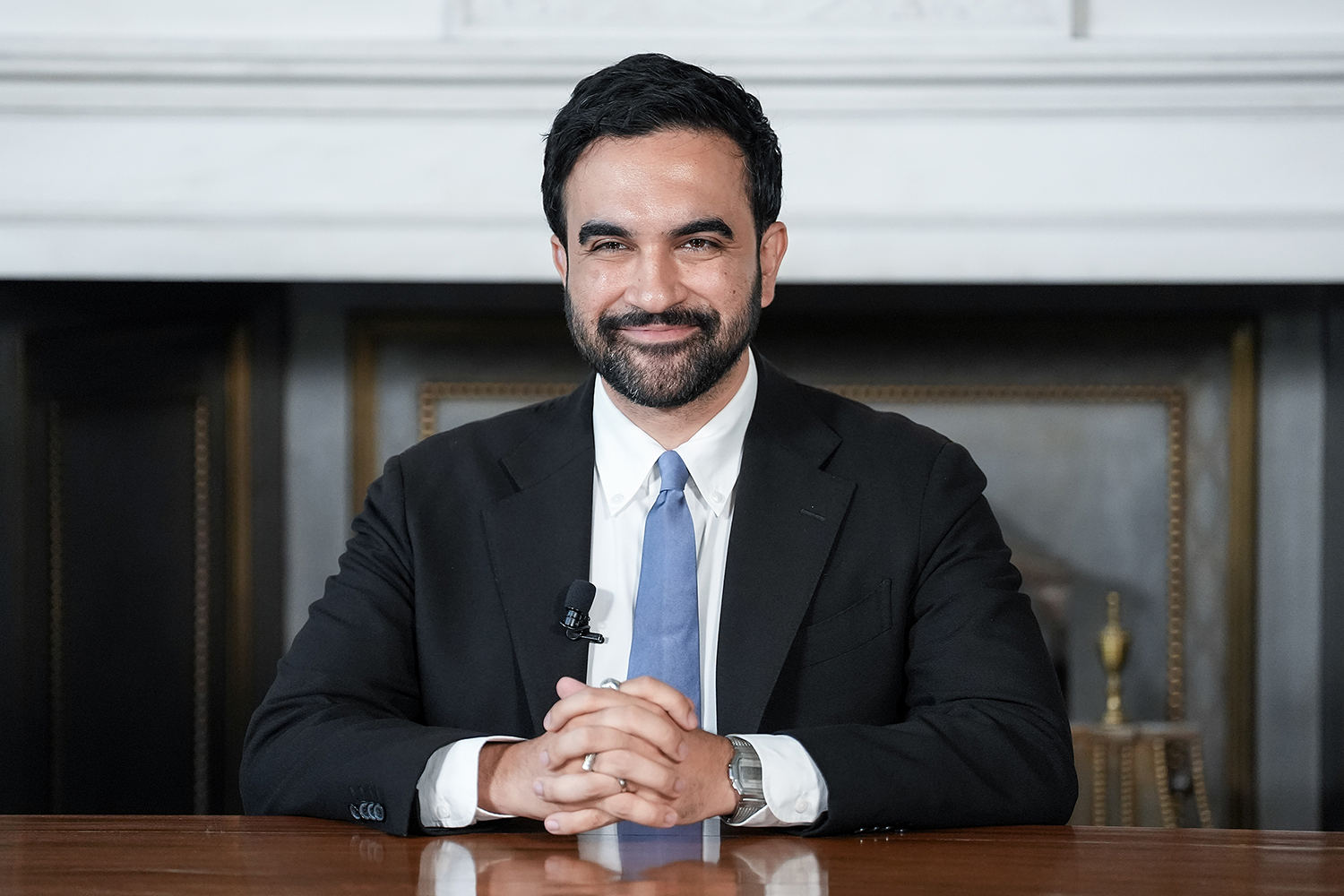
Zohran Mamdani wants to rewrite the script for America’s semiquincentennial, but the structural realities of his political party might rewrite him first.
As the United States approaches its 250th anniversary, the political establishment is scrambling to define what the milestone actually means. On one side, Donald Trump promises a monumental, year-long celebration focused on national grandeur, industrial might, and a traditionalist view of American history. On the other, the progressive wing of the Democratic Party is attempting to mount a counter-narrative. State Assemblymember Zohran Mamdani’s recent address offered the sharpest distillation of this alternative vision yet, pitching a future rooted in socialist economic redistribution and systemic overhaul rather than flag-waving patriotism.
But looking past the soaring rhetoric reveals a deeper crisis. The progressive attempt to offer a coherent alternative to Trump’s vision is fracturing under the weight of its own internal contradictions and an institutional backlash from moderate Democrats.
The Two National Birthdays
The upcoming 250th anniversary is not just a party. It is a multi-billion-dollar branding war for the soul of the electorate.
Trump’s blueprint for the semiquincentennial relies on nostalgia and scale. His proposals include a massive "Great American Exhibition" showcasing state-by-year achievements, a renewed emphasis on traditional historical figures, and a narrative of uninterrupted progress. It is a potent political tool designed to consolidate his base and appeal to a deep-seated desire for national pride.
Mamdani’s address attempted to flip this script entirely. Instead of celebrating the past 250 years as a triumph, the progressive argument frames American history as a continuous struggle between entrenched capital and the working class. The core premise is that true patriotism lies in dismantling systemic inequalities rather than venerating the institutions that created them.
This is not a subtle policy disagreement. It is a fundamental clash over the American mythos. While one side views the country as an inherently great experiment that needs to be preserved, the other views it as an ongoing project that requires radical reconstruction.
The Friction Inside the Democratic Tent
Progressives face a massive hurdle. Their primary obstacle is not Donald Trump, but the leadership of their own party.
Mamdani and the Democratic Socialists of America (DSA) faction are operating on an island. While national Democratic leaders like Joe Biden and Hakeem Jeffries attempt to court moderate suburban voters with a message of institutional stability and economic incrementalism, progressives are pushing for sweeping changes that alienate the party's donor class.
Consider the mechanics of legislative power in New York, Mamdani’s home turf. Despite holding supermajorities, mainstream Democrats have consistently diluted or blocked signature progressive proposals, from aggressive tenant protections to sweeping tax hikes on ultra-wealthy residents.
- The Tax Divide: Progressive platforms demand high marginal tax rates on top earners to fund universal social programs. Mainstream Democratic governors frequently reject these measures, citing fears of capital flight.
- The Housing War: Left-wing lawmakers push for "Good Cause" eviction laws and state-funded social housing. Moderate factions favor developer incentives and zoning deregulation to boost supply via the private market.
- The Rhetorical Gap: National Democrats lean heavily into defending democratic norms and institutional guardrails. The socialist wing argues that those very institutions are fundamentally broken and designed to protect the status quo.
This internal rift leaves the left's counter-narrative crippled. It cannot mount a unified defense against a disciplined populist message from the right when it is locked in a perpetual civil war with its own party leadership.
The Working Class Disconnect
The ultimate test of any political vision is whether it can build a durable coalition. Here, the progressive alternative faces its most brutal reality check.
For decades, the bedrock of the American left was the unionized working class. Today, that demographic is fracturing. While progressive intellectuals and activists articulate a vision of economic justice, substantial segments of the multiethnic working class are moving in the opposite direction.
Data from recent election cycles shows a steady drift of working-class voters—particularly Latino and Black men—toward the Republican party. Trump’s message of economic nationalism, border security, and cultural traditionalism is resonating in communities that were once reliably blue.
Progressives argue that this is a matter of messaging, believing that if voters truly understood the benefits of universal healthcare or state-guaranteed housing, they would come home to the left. This view is patronizing and incorrect. The shift is driven by a profound distrust of government institutions and a cultural estrangement from the socially progressive language that dominates modern left-wing discourse.
When a factory worker or a small business owner hears a politician talk about a total transformation of the American system, they do not always hear a promise of liberation. Often, they hear instability. Trump’s vision, whatever its faults, offers the illusion of certainty and order. The progressive alternative offers a chaotic leap into the unknown.
The Funding Machinery Behind the Visions
To understand why one narrative dominates while the other struggles for airtime, look at the money.
The machinery behind the conservative national vision is heavily capitalized, decentralized, and highly efficient. A vast ecosystem of think tanks, media outlets, and dark-money groups ensures that the populist-right message is blasted into millions of homes daily. This apparatus does not just react to events; it shapes the cultural terrain years in advance.
The progressive movement relies on a completely different infrastructure. It is fueled by small-dollar donations, grassroots volunteer mobilization, and a handful of left-aligned non-profits. While this model is effective for winning localized primary elections in deeply blue urban districts, it lacks the scale required to wage a national narrative war.
Furthermore, mainstream Democratic funding is explicitly tied to corporate interests and high-net-worth individuals who are fundamentally opposed to the economic restructuring that Mamdani advocates. When the choice comes down to funding a message of traditional American patriotism or one of democratic socialism, the institutional money will choose patriotism every single time.
Beyond the Anniversary Rhetoric
The debate over America's 250th anniversary is a proxy war for the immediate future of the country's political alignment.
If the progressive wing cannot find a way to ground its ideas in the practical, everyday material needs of the public—without the academic jargon and moral grandstanding that defines its current output—it will remain a regional curiosity. A vision for America cannot succeed if it only appeals to voters in Brooklyn, Chicago, and San Francisco.
Meanwhile, the populist right's narrative moves forward completely unimpeded. By anchoring its message in familiar symbols of national identity and economic pride, it provides a clear, easily digestible alternative to a status quo that many Americans feel is failing them.
The tragedy of the progressive position is that its diagnosis of America’s economic ailments is often highly accurate. The concentration of wealth is at historic highs, the housing market is broken, and the cost of basic necessities continues to outpace wages. But diagnosing a disease is not the same as convincing the patient you have the cure. Until the left can bridge the gap between its radical rhetoric and the conservative instincts of the broader electorate, its alternative vision for America will remain a script that never makes it to production.