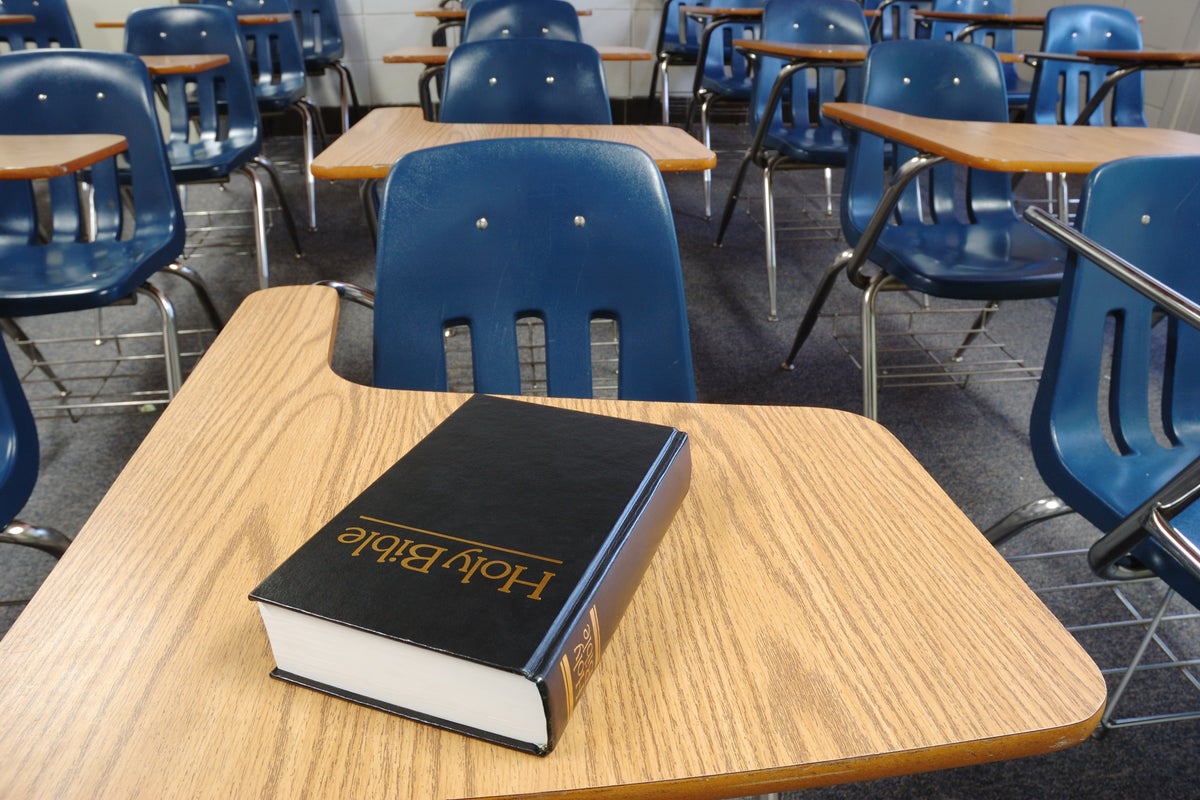
The sun rises hot and early over Tallahassee, baking the asphalt of school parking lots before the first yellow buses even arrive. Inside these classrooms, the air conditioning hums a steady, monotonous baseline. For decades, the morning routine has been predictable. Backpacks unzip. Formica desks scrape against linoleum. A PA system crackles to life with the Pledge of Allegiance.
But a quiet, profound shift is moving through the corridors of American education, and Florida is poised to become its next major battleground.
Following the legislative blueprint laid down by Texas, Florida lawmakers are increasingly looking at public school classrooms not just as spaces for civic education, but as frontiers for spiritual instruction. The debate is no longer about whether religion belongs in the cultural conversation. It is about a specific, mandatory directive: putting the Bible into the hands of every student, every day, by law.
When we talk about policy, we tend to speak in the cold language of tallies and legal precedents. We analyze Supreme Court frameworks like Kennedy v. Bremerton School District or debate the shifting boundaries of the Establishment Clause. But policy does not live in a vacuum. It lands squarely on the shoulders of seven-year-olds trying to memorize spelling words, and teachers balancing lesson plans on razor-thin margins.
To understand what this looks like on the ground, consider a hypothetical classroom in a mid-sized Florida suburb.
Let’s call the teacher Sarah. She has taught third grade for twelve years. Her morning is already a tightly choreographed sprint. She has twenty-two students. Three of them are still learning English. Two are reading at a kindergarten level. One hasn't eaten breakfast. Sarah’s job is to ensure every single one of them passes the state reading assessment, or risk seeing her school’s funding slashed.
Now, add a new mandate to the chalkboard.
Under proposals mirroring the recent legislative push in Texas—where state leaders have championed plans to inject biblical text directly into the standard curriculum—Sarah must allocate a portion of her precious instructional time to reading scriptures.
The immediate question isn't just legal. It is intensely practical.
Which translation does she use? The King James Version, with its majestic but archaic syntax that her struggling readers will stumble over? The New International Version? What happens when a student asks why the Bible their family reads at home looks different from the one on their desk?
Religion in America has always been a deeply personal tapestry, woven in living rooms, temples, mosques, and churches. It relies on the nuanced guidance of parents and faith leaders who know a child’s heart. When the state steps into that role, the nuance evaporates. A text meant for spiritual contemplation becomes a textbook. It becomes something to be tested, graded, and enforced.
The driving force behind these legislative pushes is a desire to return to what proponents call a foundational moral bedrock. Supporters argue that Western literature, history, and law are inextricably linked to biblical narratives. To understand Shakespeare, or the rhetoric of the Civil Rights movement, one must understand the Bible.
That argument possesses historical merit. But there is a vast, yawning chasm between teaching about religion as a historical force and mandating the reading of religious texts as an institutional ritual.
Consider what happens next in Sarah’s classroom.
A student raises their hand. They don't want to know the historical context of a passage. They want to know if the story they just read is literally true. They want to know if their family, who practices a different faith—or no faith at all—is wrong.
In that moment, Sarah is no longer an educator. She is an accidental theologian, walking a tightrope over a canyon of parental expectations and constitutional liability. If she answers one way, she alienates a parent who believes in a literal interpretation. If she answers another, she infringes upon the deeply held beliefs of a secular family.
The human cost of this friction is born by the children. School is supposed to be the great equalizer, a neutral ground where every child, regardless of their background, surname, or zip code, stands on equal footing. When the state selects one specific religious text and elevates it above all others within a mandatory public setting, the classroom dynamics shift.
Instantly, an invisible line is drawn. There are those who belong to the text, and those who sit on the outside looking in.
Texas has already crossed this threshold, utilizing its state education board to embed biblical stories into elementary reading curricula. Florida, a state that has spent the last several years aggressively reshaping its educational landscape through book restrictions and voucher expansions, is the logical next step for this policy experiment.
But the real problem lies elsewhere, far from the grandstanding of state capitols.
Our public schools are already fracturing under the weight of culture war fatigue. Teachers are leaving the profession in droves, exhausted by low pay and the feeling that their classrooms have become political theater. Parents are anxious, watching their children navigate an increasingly polarized world.
Introducing mandatory scripture reading into this environment doesn't heal the divide. It weaponizes it.
True faith does not require the coercion of a school bell. It thrives in the quiet spaces of human conviction, passed down through generations by choice, love, and community. When we ask the state to enforce reverence, we usually end up with the opposite: a resentment of the very things we meant to protect.
The final bell rings. Sarah’s students pack their bags, the air conditioning clicks off, and the silence returns to the room. On the corner of her desk sits a stack of uncounted papers, a state-mandated curriculum guide, and an uncertain future for the children who will walk through her door tomorrow morning.