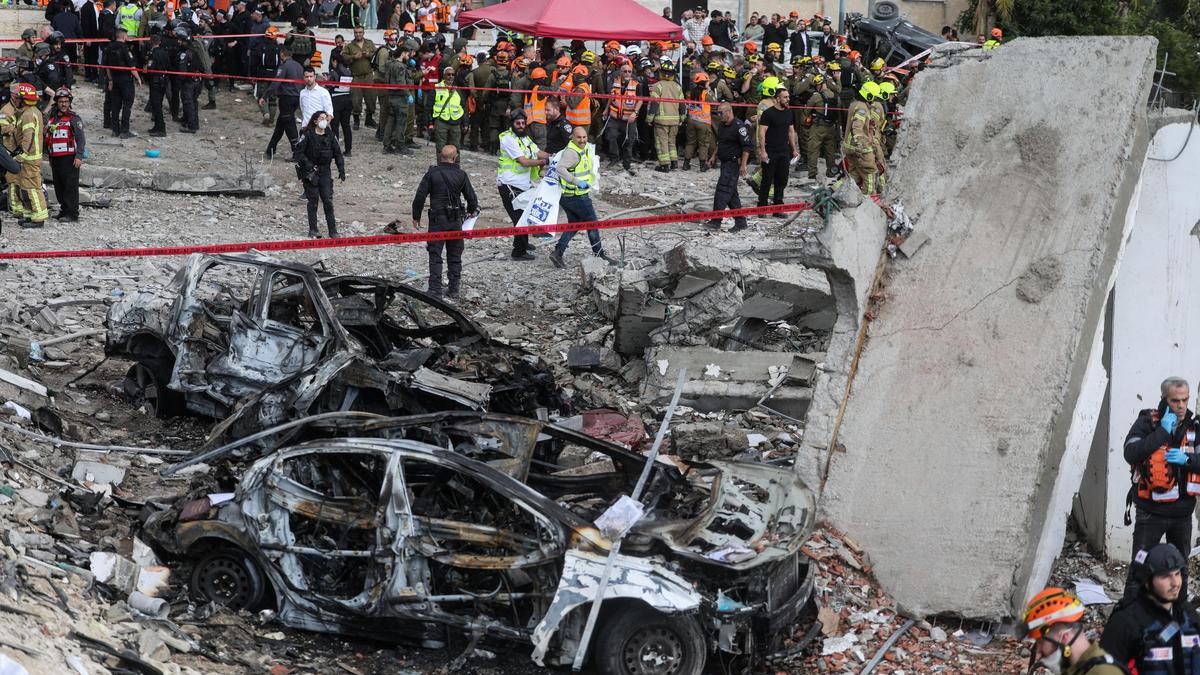
The headlines are predictable. They read like a template: "Tragedy in Beit Shemesh," "Death Toll Rises," "Escalation Imminent." The media treats every kinetic event in the Middle East as a freak occurrence or a sudden lapse in a supposedly perfect defense net. It is a comforting lie.
Nine people are dead because we have collective amnesia about the physics of modern warfare. We’ve been sold a bill of goods by defense contractors and talking heads who want us to believe that interceptors are magic wands and that "precision" is an absolute. It isn't. The tragedy in Beit Shemesh isn't just a failure of diplomacy or intelligence; it is a brutal reminder that the era of the impenetrable shield is over, and the "lazy consensus" of air defense supremacy is getting people killed.
The Interceptor Fallacy
The public has been conditioned to see a 90% interception rate as a victory. In any other industry, a 10% failure rate that results in catastrophic loss of life would be a scandal. In the context of rocket fire on civilian centers, that 10% is where the reality lives. We focus on the iron domes and the arrows, forgetting the basic math of saturation.
If an adversary fires 100 projectiles and your system is 90% effective, 10 warheads hit. If they fire 1,000, 100 hit. The math of the aggressor is cheaper, faster, and more scalable than the math of the defender. I’ve watched defense budgets balloon by billions while the actual security of the average resident in a "protected" zone remains tethered to a coin flip. We are spending $50,000 interceptors to chase $500 pieces of flying pipe, and then we act shocked when the volume eventually overwhelms the logic.
The Dead Zones of Urban Planning
Look at the layout of Beit Shemesh. It’s a dense, rapidly growing urban center. The "status quo" narrative blames the tragedy solely on the launch site. While the moral culpability rests there, the practical culpability rests on an urban planning philosophy that assumes the military can stop every rain of fire.
We build glass towers and dense residential blocks in the middle of a missile path and then wonder why the shrapnel—even from a "successful" interception—turns streets into kill zones. A kinetic kill in the sky doesn't make the energy disappear. It redistributes it. Gravity always wins. The debris from a high-altitude intercept travels at terminal velocity. Nine people died, and many likely weren't hit by a primary warhead, but by the secondary debris that our "surgical" defense creates. We are ignoring the physics of falling metal.
Precision is a Marketing Term
The term "precision strike" is the greatest PR victory of the 21st century. In reality, precision is a probability distribution. When a missile is fired toward a city like Beit Shemesh, the Circular Error Probable (CEP) is what matters.
$$CEP = 0.5887 \cdot (\sigma_x + \sigma_y)$$
Even with GPS guidance, environmental variables—wind shear, sensor degradation, electronic jamming—expand that circle. When the target is a "town," the entire concept of precision is moot. The town is the target. By focusing on whether the missile hit its "intended" military asset or a residential street, we are playing a semantic game while families are buried. The distinction between a "targeted strike gone wrong" and "indiscriminate fire" is a luxury for lawyers and pundits. To the kinetic energy hitting a roof, the distinction is zero.
The Intelligence Hubris
We hear the same refrain after every strike: "How did this get through?" This question assumes that intelligence is a total-information game. It’s not. It’s a game of signals and noise. I’ve been in rooms where the data is overwhelming, and the "noise" is often intentionally generated by the adversary to mask the one real threat.
The failure in Beit Shemesh is a failure to admit that we cannot see everything. We have over-relied on SIGINT (Signals Intelligence) and neglected the messy, human reality of the ground. We assumed the adversary’s capability was static. It never is. They iterate. They find the gaps in the radar. They learn the refresh rates of the satellite sweeps. While we were patting ourselves on the back for the last successful interception, they were calculating the exact angle to exploit the terrain masking around the Judean Hills.
The High Cost of the "Buffer Zone"
The geopolitical "experts" will tell you we need a wider buffer zone. They are living in 1967. In an era of hypersonic glide vehicles and long-range precision fires, a buffer zone is a psychological comfort, not a physical one. You cannot out-walk a missile.
By clinging to the idea that "land equals safety," we neglect the hardening of the infrastructure we already have. Why are we still building apartments without integrated, high-pressure blast shielding in the 2020s? Because it’s expensive. Because it’s "alarmist." Because it ruins the aesthetic of the "startup nation." We prioritize the appearance of normalcy over the reality of the threat, and then we pay for that vanity in blood.
Stop Asking "Why" and Start Asking "How Much"
The "People Also Ask" sections are filled with queries like "Why did they attack Beit Shemesh?" or "Is it safe to travel?" These are the wrong questions. The "why" is academic. The "is it safe" is a binary answer to a spectral problem.
The real question is: How much risk are we willing to socialize?
We've socialized the risk of living in a combat theater by pretending the Iron Dome is a ceiling. It isn't. It's an umbrella in a hurricane. It might keep you dry for a minute, but it won't stop the flood. We need to stop the "thoughts and prayers" cycle and start demanding a radical shift in how we defend civilian spaces.
- Hardened Infrastructure: Stop building for beauty; build for survival.
- Interception Transparency: Admit that a 90% success rate is a 10% catastrophe rate.
- Electronic Warfare Decentralization: Move defense capabilities away from centralized military hubs and integrate them into the municipal fabric.
The Brutal Truth
The tragedy in Beit Shemesh was not an anomaly. It was a statistical certainty. As long as we continue to buy into the myth of the "clean war" and the "perfect defense," we are complicit in the shock that follows the next strike.
We are fighting a 21st-century war with a 20th-century mindset, relying on expensive toys to solve deep-seated ballistic realities. The missile didn't just break a building; it broke the illusion of safety we've spent billions to maintain.
If you want to honor the nine people who died, stop pretending this was a "failure of the system." The system worked exactly as it was designed. It just wasn't designed to save everyone. It was designed to maintain a manageable level of loss.
Tell the families in Beit Shemesh that their lives were part of a "manageable loss" and see how well the "lazy consensus" holds up then.
Stop looking at the sky and start looking at the blueprints. The shield is leaking, and it’s time to stop acting surprised when we get wet.