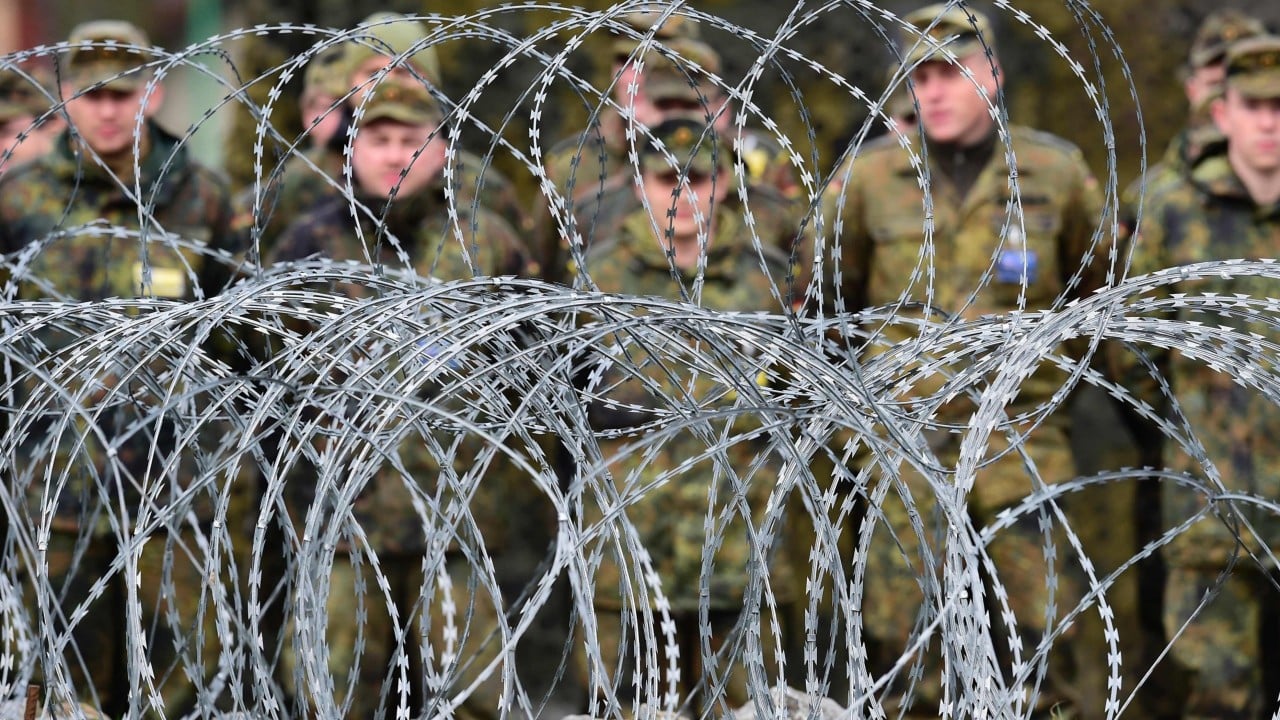
Germany and the Netherlands are moving to solidify a joint military command center in the Baltic region, a decision that fundamentally alters the security architecture of Northern Europe. This is not just another bureaucratic layer within NATO. It is a pragmatic, bilateral response to the slow-moving gears of broader alliance logistics. By integrating their naval and land force structures specifically for the Baltics, Berlin and The Hague are bypassing the traditional hurdles of multi-national consensus to create a "plug-and-play" military presence that can act before a full NATO Article 5 mobilization is even debated.
The move marks a departure from the post-Cold War era of symbolic deterrence. For years, the presence in Lithuania, Latvia, and Estonia consisted of "tripwire" forces—small units designed to ensure that any aggression would immediately involve international casualties, thereby forcing a larger response. That strategy is dead. The new command structure focuses on "defense-in-depth," providing the infrastructure for heavy divisions to move, fuel, and fight within forty-eight hours.
The End of Strategic Ambiguity in the Baltics
For decades, European defense was defined by a reluctance to offend and a hope for economic integration to solve political friction. That hope vanished in February 2022. The Baltic states have long warned that their geography—connected to the rest of the EU only by the narrow Suwalki Gap—makes them a strategic island. If that gap is closed, NATO forces in the region are cut off.
The German-Dutch initiative addresses this by establishing a permanent, high-readiness headquarters that manages the specialized logistics of the region. This includes the integration of the Dutch 13th Light Brigade into the German 10th Panzer Division. It is a level of military merging rarely seen between sovereign nations. They are effectively sharing a nervous system. This reduces the time wasted on translating orders or aligning different radio frequencies during a crisis.
Logistics as the Ultimate Weapon
Amateurs discuss tactics while professionals study logistics. This command center is, at its heart, a logistical engine. The Baltic terrain is difficult; it is a mix of dense forests, marshland, and aging Soviet-era infrastructure that often cannot support the weight of modern Western Main Battle Tanks like the Leopard 2.
Berlin and The Hague are investing in "military mobility." This involves mapping every bridge, rail line, and port capability from Rotterdam to Tallinn. The goal is to ensure that a Dutch armored column can roll off a ship in the Netherlands and reach the Lithuanian border without getting stuck under a low bridge or waiting for customs paperwork. The command center will act as the traffic controller for this massive flow of hardware.
The Problem of the Suwalki Gap
The Suwalki Gap remains the most dangerous piece of land in Europe. It is a sixty-mile strip along the Polish-Lithuanian border that separates the Russian exclave of Kaliningrad from Belarus. If a conflict breaks out, this is where the first shots will likely be fired.
The new command center is designed to manage the "pre-positioning" of equipment. Instead of flying troops and tanks in during a war, the tanks are already there, sitting in humidity-controlled warehouses, while the troops fly in and marry up with their gear. This cuts the deployment window from weeks to days. It turns a vulnerable corridor into a reinforced gateline.
Why the Netherlands and Germany
The partnership between these two nations is not accidental. The Dutch military is small but highly specialized, particularly in maritime logistics and high-tech reconnaissance. Germany provides the industrial weight and the heavy armor. Together, they represent the "Middle Power" backbone of European defense.
Germany, in particular, is undergoing a painful transformation. The Zeitenwende, or historical turning point, has forced a country that was once deeply uncomfortable with its military history to become the primary guarantor of Baltic security. This shift has not been easy for the German public or its political class. However, the reality of the Suwalki Gap has silenced most of the opposition. The Dutch, meanwhile, have become the most integrated military partner Germany has, effectively serving as a model for how other European nations might eventually merge their forces to save costs and increase lethality.
Technological Integration and Electronic Warfare
Modern warfare in the Baltics will not just be about steel and gunpowder. It will be fought in the electromagnetic spectrum. Russia has spent years perfecting electronic warfare (EW) in the region, frequently jamming GPS signals and disrupting civilian aviation.
The new command center is being built with "hardened" communications. This means moving away from standard satellite links that can be easily spoofed or jammed. The German and Dutch signals units are working on decentralized data networks that can operate even when the broader internet is dark. They are practicing "silent" maneuvers, where units move without emitting radio signals, relying instead on pre-coordinated movements and burst transmissions.
The Risk of Regional Fragmentation
While this bilateral move strengthens the Baltics, it also highlights a growing fracture within NATO. There is a "Two-Speed Europe" emerging in defense. On one side, you have the nations like Poland, Germany, the UK, and the Netherlands who are actively rearming and building new command structures. On the other, you have Southern European nations who remain more focused on Mediterranean migration and North African instability.
This command center is a signal that Northern Europe is tired of waiting for a unified EU or NATO consensus on every detail. They are building their own "Coalition of the Willing." The danger is that by creating these smaller, more efficient command hubs, the overall unity of the 32-member NATO alliance might be diluted. If a crisis occurs, who does the Baltic commander listen to: the German-Dutch HQ or SACEUR in Mons? These lines of authority are still being negotiated in the shadows of the main announcement.
Economic Costs and the Industrial Base
Maintaining a permanent command and pre-positioned stocks is an expensive endeavor. It requires a permanent flow of spare parts and a workforce capable of maintaining complex electronics in harsh winter conditions.
The Dutch and German defense industries are seeing a surge in orders, but they are struggling with "just-in-time" manufacturing models that were designed for peace, not high-intensity conflict. To make this command center effective, the two nations must move toward "just-in-case" manufacturing. This means stockpiling millions of rounds of ammunition and thousands of replacement parts. It is a return to a Cold War economic footing that many politicians are still hesitant to fully fund.
The Human Element
Beyond the tanks and the tech, there is the issue of personnel. Training a Dutch sergeant to work seamlessly with a German lieutenant requires more than just a shared manual. It requires years of joint exercises. The Baltic deployment will see thousands of soldiers rotating through the region every year.
This creates a "learning loop." Soldiers returning from the Baltics bring back real-world data on how their equipment handles the cold, how Russian drones operate in the area, and how the local population reacts to a large military presence. This data is fed back into the command center to update tactics in real-time. It is an evolutionary process, not a static one.
The Baltic Perspective
For the governments in Vilnius, Riga, and Tallinn, this command center is the culmination of a decade of lobbying. They no longer want promises; they want boots, and they want those boots to have a clear chain of command. They are not concerned with the internal politics of the Dutch or German parliaments. They are concerned with the fact that their capitals are within artillery range of a hostile power.
The presence of this command center acts as a psychological deterrent for the local population as much as a military one for the adversary. It signals that if the borders are crossed, the response will be automatic. There will be no delay for a committee meeting in Brussels. The command is already on the ground, the fuel is already in the tanks, and the targets are already programmed into the fire control systems.
Operational Realities on the Ground
The command center will likely be situated in a location that allows for rapid oversight of both the Baltic Sea and the land corridors. This means a heavy reliance on "Domain Awareness."
- Sea: Tracking every vessel in the Baltic to prevent sabotage of undersea cables and pipelines.
- Air: Managing the complex air-policing missions that occur daily as Russian jets test the borders.
- Land: Overseeing the movement of multinational battle groups to ensure they are not clustered in a way that makes them easy targets for long-range missiles.
This is a 24/7 high-stakes chess match. The command center provides the board and the timer.
The true test of this new German-Dutch alliance will not be found in the press releases or the ribbon-cutting ceremonies. It will be found in the mud of the Suwalki Gap during a November rainstorm, when a logistics officer has to decide which convoy gets the last of the bridge-layer units.
Defense is a matter of hard physics and cold math. By merging their command structures, Germany and the Netherlands have decided that the math of the Baltics no longer adds up if they act alone. They have chosen to sacrifice a degree of national autonomy for the sake of collective survival. This is the new reality of European security: smaller, tighter, and far more lethal than the sprawling alliances of the past. The infrastructure is being laid, the gear is being moved, and the command is taking its post.
Speed is the only currency that matters in a modern opening move.