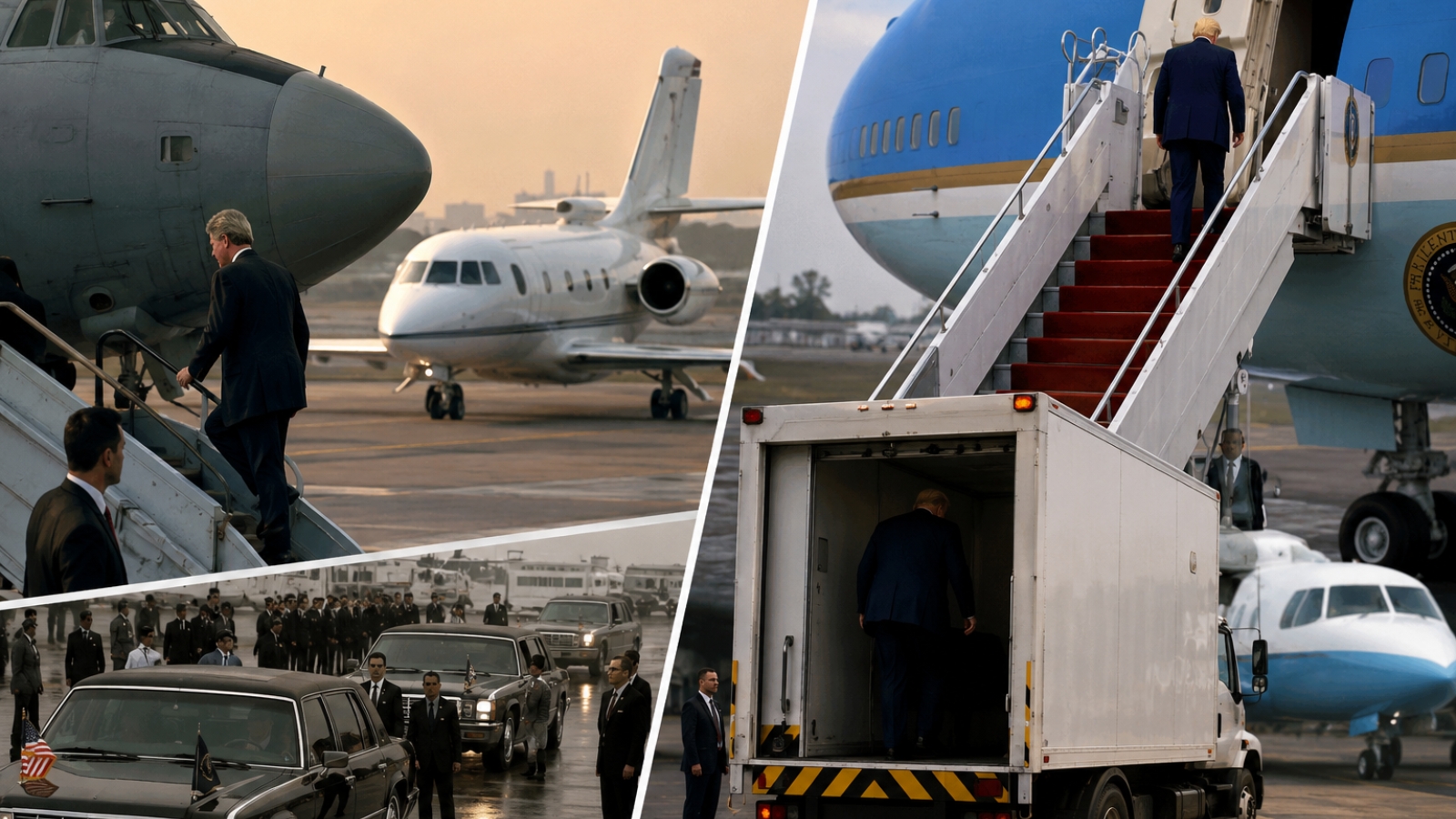
Every few years, internet historians exhume a piece of trivia about Bill Clinton’s year 2000 trip to South Asia and treat it like a geopolitical revelation. The headline always reads the same: Donald Trump wasn't the first, look at how Clinton used a decoy plane from Mumbai to Pakistan.
It is a neat little anecdote. It satisfies our collective obsession with presidential trivia and gives armchair analysts a chance to pat themselves on the back for uncovering a historical footnote.
It is also completely missing the point.
Focusing on whether Clinton or Trump utilized more theatrical decoy aircraft misses the fundamental reality of executive aviation security. It treats statecraft like a spy thriller where the primary objective is evading a surface-to-air missile via shell games in the clouds.
That is not how strategic risk management works. That is not how intelligence operations function. And worst of all, it mistakes a routine administrative precaution for masterclass tactical genius.
Let us dismantle the myth right now.
The Lazy Consensus Of Presidential Paranoia
The narrative pushed by historical hobbyists relies on a seductive, Hollywood-fed premise: world leaders fly into dangerous airspace surrounded by elaborate ruses because assassins are lurking behind every cloud.
When reporters breathlessly detail how Air Force One touched down in Islamabad with its transponders off, or how a backup Gulfstream served as a decoy while the actual President sat in a nondescript transport, the public reacts with wide-eyed awe. We love the theatre of paranoia.
I have spent decades watching organizations, governments, and high-net-worth individuals blow millions of dollars on elaborate security measures that serve only one master: psychological comfort.
Decoy planes are the ultimate security blanket. They look great in a debriefing memo. They provide a rush for the protective detail. But in the grand calculus of modern state-level threat mitigation, they are largely an outdated relic of Cold War thinking.
Let us look at what actually happens when a sitting American president enters contested airspace.
First, the airspace is not a wild frontier where enemy combatants scan the horizon with binoculars waiting to spot the presidential silhouette. Long before Air Force One crosses a border, the airspace is entirely sanitized, monitored, and negotiated. Hostile actors capable of launching a sophisticated anti-air strike against a hardened, heavily escorted presidential aircraft already know the schedules, the routes, and the electronic signatures.
If a rogue state or a well-funded non-state actor wanted to bring down a head of state, a decoy plane would do precisely zero to stop them. Modern radar systems, satellite telemetry, and signal intelligence do not get fooled by a Gulfstream flying twenty minutes ahead of schedule.
The Mechanics Of Executive Movement
To understand why the Clinton-era decoy narrative is overblown, we need to look at the actual physics and protocol of executive transport.
When a president travels, Air Force One is not just a plane; it is a flying command post designated as a military installation. It carries a suite of countermeasures that make civilian decoy tactics look quaint. We are talking about advanced missile deflection systems, electronic jamming equipment, and a persistent fighter escort that ensures any unauthorized aircraft within a fifty-mile radius is intercepted long before it poses a kinetic threat.
When Clinton flew from India to Pakistan in March 2000, his security team faced a genuinely tense diplomatic and tactical environment. Pakistan was under military rule following Pervez Musharraf's coup just months prior. Tensions with India were volatile. Security protocols had to be airtight.
So, did they use a decoy? Yes. Was it a groundbreaking stroke of tactical brilliance? No. It was standard operating procedure for high-risk zones.
Security details do not improvise these measures on the fly. They run simulations, evaluate worst-case scenarios, and deploy redundancy because redundancy is cheap compared to the alternative. Using a backup aircraft is the aviation equivalent of bringing an extra umbrella. It is prudent, but it does not make you a military strategist.
The mistake commentators make is equating an operational precaution with a legendary act of espionage. Clinton was not playing four-dimensional chess against hostile intelligence agencies. His Secret Service detail was simply checking a box on a very long, very rigorous risk-mitigation checklist.
The Real Danger Is Not In The Sky
If you want to understand where executive security actually fails, look at the ground.
History shows us that leaders are rarely assassinated or attacked while cruising at thirty-thousand feet inside a heavily armored Boeing VC-25. The vulnerabilities happen during the transition phases. The motorcades. The tarmac handshakes. The brief seconds of exposure when the principal steps out of the secure cocoon and into the open air.
During that 2000 trip, the real risk to Clinton wasn't a surface-to-air missile fired over the Hindu Kush. The risk was the chaotic political climate on the ground in Islamabad, the potential for internal security lapses within the host nation's military ranks, and the intense polarization of a region on the brink of nuclear escalation.
Fixating on decoy planes allows pundits to ignore the messy, unglamorous reality of ground security. It is much easier to write a breathless article about shell games in the stratosphere than to analyze the intelligence failures that routinely plague diplomatic visits on terra firma.
This is a classic symptom of modern media coverage: spectacularizing the mundane while ignoring the systemic.
The Cost Of Security Theater
Security theater has a direct cost. When we mythologize administrative precautions like decoy planes, we encourage organizations and leaders to invest in the wrong things.
I have seen corporate executives spend six-figure budgets on high-end defensive driving courses and decoy vehicles while completely ignoring basic digital hygiene. They worry about an ambush on the highway while leaving their corporate networks wide open to social engineering attacks that could collapse their entire enterprise from a laptop three continents away.
The obsession with presidential spy-thriller tactics creates a distorted benchmark for what real security looks like. It teaches people that safety comes from clever deceptions and cinematic stunts rather than rigorous intelligence, redundancy, and disciplined protocol.
Real security is boring. It looks like endless spreadsheets, redundant communication channels, background checks on local vendors, and hours of dull reconnaissance. It rarely makes for a good Hollywood script, which is why the media prefers the myth of the decoy plane.
Why We Keep Falling For The Myth
Human beings are hardwired to love a good legend. We prefer our leaders to be mastermind tacticians who outwit villains in real-time, rather than executives executing a pre-planned script written by risk-assessment specialists six months in advance.
When writers dust off the 2000 Clinton trip and frame it as a historical precedent for later administrations, they are feeding a narrative addiction. They want continuity in the mythos of executive power.
We need to break this habit. Stop looking at statecraft through the lens of a spy novel.
Clinton’s flight to Pakistan was a routine exercise in high-risk logistics. Trump's clandestine trips were the same. Neither was a cinematic masterclass in evasion. Both were simply what happens when you move the most targeted person on earth through a hostile neighborhood.
The next time you read a breathless retrospective about decoy planes and secret flight paths, remember what is actually happening behind the curtain. It is not James Bond. It is just logistics with a better public relations team.
Stop romanticizing the theater. Pay attention to the ground game.