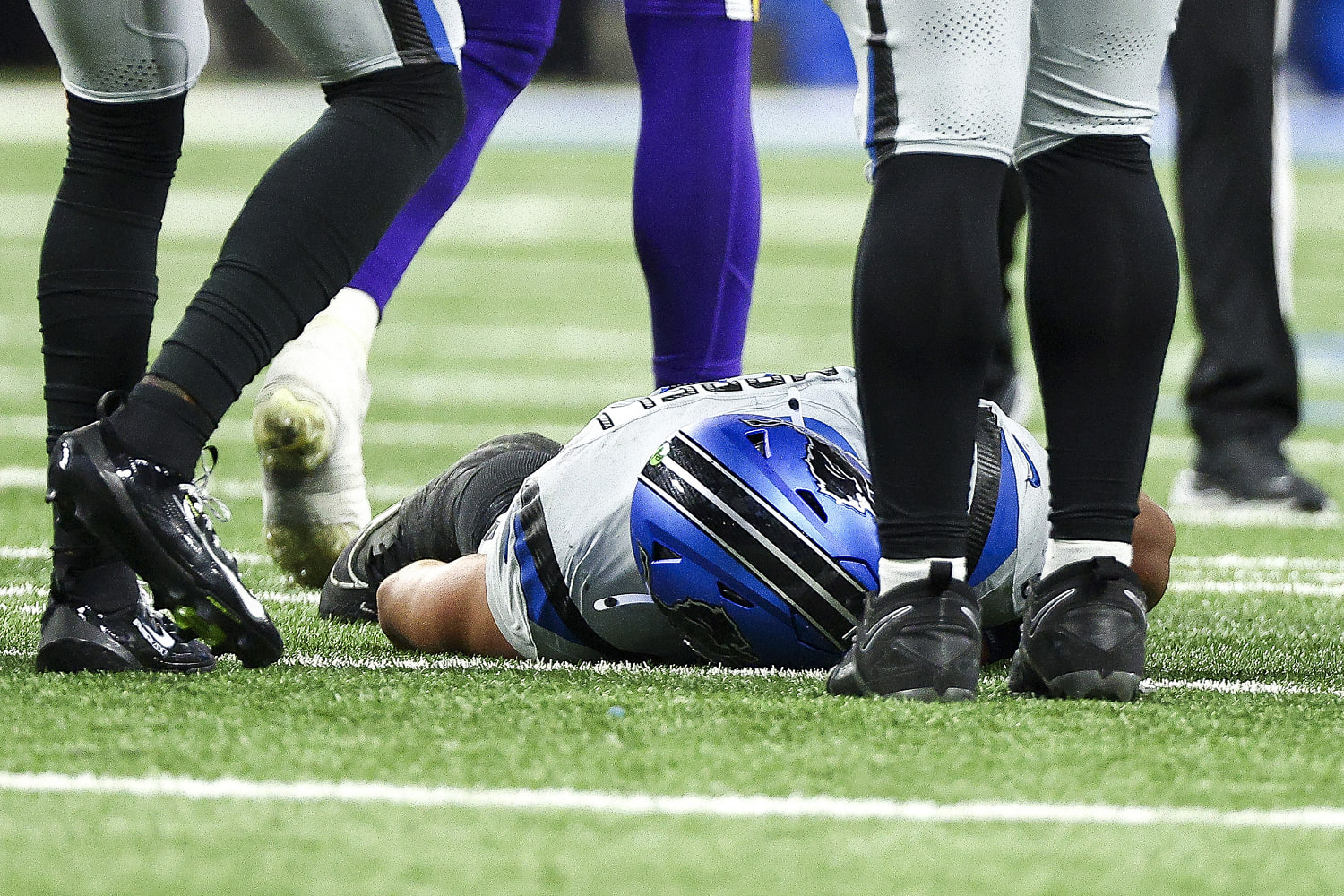
When an NFL linebacker like Detroit Lions defender Jack Campbell remains motionless on the turf following a tackle, the immediate broadcast reaction centers on shock, while the underlying reality involves a precise sequence of kinetic energy transfer, neurotrauma physiology, and standardized emergency medical logistics. Understanding what happens in the seconds and hours after a severe on-field collision requires separating emotional sports commentary from the mechanical and clinical systems that govern player safety.
The Physics of a High-Velocity Collision
Every tackle in professional football is a conservation-of-momentum problem played out with human tissue. Linebackers operate at the geometric intersection of mass and acceleration, routinely closing distances at speeds exceeding 18 miles per hour while carrying 245 to 250 pounds of body mass.
The kinetic energy generated in such an impact scales linearly with mass and exponentially with velocity ($KE = \frac{1}{2}mv^2$). When an athlete’s head or upper torso decelerates abruptly against an opposing player or the playing surface, the external skeleton stops moving fractions of a second before the internal organs.
This differential deceleration creates two primary injury mechanisms:
- Linear Acceleration Trauma: Direct, straight-line force drives the brain against the interior wall of the skull, causing focal bruising or coup-contrecoup contusions.
- Rotational Shear Stress: Off-center impacts force the head to twist rapidly around the cervical axis. Brain tissue resists sudden rotational deformation poorly, resulting in microscopic stretching or shearing of axons—the cellular wiring that transmits neurological signals.
A player lying motionless immediately after contact typically exhibits transient global neurological disruption or protective neuromuscular shutdown. The central nervous system temporarily suspends motor output to the extremities while assessing structural integrity along the cervical spine and brainstem.
Differentiating Known Facts from Clinical Hypotheses
In the immediate aftermath of an on-field hospitalization, public reporting often conflates confirmed operational actions with speculative medical diagnoses. Rigorous analysis requires partitioning what is empirically verified from what remains a clinical hypothesis until diagnostic imaging concludes.
Verified Operational Facts
- Mechanism of Onset: The injury occurred during live game action following a direct physical collision involving Jack Campbell.
- Immediate Presentation: The player remained unresponsive to standard self-recovery cues, remaining motionless on the field surface.
- Emergency Escalation: On-field medical personnel initiated high-acuity trauma stabilization protocols rather than standard sideline evaluation, resulting in ambulance transport to a local trauma center.
Educated Clinical Hypotheses
- Suspected Cervical Spine Involvement: Anytime an athlete fails to move extremities voluntarily after high-energy axial or hyperflexion loading, sports medicine physicians treat the event as an unstable cervical spine injury until radiographic clearance proves otherwise.
- Acute Concussive Syndrome: Loss of consciousness or prolonged motor stillness strongly correlates with Grade 3 concussive trauma, characterized by an immediate neurometabolic cascade—a sudden efflux of potassium and influx of calcium ions that temporarily paralyzes normal neuronal firing.
- Thoracic or Visceral Contusion: High-velocity impacts to the trunk can trigger vagal nerve stimulation or acute diaphragmatic spasm, producing temporary immobilization without permanent structural damage.
The Five-Stage Emergency Action Plan (EAP)
NFL stadiums operate under mandatory, pre-rehearsed Emergency Action Plans audited before every game. When a player goes down motionless, medical staff execute a rigid decision tree designed to prevent secondary iatrogenic injury—harm caused by improper handling during rescue.
- Primary Survey and C-Spine Stabilization: The first responder to reach the athlete manually stabilizes the head and neck in neutral alignment. Verbal commands are issued immediately ("Do not move, stay still") to override the athlete’s instinct to sit up or remove their helmet.
- Airway, Breathing, and Circulation (ABC) Assessment: Physicians evaluate consciousness, respiratory rhythm, and peripheral pulse without removing protective equipment. Because football helmets and shoulder pads maintain neutral cervical alignment when worn together, removing one without the other risks fatal hyperextension of an injured neck.
- Equipment Modification for Access: If airway intervention is required, athletic trainers use specialized quick-release tools or cordless screwdrivers to detach the facemask while leaving the helmet shell intact.
- Spine Board Immobilization: A team of six to eight trained personnel performs a coordinated log-roll or eight-person lift to place the athlete onto a rigid spine board or vacuum mattress, securing the torso, pelvis, and head independently.
- Hospital Transfer Protocol: An ambulance staged inside the stadium tunnel transports the athlete directly to a designated Level 1 trauma center, bypassing stadium X-ray facilities in favor of high-resolution Computed Tomography (CT) and Magnetic Resonance Imaging (MRI).
Diagnostic Architecture Inside the Trauma Center
Transporting a player to a hospital does not automatically indicate a catastrophic outcome; it reflects a zero-tolerance risk threshold. Stadium imaging suites rely on standard X-rays, which detect gross fractures but lack the resolution to rule out ligamentous instability, subtle vertebral hairline fractures, or intracranial hemorrhage.
Once inside the trauma bay, emergency physicians execute a tiered diagnostic sequence:
- Non-Contrast Head CT: Completed within minutes of arrival to exclude subdural or epidural hematomas—acute bleeding inside the skull that requires immediate neurosurgical decompression.
- Cervical Spine CT: Provides sub-millimeter cross-sectional reconstructions of all seven cervical vertebrae ($C_1$ through $C_7$) to verify bony alignment and canal patency.
- Cervical and Brain MRI: Ordered if neurological deficits—such as numbness, tingling, or motor weakness—persist despite normal CT scans. MRI visualizes soft tissues, including spinal cord edema, intervertebral disc herniation, and ligamentous tearing.
The Strategic Cost Function of Roster Volatility
From a front-office and coaching perspective, losing a starting middle linebacker mid-game disrupts the defensive communication hierarchy. In modern NFL defensive schemes, the interior linebacker often wears the green-dot helmet—the single defensive player equipped with a one-way radio receiver connected to the defensive coordinator.
When that player exits on a stretcher, the defensive unit absorbs three compounding operational costs:
- Signal Transmission Latency: Backup linebackers must assume play-calling responsibilities instantaneously, increasing the risk of pre-snap alignment errors and delayed coverage checks against up-tempo offenses.
- Run-Fit Integrity: Starting linebackers possess thousands of repetitions reading offensive line blocking schemes. A sudden substitution degrades gap discipline, exposing the defense to explosive interior runs.
- Psychological Contagion: Witnessing a teammate immobilized and transported off the field induces an acute stress response across the roster, temporarily elevating cortisol levels and impairing fine motor execution during subsequent series.
Limitations of Current Protective Technologies
Despite continuous iteration in helmet engineering and rule enforcement, structural physics imposes hard limits on injury prevention. Modern position-specific helmets incorporate deformable outer shells and multi-density energy-absorbing liners that reduce peak linear acceleration by 15 to 25 percent compared to legacy designs.
No helmet, however, can eliminate inertia. Because the brain floats inside cerebrospinal fluid within the cranial vault, external padding slows the skull’s deceleration over a few additional milliseconds but cannot prevent the brain from colliding with the interior bone during rapid rotational stops. Similarly, cervical collars and neck rolls restrict extreme range of motion, yet they offer minimal protection against direct axial loading—force applied directly to the crown of the helmet when the neck is straight.
Tactical Imperatives for Coaching and Medical Staffs
To mitigate both the probability and organizational fallout of severe collision trauma, NFL franchises must treat emergency preparedness and tackling mechanics as unified operational disciplines rather than separate departments.
- Mandate Shoulder-Lever Tackling Drills: Coaching staffs must audit practice film weekly to penalize crown-of-the-helmet initiation, reinforcing head-out-of-the-line tackling geometry that shifts impact forces onto the deltoid and pectoral girdle.
- Maintain Redundant Green-Dot Personnel: Defensive coordinators must allocate at least 25 percent of weekly practice reps with the green-dot communication headset assigned to the primary backup linebacker, ensuring zero communication drop-off during emergency substitutions.
- Enforce Conservative Return-to-Play Thresholds: When a player undergoes hospital evaluation for a motionless episode, team physicians should treat normal initial CT scans as a baseline clearance rather than a green light, requiring complete resolution of autonomic symptoms and full vestibular-ocular recovery before clearing the athlete for contact.