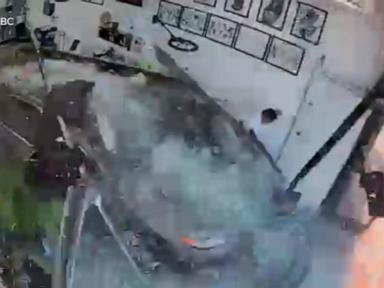
Every single time a vehicle plows through the plate glass window of a local storefront, a tattoo parlor, or a corner bakery, our collective outrage follows a predictable, lazy script. The internet explodes with calls for mandatory re-testing for senior citizens, harsher penalties for texting behind the wheel, and stricter driver licensing laws. Pundits shake their heads at the state of modern human concentration. We treat every single one of these catastrophic impacts as a tragic moral failure of an individual operator.
It is a comforting narrative. It allows us to point a finger at a distracted teenager or an elderly motorist, shake our heads, and pretend that the built environment around us is an innocent bystander.
It is also entirely wrong.
When a car slams into a tattoo shop, it is rarely just an isolated story of bad luck or clumsy driving. It is the predictable, mathematical output of a fundamentally broken spatial design. We have built our cities, our strip malls, and our commercial districts with a suicidal disregard for physics, prioritizing parking convenience over human life. Until we stop treating these incidents as driver errors and start treating them as architectural design failures, storefronts will keep serving as vehicular crash pads.
The Geometry of Slaughter
Let us look at the physical reality of how American and international commercial real estate is laid out. You pull your vehicle up to a business. Between the flow of high-speed or parking-lot traffic and the drywall of the store sits a row of parking stalls. More often than not, these stalls are angled head-in directly toward large, floor-to-ceiling glass windows, separated only by a three-inch curb and a decorative strip of mulch.
This layout invites catastrophe.
Consider the mechanics. Millions of vehicles on the road today are equipped with automatic transmissions. Drivers are human beings prone to cognitive slips, spatial confusion, foot slippage, and momentary panic. In a moment of panic—mistaking the accelerator for the brake pedal—what happens? A two-to-three-ton hunk of steel and aluminum goes from zero to twenty miles per hour in a span of thirty feet.
There is no structural barrier. There is no reinforced concrete bollard. There is only a pane of glass and a sheet of drywall standing between a customer getting inked and a motorized missile.
Blaming the driver for hitting the wrong pedal is like blaming gravity for a falling rock. Human error is a constant, unchangeable variable in transportation design. You cannot legislate away foot slippage, sudden medical episodes, or momentary confusion. What you can change—and what commercial developers systematically refuse to change because it costs a few thousand dollars—is the physical hardening of the target.
The Myth of Driver Accountability
For decades, traffic safety advocates have pushed the Vision Zero initiative, aiming to eliminate traffic fatalities through better engineering. Yet, when vehicles leave the asphalt and enter private commercial property, urban planning principles evaporate into the ether.
Property owners and strip mall developers maximize every square inch of asphalt for parking capacity to satisfy outdated zoning minimums. They squeeze parking spaces as tightly as possible against the front doors of businesses to maximize customer convenience. Then, when a vehicle inevitably breaches the perimeter, the property owner shrugs and points liability squarely at the motorist's insurance policy.
This is a profound abdication of responsibility.
I have consulted on municipal zoning boards where developers fought tooth and nail against installing steel-reinforced bollards in front of storefronts, arguing that heavy-duty posts ruin the aesthetic appeal of the shopping center strip. Let that sink in. They would rather preserve an unobstructed view of a parking lot than invest in physical infrastructure that stops a rogue SUV from crushing a row of patrons inside.
Insurance companies pay out millions of dollars every year for storefront crashes—often numbering in the thousands annually across the globe. Yet the financial incentive structure remains warped. Commercial property insurance rates rarely reflect the catastrophic risk of unprotected glass frontages, leaving landlords free to gamble with human lives to save a few bucks on protective barriers.
Redefining the Built Environment
If we want to stop vehicles from turning tattoo shops and coffee houses into drive-thrus, we have to throw out the prevailing planning playbook and adopt a set of hard-nosed, counter-intuitive countermeasures.
First, ban head-in parking directly adjacent to pedestrian-heavy commercial facades. If parking must be positioned near buildings, mandate parallel parking only. In a parallel parking scenario, a confused driver slamming on the gas pedal might hop a curb or scrape a bumper, but they cannot project a multi-ton vehicle straight through a front entrance at high velocity.
Second, treat bollards as non-negotiable structural elements, just like fire sprinklers and load-bearing walls. Every commercial building with parking stalls oriented toward its exterior glass should be legally required to install ASTM-rated, steel-and-concrete bollards capable of stopping a 5,000-pound truck traveling at 30 miles per hour. These barriers do not need to look like prison camp defenses; they can be integrated into planters, seating walls, and architectural columns.
Third, force municipalities to overhaul zoning codes that mandate excessive parking minimums. By reducing the sheer volume of parking spaces crammed against building fronts, we create natural buffer zones—wide pedestrian promenades, elevated curbs, and landscape barriers that absorb kinetic energy before it reaches human bodies.
The Uncomfortable Truth About Convenience
The real friction here is cultural. We have engineered a society addicted to frictionless convenience. We expect to step out of our cars and walk directly through a glass door without navigating physical obstacles. That absolute insistence on vehicular proximity is what drives this carnage.
When you prioritize the driver's convenience over the occupant's safety, you are engaging in a silent, continuous trade-off where human lives are sacrificed for the sake of saving people fifty extra feet of walking.
Stop blaming the eighty-year-old grandmother who mixed up her pedals. Stop writing think pieces about declining driver attention spans as if human biology is suddenly going to evolve better reaction times. Fix the damn curb. Pour the concrete. Install the bollards.
Until commercial real estate developers are held legally and financially liable for the lack of physical protection around their buildings, cars will keep crashing into tattoo shops, and we will keep acting surprised by a disaster we engineered ourselves.